Sunday, February 22, 2009

My Matchday - 202 Crown Ground

Accrington Stanley 0v0 Dagenham & Redbridge, League Two, 21st February 2009

Accrington is a town in the Hyndburn district of Lancashire, as common place in this part of the country, it’s former industrial roots were in the cotton and textile industries. “Accy” is also famed for producing the hardest building bricks in the world - “The Accrington Nori” which have been used in the construction of the Empire State Building and the foundations of Blackpool Tower.
The first football club in the town were Accrington FC, one of the original twelve founder members of the Football League in 1888, before resigning after only five years. Another team in the town already existed called Stanley Villa, taking their name from the clubs headquarters at the Stanley Arms on Stanley Street. After Accrington FC folded Stanley Villa took the town name becoming Accrington Stanley.
They originally played in the Lancashire Combination, until League Football returned to the town in 1921 as original members of Division Three North, where they twice finishing runners up in 1954-55 and 1957-58. When the League got rid of the north/south divide Stanley were placed in League Division Three in 1958. Two seasons later they were relegated, then in 1961-62 resigned from the League, playing their last game on 2nd March 1962. The club played on for a couple more seasons in the Lancashire Combination until eventually calling it a day in 1966.
The resurrected Accrington Stanley FC was formed in 1968, the club having remarkably rising through the football pyramid and back into the Football League. They began playing competitive football again in 1970, returning to the Lanc Combo, until progressing as founder members through three leagues; the Cheshire League, North West Counties League, then the Northern Premier Division One in 1987. The Reds became Northern Premier League champions in 2002-03 and thus promotion to the Conference, where they didn’t stick around for long, winning the title in only their third season in 2005-06.

The original club played at Peel Park which in it’s heyday held 20,000 including an impressive Spion Kop and seated stands on either side. When the club reformed they applied for permission to play there, but unfortunately a huge fire to the Main Stand in 1972 led to the grounds demise and put pay to the clubs return.
The Crown Ground is currently called the Fraser Eagle Stadium, and was built on the site of an old clay pit, used by works team Ewbanks when the reformed Stanley first began playing there. In those days the ground only possessed a small pavilion, used as changing rooms and clubhouse purposes, with a wooden fenced enclosure. In 1989 a new changing room block was built and the pavillion was replaced with a new seated stand.
The ground looked much better than I expected, the shallow Whinney Hill Terrace, with it’s rickety looking corrugated iron roof the only part which still looks like it belongs to a non league ground. There’s terraces behind each goal, the vocal home support gather in the covered Clayton End, which is now known as the Sophia Khan Stand. At the opposite end the Coppice Terrace is mainly unemployed, apart from a small section in the corner for away fans. A not so chirpy cockney complained about this fact, unhappy he was unable to stand directly behind the goal, saying it was a disgrace that there was only two home spectators standing on that terrace, before the steward informed him that the terrace isn’t used and those two spectators were in fact the ball boys. Away supporters have no need to complain, at least Accrington are kind enough to offer cover to its visitors, giving them half of the Whinney Hill Terrace.
The seated area of the ground is two separate stands, broken up by the team dugouts, which aren’t the traditional style boxes, but four rows of seats for both teams divided by a wall. The Main Stand is slightly bigger than the Thwaites Stand, both have red flip seats with ASFC picked out in white in the Main Stand, which also houses a kiddies section next to the players entrance(no tunnel) in the near corner. The young’uns sang throughout the game, with those youthful tones reminiscing of the caterwaul at those old schoolboy internationals at Wembley.
The ground is finished off by the red tubular steel supports which appear on top of the covered stands, they somehow give the ground a more attractive look, accessorizing with the red crash barriers and seats. The current capacity is 5,050 which only 1200 are seats, however this may have to change with the Football League criteria set at 2,000 seats within 3 years of become a League Club, so changes will have to be made to bring the Crown Ground up to the required standards.

The players entered the field at the start of both halves to The Jam’s ‘Town Called Malice’ a fine selection indeed and a single I bought in both 7’ and 12’ editions on it’s day of release in February ‘82, reaching number one in the ‘Hit Parade’ the following week. I doubt that three lads from Woking have any connection to this tiny Lancashire town, which means it gets played because of a link to the song title, but is Accrington such a troubled town? - or is it reference to the clubs malicious past? - I don’t think it’s neither, they probably just recognise it as a bloody good song and a top tune!
It’s always disappointing to go to a game which finishes goalless, but I’m not one of those sad sack groundhoppers who doesn’t count 0-0’s and does a revisit until a goal is witnessed. The teams did produced an open entertaining affair, both missing several good chances with the majority of those falling to the home side. Lindfield and a young Dean Saunders lookalikey -John Paul Kissock went close, with the best chance of the first half coming from Paul Mullen, whose thunderous volley rattled off the crossbar.
Dagenham had a good spell in the second period, but failed to take advantage, lacking a cutting edge in front of goal. Stanley finished strongly missing a couple of one-on-one situations until winning a penalty in the 90th minute after a hand ball from Okuonghae. Veteran Daggers keeper Tony Roberts capped his 400th club appearance by saving Andy Procter’s spot kick, giving his side a share of the spoils.
I booked train tickets in early January for my planned trip to Accrington, however my ‘current’ employees are trying their best to mess up ‘My Matchdays’ telling the staff just last week that we now start one hour later on Saturday‘s, which means a later start and a later finish. Thankfully I was assisted by my loyal (and maybe soon to be former) workmates and I made the 11am National Express train from Central Station to York, without any problems.
The train journey to Accrington was a long slog across country, finally arriving in the town at 2.05pm.
I arranged to meet up with Squad#34 David Poole aka ‘The Groundhog’ who was giving an owed “ day out pass” having missed out on a trip to Hereford a fortnight ago to see his beloved Brighton & Hove Albion. He was joined by his mate Martin(a ‘Citeh’ fan) and we arranged to meet up for a bevvy in The Abbey before the game. I arrived at the pub to find they hadn’t arrived but instead found a couple of blokes sporting Chelsea away shirts watching their heroes on the box away at Aston Villa. I stood next to them at the bar and was surprised to hear they had thick Lancashire accents, obviously part of the new breed of Chelsea supporter.
I received a text message from David, informing me they couldn’t find the pub and they were in The Black Horse , so I asked one of the Chelsea lads and he gave me directions, being only a short distance away. After another quick pint we headed to the ground, The Groundhog had travelled by car so I was able to get a lift to the ground and back to the train station after the game.
My train journey back to York went by more quickly after falling asleep, I called in to the Coopers pub in the station, only because I didn’t have much time to venture elsewhere. I had an extortionately priced pint of Davenports Bitter, which was nice but I’m promising myself never to return to this pub, I’ve never liked the place, I’d rather do without a bevvy than come back in here again.
I caught the train back to Newcastle at 1955 and was alarmed to find the train infested with drunken yobs, there was bottles and cans lying all over the place, with no consideration and much annoyence to the other passengers. So I ignored that lot and put my i-pod on at full blast and kept myself to myself until reaching the safety haven of Tyneside.
I purposely wrote this piece without any reference to the one thing that Accrington Stanley have been infamously linked with for a number of years, no clichés or puns regarding that unmentionable burden on a historical club. I’ve did my usual matchday write up, which covers my day out, a description of the ground and a brief history of the club, that’s just in case you were unaware of their background - so now do you know who they are? ...EXACTLY!

Link - The Groundhog's report


Matchday stats
ASFC 0 D&R 0
Att. 1123
Admission £13 (away terrace)
Programme £3


Ground no.202 Crown Ground - Matchday Web album(14 pictures)

.

Sunday, February 15, 2009

My Matchday - 201 Victoria Park

Burscough 2v4 Gateshead
Conference North
14th February 2009
Burscough is a village in West Lancashire, on the main Liverpool to Ormskirk Road, which was originally developed from two local farming villages, the name derives from Viking speak - Burh-skogr meaning ‘fortress in the woods
The present Burscough FC was formed in 1946, although football in the village stems way back to 1880. The first club played for 20 years in the Liverpool & District League, then in 1905 the successful Burscough Rangers were formed, winning three Liverpool Combination County league titles in the 1920’s. The club went on the play in the Lancashire Combination, but couldn’t repeat their earlier success and after running into financial troubles, folded in 1935.
The Linnets won many cup honours in their formative years, including three pots in 1947-48 season and their first Liverpool Combination County title two seasons later. In 1953-54 they joined the Lancashire Combination, winning the Division Two title and notching 155 goals in their first season, then adding the Division One title only two years later.
After a second league title in 1969-70, the club joined the Cheshire League the following season, at the end of the decade they reached the First Round proper of the FA Cup three times in four years, including a tie against Sheffield United in front of 14,000 at Bramall Lane in 1979.
The club has the accolade of becoming the first title winners of the North Western Counties League in its primary season in 1982-83, then after finishing runner up in 1997-98, joined the Northern Premier League Division One, again promotion to it’s Premier Division was achieved after only two seasons.
The greatest day in the clubs history came on May 18th 2003, becoming the smallest club to win the FA Trophy, a twelve game cup run, including knocking out Football League bound Yeovil Town, culminated in an unforgettable 2-1 win over Tamworth at Villa Park.
After going close in the Northern Premier League, reaching the play-offs and also recording a 3-2 win over League One Gillingham in the FA Cup, Burscough achieved promotion to the Conference North after winning the Unibond Premier League in 2006-07, they then finished a credible 8th last season.

Victoria Park is found on Bobby Langton Way, named after the locally born former England winger, who’s career included spells at Blackburn Rovers, Bolton Wanderers and Preston North End.
Football has been played on land close by at Mart Lane since the early 20th century, but it wasn’t until 1921 that the current site came into existence. In 1926 the club purchased the Bullen Road Stand from Everton, transporting it by train and steam lorry, with volunteered labour building the 400 seated grandstand. After the Bradford Fire it was replaced by a new structure, which was opened in August 1986, the stand originally had 250 seats, with more seats later added to meet the required grading to host Conference North football. The work in March 2008 increased the overall capacity to 3,054, around this time the floodlights were also upgraded, which were first installed in 1972.
Opposite the Main Stand is the Crabtree Lane End, built in 1994 it gives cover to 500 spectators, there’s also a smaller covered terrace at the far goal, parallel with the 6yard box, both stands are connected with five steps of temporary meccanno type terracing, which is also featured behind the nearside goal.
The turnstiles are on Bobby Langton Way, next to the clubhouse, called ‘The Baron Club’ which isn’t the same Baron Club which some of you may be familiar with, which is the 4th best club in Hull and is owned by
Paul & Tony Baron, where the compare is Kinky John, with security supplied by Carl and Chris.
Victoria Park celebrated it’s 100th birthday last year, the record attendance stands at 4,798, which was recorded against Wigan Athletic, for an FA Cup tie in 1950-51 season. The ground is currently (using
Groundtastic lingo) on amber, as the club are planning to move a short distance to a community based sports complex, adjacent to the current ground.

We set off for Burscough at 10.30am, I travelled shotgun with Captain Carter, with the back seats taking up by Paul and Ray, arriving at the ground before 1.30pm, naturally a few pints at a couple of the locals followed, namely the ‘Waterfront’ and ‘The Bridge’ prior to kick-off.
Our Heed Army Captain and chauffeur had a bad feeling about the game, after 13 matches Burscough have yet to taste league success at Victoria Park this season, there’s always the fear that they must win one sometime, and we could be the ones to break their duck, however there was no need to be so concerned, as Gateshead blitz into a three goal lead in the first 10 minutes.
Gateshead made the ideal start, when a Harwood cross found Phillips at the back stick, catching the ball on the half volley with only 4 minutes gone, then five minutes later a Turnbull free kick fell to Harwood, who had time and space to pick his spot and double the lead. Novak made it 3-0 a minute later, after beating the offside trap, he raced through on goal before unleashing a fierce right foot shot into the corner of the net. Gateshead were unlucky not to add to their lead before half time, Armstrong harshly had a goal ruled out and a penalty appeal was turned down after a blatant handball.
Heed took there foot of the gas in the second half, the home side improved and reduced the arrears on the hour, when a Stanford free kick crept in under Musselwhite’s body. Phillips got his second goal of the afternoon, although he didn’t know much about it, going in for a 50-50 ball which somehow rebounded off his head, spinning into the net via the crossbar.
Gateshead created more good chances to add to their tally, but it was Burscough who grabbed the final goal of the game, with a volley from Parry ten minutes from time, which was little more than a consolation and continued their search for that elusive first home win.Throughout the game, the lads received score updates via text message, involving the other sides at the top of the Conference North, among those were fans of league leaders Tamworth, who had been ringing/texting earlier in the day, trying to wind us up saying; well to put it in a more polite and printable term; We’re not as good as what they are!
Well, all I can say on this matter is the league table doesn’t lie, I know Gateshead have played more games than our rivals, but we’re not dropping many points (last dozen games - W 10 D 1 L 1) while the teams around us continue to slip up. I don’t know how long we‘ll be top of the league, maybe it’ll be for one week only, but we’ll make the most of it and enjoy it while it lasts, especially seeing our( and our rivals) constant reminder on Sky Sports News.

Matchday stats
Linnets 2(Stanford 60, Parry 78) Heed 4(Phillips 4,66, Harwood 9, Novak 10)
Att. 313
Admission £9
Programme £2


Ground no.201 Victoria Park - Matchday Web album(15 pictures)

.

Saturday, January 31, 2009

My Matchday - 200 Edgeley Park

Stockport County 4v1 Hereford United
League One
31st January 2009


Stockport is a large town six miles south-east of the City of Manchester and lies on the River Mersey, meaning County are the nearest League club to the famous old river (and you thought it was some Premier League club!)
The town is traditionally know for its manufacturing of hemp and rope, it also produced one of the first mechanised silk factories in the UK, in the 18th century. By the following century the towns main industry was cotton and the country’s capital of hat making, exporting over 6 million hats a year. 1997 saw the end of the hatting industry, but the towns heritage is still maintained at the ‘Hat Works - The Museum of Hatting’ which I unfortunately didn’t get a chance to visit, due to being unable to get out of the pubs!
Stockport County were originally formed as Heaton Norris Rovers in 1883, playing at the Recreation Ground in the Combination and then the Lancashire League. The club lead a nomad existence playing the following season at Heaton Norris Wanderers Cricket Ground, before moving onto Chorltons Farm, when they merged with local rivals Heaton Norris. They then relocated, relocated, relocated to Ash Inn Ground, Wilkesfield, until moving to their first enclosed ground at the Nursery Inn on Green Lane, where the players built a 4000 strong wooden stand and changed their name to Stockport County.
The Hatters became a Football League club in 1900, two years later they moved to their seventh ground -Edgeley Park, which had been in existence since 1891, being home to Stockport Rugby Club.
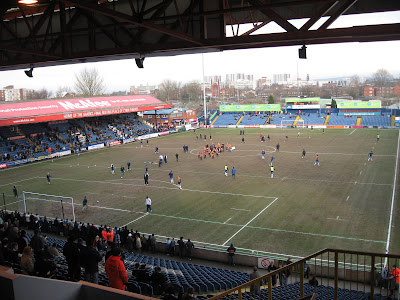
The following year the rugby club folded, the same year as the grounds first development; a roof added to the Popular Side with a capacity of 1400. This side of the ground was well named, as it once housed 16,000 for a 5th Round FA Cup against Liverpool, when the ground witnessed it’s record gate of 27,833 in 1950, the same decade floodlights were installed and opened with a friendly in 1956 against Fortuna 54 Geleen. In 1954 the roof was extended forwards, then renamed the Barlow Stand in honour of club chairman Ernest Barlow. By 1978 the capacity was halved, then in 1994 became all seated, now with a capacity 2,411 of a single tier split into five sections, with one section designated to away supporters.
The Main Stand was built in 1936, a year after the original timber structure (erected in 1913) was destroyed by fire, along with the club records and a dozen houses on the other side of Harcastle Road.
The stand has a classic look, with it’s sharp triangle roof covering 2,000, which includes executive and sponsors seats, it sits on the half way line with the end filled in with separate buildings to either side, including entrance to the conference and banqueting suite.
The Railway End was always an uncovered terrace with a 6,000 capacity up until 1985, when the terrace was cut down by a third. In 2001 the addition of seats completed Edgeley Park as an all-seated ground, it’s used by the away fans, so naturally it’s the only part of the ground without cover, there’s also an electric scoreboard situated at the back of the stand.
The original Cheadle End was a small timber stand with cover for 3,000, when first built in 1923. Seats were added in 1967, but as a result of the Bradford Fire it was demolished, unsafe due to its tarred and felted roof and replaced by a concrete terrace. The new Cheadle End stand was opened in 1995, and is a steep two tier stand with a capacity of over 5,000, like to rest of the ground it has blue flip seats, with the bottom tier having SCFC picked out in white.
We chose to sit in the Cheadle End, underneath the stand is a spacious concourse, decked out with a blue carpet and club colours and the Connor Bar named after County legend Jack Connor. There is a few TV’s in this area, but it seems no remote control, as there was a member of staff walking round with a broom handle switching channels. My only disappointment about the stand was that there was no bookies, as I really fancied backing County to win 3-1, thankfully they scored that fourth goal.
The ground (as it was in the beginning) is shared with rugby, the home of Guinness Premiership club Sale Sharks and is owned by the Stockport County Supporters Trust, which was formed in 2002.
County overcame what’s been a difficult week with a convincing win over Hereford United, two defeats and increasing press speculation regarding the club’s current financial situation were forgotten for the time being as The Hatters got off to a dream star with a goal straight from the kick off. Dominic Blizzard capitalised on a defensive error, then coolly slotting the ball past the keeper with only 13 seconds on the clock.
Hereford drew level midway through the first half with a goal from ManU loanee Sam Hewson, finishing off a good move, but County regained the lead before half time, McNeil with a simple diving header in the six yard box from a corner kick.
Stockport made their dominance count in the second half, a good finish by Mainwaring on 52 minutes, and then McSweeney, shooting through a crowded penalty area capped off a good performance.


Edgeley Park is a ground I’ve been wanting to tick for quite a while now, it’s in a perfect town centre location, not too far from the railway station, which means I don’t have to hotfoot a couple of eight minute miles to catch my train.
I departed Newcastle at 9am, on my five quid single fare train to Doncaster. I arrived by 1030 and caught my connection to Stockport, arriving just before noon. After grabbing a late breakfast at a café which overlooks the market place, I needed something to wash it down, so I naturally visited a couple of the local hostelries. There was plenty to choose from, but I selected ’The Calvert Court’ and ‘The Pack Horse’ before again meeting up with 100FGC squad#93 Dan Gooch, his girlfriend Sam(visiting her 37th ground of the season) and squad#109 Paul Hodkinson at the Grade II listed ‘Arden Arms’ (details on Bevvy Almanac)
We headed over to Edgeley Park at around 2pm, we were all impressed by the ground and enjoyed an entertaining game with a praiseworthy performance from our hosts.
My train home wasn’t due until 17.28, so I had time for a swift pint on my way to the station, we noticed plenty of bars on Castle Street which is in between the ground and rail station. I don’t know how it came about, maybe it was because it looked quite quaint from the outside, but we selected ‘The Pineapple’ as our post match alehouse of choice. How would I describe this pub? Let’s just say the words -Avoid, as F**k, Rough, come to mind. I left The Pineapple at 1720, saying my farewell to my ground hopping friends and wishing them the best of luck in getting out of the pub alive.
The return train journey home went smoothly, I made a short detour to ‘The Leopard’ pub, next to the train station in Donny, before arriving home at 9pm. I received several txt messages from Dan, informing me that their safety was assured and they’d visited more pubs in Castle Street before catching a later train.
Edgeley Park turned out to be my 200th ground, I’ve been stuck in the 190’s for what seems an eternity, a bit like a cricketer at the crease on the verge of his double century, but then growing frustrated as the clouds darkened and the covers come out, unable to hit the few remaining winning runs. Compared to others who share this groundbagging hobby, this isn’t much of a milestone, however I’m pleased a classic ground like Edgeley Park, turned out to be the venue which finally completed my second ton.
Bevvy Almanac - Port of Crawl

Matchday stats
SCFC 4(Blizzard 1, McNeil 33, Mainwaring 52, McSweeney 76) HUFC 1(Hewson 26)
Att. 5586
Admission £16
Programme £2.50
Match report


Ground no.200 Edgeley Park - Matchday Web album(21 pictures)

Saturday, January 24, 2009

My Matchday - 199 Purvis Park

Percy Main Amateurs 2v2 Gosforth Bohemians Garnet
Northern Alliance Division One
24th January 2009
I hadn’t planned another Alliance ground this season, my usual ’Around the Alliance’ articles finished for this term, however a 11am Saturday morning kick-off was too good to miss out on, tailor made for groundhoppers to bag a welcome double.
Many groundhoppers took advantage of this early start, travelling from far flung parts of the country, then heading off to a Northern League game and some further north to Scotland. The reason the match kicked off early was the Gosforth lads were off to York for a stag-do, with one of their players about to 'tie the knot', and Percy Main being the helpful club they are, agreed to an early start.
This year Percy Main Amateurs celebrate their 90th birthday, having been formed by ex-servicemen returning from the First World War. They began life playing in the Northern Amateur League, becoming champions in their first season before adding four consecutive titles during the 1920’s. The club’s proud history includes a quarter-final appearance in the FA Amateur Cup in 1929-30, losing out to eventual winners Bournemouth Gasworks Athletic after knocking out Cleethorpes Town, Rawmarsh Welfare and Yorkshire Amateurs. The club joined the Tyneside Amateur League in 1931, before returned to the Northern Amateur League after the Second World War.
The Villagers joined the Northern Alliance in 1968, adding cup honours in the Northumberland Amateur Cup, Northern Alliance League Cup and the Northumberland Senior Bowl, before becoming title winners in consecutive years in ‘81 and ‘82 and runners up in 82-83, the same season they reached the 5th round of the FA Vase, going out to Brandon United.
The club suffered relegation in 1991 to Division One, but won promotion by the end of the decade, adding the League Cup in their first season back in the Premier, The Villagers are currently back in Alliance One after relegation in 2004-05.


Percy Main is a village in North Tyneside, on the outskirts of North Shields. Purvis Park takes its name in honour of the late Ian Purvis, who served the club as a player, secretary and chairman over 50 years. The ground was originally called Middle Row Park until 1996 and neighbours with the local cricket club, entrance is gained through the pavilion building, which incorporates the changing rooms and tea bar, which serves delicious hot soup at 60p a cup. Access pitch side is gained through the back of the building, which has an extended roof, giving spectators valuable cover.
Those travellers who set off early, (which including the first arrival from Hampshire who had departed at 4.30am) were treated to an entertaining game, the early kick-off didn’t cause a lethargic display, as both teams looked up for it.

Bohs took the lead half way through the first half, a point blank save from the keeper was tipped on to the bar, but Atkin was alert to force the ball over the line with an acrobatic-type-kick. Percy pushed for an equaliser, missing several good opportunities, then in first half injury time Gosforth doubled their lead, Atkin again netting another rebound after another good save, this time from a tight angle.
Percy Main must have got a good rollicking at half time, scoring with their first attack of the half, Betts with a cracking shot from 20yds which gave the keeper no chance. This gave the team a lift and it was just a matter of time before they equalised, this duly arrived on 70 minutes, Percy Mains very own miniature version of Rory Delap; Pierre-Luc Coiffait fired in another bullet throw which eventually fell to McEnany who fired home with his right foot. The teams fought out the final twenty minutes in search of a winner, but after over 100 minutes(51 minutes each way!) of football the draw was a fair result in the end.
The early kick-off was definitely a success for Percy Main, mainly thanks to club secretary Norman De Bruin who made Groundhoppers aware via the internet, on Tony Kempster’s forum and Non League Zone. Hopefully other clubs in the region will take note and follow Percy Main’s example, to give the country’s groundhoppers an excuse and opportunity to visit, where without doubt... is the best region of the country.


Matchday Stats
PMA 2(Betts 47, McEnany 70) GBG(Atkin 22,45+4)
Att. 65 (HC)
Admission £1
Programme 50p


Sunday, January 18, 2009

My Matchday - 198 Christie Park

Morecambe 0v1 Gillingham
League Two
17th January 2009
Morecambe is a Lancashire seaside resort off the Irish Sea within the City of Lancaster. In 1889 the villages of Bare, Poulton-le-Sands and Torrisholme became communally known as Morecambe, with the three villages still maintaining their own identity and original names.

Morecambe FC formed in 1920, playing their first season in the Lancashire Combination League whilst sharing the towns cricket ground at Woodhill Lane. The club moved to their own ground the following year, thanks to the financial backing of retired businessman and supporters club president Joseph Barnes Christie, who acquired land to rent on Lancaster Road.
The ground was then know as Roseberry Park, originally having a 700 capacity wooden stand, dressing rooms and a covered end known as the ‘Scratching Shed’ with the ground’s first league action played in August 1921, against coastal neighbours Fleetwood, in front of a healthy crowd of 3,500, with similar sized crowds maintained during their first season.

The ground was renamed Christie Park in January 1928, honouring Mr Christie who was now the club president, he formed the club into a limited company with a share capital of £1,000. He purchased the ground and gave it to the Corporation of Morecambe on the condition that it could be only used by Morecambe FC, and should the club ever disband it should become a children’s playground, sadly the clubs great supporter and benefactor died the following year.

The grounds steady progress began with cinder banking added to the Lancaster Road end with a covered concrete stand at the town end in the late 1950’s costing £2,000. Another £4,000 was spent on installing floodlights at the turn of the next decade. The Main Stand was built in 1962, at a cost of £20,000 as part of major ground improvements totalling £35,000, the same year as the ground witnessed it’s record gate, 9,383 for a 3rd Round FA Cup tie against Weymouth, then in 1968 the old fans favourite the ‘scratching shed’ was demolished to make way for a new covered terrace at the Christie Avenue end.

In 1967-68 they were Lancashire Combination champions for a fifth time, and the following season became original members of the Northern Premier League. The Shrimps made little impact in the new division, but glory came in the FA Trophy, the biggest day in their Non-League history saw a 2-1 victory over Dartford in the 1974 final at Wembley.
The clubs ambition to rise up the pyramid began with more ground improvements during the 1990’s which included new floodlights and grass banking replaced by concrete terracing, their desire was fulfilled when in 1994-95 they joined the Conference after finishing runners-up to Marine in the Northern Premier League.

In 1997 a new £560,000 stand was built at the town end with major improvements made to the South Stand bringing Christie Park up to Football League standards. League football was eventually accomplished, following play-off semi finals defeats in 2002-03 to Dagenham & Redbridge, then three years later to Hereford, it was third time lucky in 2006-07, after disposing of York City in the semis they went on to beat Exeter City 2-1 in the first Conference Final to be played at the new Wembley.

Last season the club comfortably maintained their newly found league status, finishing in 11th position with sixty points, season highlights including League Cup victories away at Preston North End and Wolves.
Christie Park has a capacity of 6,400, the Main Stand has a traditional old fashioned look to it, sitting perched on the half way line with 1200 red flip seats, with a wee small standing section at the front. The dugouts are situated centrally in front of the stand with the players tunnel further along towards the south side, with a small stand to cater for disabled supporters towards the north end.
The North Stand terrace looks brand new, spick-and-span with bright red crash barriers, opposite is the away end, a smaller terrace with a police control box situated centrally, the back walls are painted battleship grey, covering the wording of the previous sponsors name. The Car Wash Terrace is the only uncovered part of the ground, a shallow terrace which is broken up by the scaffold assembled TV gantry and four thin floodlight pylons.

Eric & Ernie’s rendition of ‘Bring Me Sunshine’ greeted the two teams, but the match didn’t produce many bright spots, with Gillingham taking all three points courtesy of a first half strike from Curtis Weston. The Gills started the better side and almost took the lead when a Mulligan shot hit the post, then on 19 minutes the same player was again denied by the woodwork, but this time Weston was on hand to net the rebound. The Shrimps pushed for an equaliser in the second half, but overall lacked that extra spark in front of goal, with the best effort coming from Stanley, which produced a brilliant save from Royce. Gillingham looked to grab a second goal on the break and defended well as the conditions worsened, holding on to claim victory.
I travelled to Morecambe by car, chauffeured by Alan Price(100FGC squad#26) along with his wife Karen(squad#126) and Dave Edwards(squad#52) setting off at 9am.
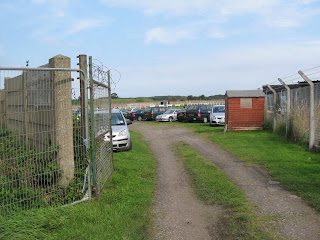
We stopped off in Lancaster city, taking a look at the home of the Dolly Blues (My Matchday planned for 10th April) then arrived in Morecambe at around 11.30am, heading straight to the ground. We purchased some goods from the club shop, then luckily found that the ground gates were open, meaning we could have a pre-match preview of Christie Park, taking a leisurely walk around the stadium and take some decent photographs.
We then headed into the town centre to see the statue of the towns favourite son Eric Morecambe, before heading off for something to eat. Alan had already researched where the towns best chippy was, the honour going to Atkinsons, found in a side street off Marine Road West (they’ve also got a chippy next to the ground) after enjoying the delicious haddock & chips on the seafront, I was thirsty for some decent ale, so I headed off on a pub crawl and arranged to meet back up later on.
The first pub I visited was named after the great man himself, Eric Bartholomew (JD Wetherspoons), followed by the towns oldest pub the ‘Smugglers Den’ and finally the York Hotel on Lancaster Road, the closest pub to the ground. (Full details on Bevvy Almanac)
I prefer to stand at the match, so with it being a dry day I opted for the Car Wash Terrace, standing on the half way line close to the action just like being at a Non-League match, I later regretted not choosing the North Stand, as it lashed down in the last twenty minutes, so I got a right drenching!

I enjoyed visiting Morecambe and look forward to returning, the club have announced plans to move to a new purpose built stadium in the Westgate area of the town. The new ground will have a capacity of 6,800(2,100 seats), the project also includes training facilities, hotel, drive-through-restaurant and car park facilities, which should be up and running by the start of 2010-11 season.
We made good time heading back home, arriving back at 7.30pm, with Mr. Price’s rendition of ‘Bring Me Sunshine’ an added bonus (well maybe not!) to our journey back north, overall a brilliant day out or as the legend Mr Morecambe would have wisely put it "Wah-hey! "
LINKS
Match Report
100FGC visits- Tims 92 (Sept’07) The Groundhog (Dec’08)
Bevvy Almanac - ‘Revisiting Eric’

Matchday stats
MFC 0 GFC 1(Weston 19)
Att. 2027
Admission £12 (standing)
Programme £3

Tuesday, December 30, 2008

Around the Alliance - part four

The fourth part of the football clubs and grounds of the Northern Football Alliance Premier League, featuring two clubs which won promotion last season.


182 Wheatridge Park
Seaton Delaval Amateurs 3v1 Heddon
Northern Alliance Premier League
16th August 2008
Seaton Delaval is a village in the Blyth Valley district, five miles north-west of Whitley Bay in south-east Northumberland.
Seaton Delaval Amateurs joined the Northern Alliance in 1983-84 and have won the championship twice; in 1989-90 and 1992-93. In 1994 the club merged with Seaton Delaval Seaton Terrace, who had been originally formed as High Pit Social in 1981, before changing their name the following year.
The ground is off the A192, and was a bit difficult to find, hidden behind a plot of allotments with no signpost on the main road. I managed to catch a glimpse of a crossbar, so doubled back into a small lane which leads to the ground, where a man standing next to a small hut was waiting to take your quid admission.
Car park spaces are providing behind the nearside goal to the entrance, where you park up facing towards the pitch, meaning you don’t need to leave your vehicle to watch the game, making it another one of those drive-in football venues.
There’s a wooden enclosed terrace, the blue painted roof overhanging from the changing rooms out parallel with the dugouts. There’s terraced steps running towards the near corner flag, and towards the opposite flank is the outside toilet block which was feature in The Football Bog Blog #12. There is uncovered hard standing all around, with a old dugout on the far side used by spectators for extra shelter with a grass bank running pitch length, giving a better elevated view.
Delaval ran out worthy winners, with the game being over as a contest after 50 minutes when Howes made it 3-0, after earlier efforts from firstly Arnos, who caught out the keeper with a well placed lob and then Baird adding to the scoring with a nice half volley, capping a fine first half performance from the home side.
The last half hour was all Heddon, but all they could muster was a solitary reply from John Dunn who capitalised on a defensive error, finishing with a well taking effort, the win took Seaton Deleval top for the first time this season and they’ve remained in contention for the title since.
Overall Wheatridge Park is a tidy little ground, the only main fault being no signposts and no identity inside, as in a ‘welcome’ sign of some sort. However I would recommend it’s worth a visit during the winter months, so you can enjoy the game from the shelter and warm of your car

Matchday Stats
SDA 3(Arnos 26, Baird 31, Howes 51) HTC 1(Dunn 62)
Att. 45 (HC)
Admission £1
Programme;none
.

195. Wark Sports Club
Wark 3v0 Amble
Longhorn Hardware Stan Seymour League Cup
20th December 2008

Wark is a small village and civil parish located twelve miles north-west of Hexham in Tynedale, west Northumberland, on the west bank of the River North Tyne
The club became members of the Northern Alliance in 1988, two successive relegation in 1995 and 1996 saw them hit the bottom division, they won promotion to Division One in 1998-99 and then last season won promotion back to the Alliance Premier, winning the league with 25 wins out of 30 and scoring 125 goals. Further research on the club was difficult to find, Google results constantly took me to the career of former Ipswich and Liverpool goal scoring Scottish midfielder John Wark.
On arrival you drive through the village, along Main Street which brings you to a single lane weak road bridge, where the Wark Sports Club is at the other side of the river. The ground is situated in the most tranquil of settings, where the only noises to be heard is the baa of sheep in the next field, the calming sound of the river flowing by and the odd tractor going to and from the neighbouring farm.
The Sports Club entrance has a spacious car park, where there’s an entrance to the clubhouse and changing facilities which share the same building block with also access at pitch side and is situated to
the right corner of the pitch. On the left side is a children’s park, a netball court and what must be a football ground first; a skateboard park, which runs parallel to the goal and the corner flag. There’s a pair of brick dugouts at one side and a white perimeter fence, with one side roped off to open up the cricket pitch.
I arrived at the ground at 1pm, with the Amble team still to arrive, then a quarter of an hour later a convoy of five cars crossed the aforementioned bridge, with players spilling out of the vehicles, with just enough time to get changed and warm up.
Wark controlled this League Cup tie from the kick off, missing an array of chance, as if they were determined NOT to score, when the goal finally did arrive on 42 minutes, it was worth the wait, a long clearance found Nixon, who struck a sweet shot on the turn from 20 yards out.
Wark continued to dominate the game after the interval, with further goals from Telfer and a second for Nixon, this time from the penalty spot after he was dragged down in the box, making a final score of 3-0, however Amble can count themselves lucky it wasn’t a heavier defeat.
During the game there was a few bad tackles, with one in the opening minute of the game setting the tone for the rest of the afternoon, ten minutes from time a bad tackle caught one of the Wark lads, everyone knew it was a broken leg straight away, the game was halted and an ambulance had to be called, best wishes to the lad and I hope he’s on the mend soon.
I can highly recommend a visit to Wark, I travelled over after finishing work (meaning I went from work to Wark) and with it being an early kick off I was a bit strapped for time, meaning I couldn‘t stop for a pint and a visit to the GBG listed Battlesteads Hotel at the entrance to the village, which looked a convivial spot and another good reason to make Wark a laudable ‘tick’
Matchday Stats
Wark 3(Nixon 42,62pen Telfer 54)Amble 0
Att.14 (HC)
Admission and programme; none
.

196. Recreation Park
Murton 4v1 Peterlee Town
Northern Alliance Premier League
27th December 2008
Murton is a former mining village in County Durham, located six miles east of Durham and seven miles south of sunderland, and forms part of the local government District of Easington.
The club was formed as Murton Colliery Welfare in 1912, becoming Wearside League members the following year, winning the championship twice in 1928-29 and 1936-37. In 1946 they joined the re-formed North Eastern League but returned to the Wearside League five years later, adding another title in 1959-60. In 1988 they joined the Northern League and also dropped the CW suffix from their name, winning the Division Two title in only their second season. Their best performance was finishing second in 1991-92, but after relegation in ‘98 the clubs fortunes nosedived, finally losing their Northern League status, joining the Northern Alliance in 2004-05. Further relegation followed but last season they regained there place in the Alliance Premier after finishing runners-up to Wark.
Recreation Park has cover behind the dugouts and behind the left hand goal, both stands are of similar stature, made from congregated iron and both looking on their last legs, as if a strong gust of wind will see them collapse like a pack of cards. Both stands have a white wall at the front with the stand behind the goal set back from the pitch on top of a slope. Next to the main stand there’s a building block which incorporates the changing rooms and refreshment area.
The ground is surrounded by a cricket pitch, the welfare park and another football pitch where I saw a cracking second goal by local side Hylton in their 3-0 win over Seaham, during the half time interval.
The match was a local derby between the only two Northern Alliance Premier clubs based in County Durham this season. Peterlee took an early lead through Pyle, but were reduced to ten men when the second scuffle in the space of five minutes saw their number 10 sent off, which was a bit more than ‘handbags’ with raised hands and threatening behaviour, this gave Murton the edge and they grabbed an equaliser before half time with a goal from Summerbell.
There was a slight delay early in the second half, in the first minute a wayward pass struck the referee on the leg and he went down needing treatment, the ball wasn’t exactly blasted off him, but he acted as if it was something serious, after a few minutes he finally got on his feet and restarted the game, the whole episode making him look nothing more than a prize soft shite!
Murton made the extra man count in the second half, with a second goal by Summerbell and further goals by Garside with a fine individual effort, and a last minute goal from substitute Walton completed the rout.
Recreation Park could do with a bit work, as it seems to have been left to wreck and ruin, the surrounding Welfare Park and cricket ground seem nice enough but the football ground looks neglected and dishevelled. After being a victim of repeated vandalism and arson throughout the years I suppose it’s like urinating against the wind as far as ground improvements are concerned, which is a shame considering it’s less than five years ago that they were a Northern League club.
Matchday stats
MAFC 4(Summerbell 37, 53 Garside 66, Walton 89) PTFC 1(Pyle 10e)
Att. 47 (HC)
Admission and programme; none
.

Sunday, December 14, 2008

My Matchday - Revisiting Durham City

Durham City 2v0 Harrogate Town
FA Trophy 1st Round
13th December 2008
I’ve being wanting to do a revisit to Durham City this season, now they’ve broken away from the motherly apron strings of the Northern League and showed some real ambition by stepping up into the Unibond League. The current side has a few ex Heed players, namely Harra, Lawsey, Magic and Speedy, so with another football Saturday decimated by the weather, meaning no new ground prospects, this was the ideal opportunity to pay a visit, for what looked an attractive FA Trophy 1st Round clash with Harrogate Town.
The Citizens were last seasons Northern League champions and after a bit of uncertainty of will they or won’t they and questions over the ground’s criteria, they finally joined the ‘Great Unibond Juggernaut’ (an expression used by the Northern League hierarchy) where they’ve made an encouraging start, unbeaten in their first eleven league games in Northern Premier League Division One North.
Durham City were once a Football League club, admitted to Division 3 North in 1921, three years after their formation, after originally playing a season in the Victory League and a further two in the North Eastern League. In 1928 they failed to gain re-election, returning to the North Eastern League until the club went out of business in 1938 due to financial troubles. During this era the club played at three different grounds, their first season was played on Garden House Park then four seasons at Kepier Heughs, until moving to Haliday Park (which was named after the former mayor) until the club disbanded.
They reformed in 1950, moving to Ferens Park, named after the clubs benefactor and club president; Alderman H.C. Ferens. After two seasons in the Wearside League they joined the Northern League, then in 1957 the ground staged it’s record attendance, 7,000 for an FA Cup tie with Tranmere Rovers, which resulted in a 3-0 victory to the visitors.
City won the Northern League Division One for the first time in 1993-94, then applied to join the Northern Premier League, but were unable to gain promotion due to the incompletion of their new ground, so the club had to ground share with Chester-le-Street Town for a season, until work was finished in 1995.
The stadium is on the Belmont Industrial Estate, just a mile off the A1 on the A690, on the outskirts of Durham, a city which is famous for it’s cathedral and Norman castle and is one of the most picturesque views on the east coast train line when approaching Durham station.
When I originally visited this ground it was called New Ferens Park, then later renamed Archibald Stadium, but now there’s a new sponsored brand name; the Arnott Stadium. The ground has one main stand with a seating capacity of 300 blue flip seats, where access is found up a flight of stairs as you emerge through the turnstile, the refreshment bar is at the side of the stand, with a hospitality bar and a tannoy booth situated at the back. The stands extended roof allowing cover for a further 600 spectators, with further hard standing on the other three sides, there’s also a shelter to accommodate disabled supports on the nearside. The clubhouse is outside next to the main entrance, which neighbours a children’s nursery and the big blue building behind the far goal is Soccarena, an indoor football complex.
Durham’s opponents were Harrogate Town, two league levels higher, currently sitting in a play-off spot in the Conference North. On paper this looked a tough one, but football isn’t played on paper it’s played on grass, but in Durham City’s case, on plastic, as the Arnott Stadium has a 3G all weather pitch, which proved to be a great leveller as City ran out comfortable winners by two unanswered goals.
Durham looked more lively than their opponents from North Yorkshire, with the City front two of Richardson and Johnston keeping the Town defence on their toes all afternoon, as they applied a high defensive line, happy playing the offside trap at every opportunity. The opening goal arrived in first half stoppage time, a corner from the left was met by ex-Gateshead (and my ex-work colleague) Mickey Laws, with a fine header, finding the net via the angle of post and bar.
In the second half the light persistent showers turned into a heavy downpour, Harrogate improved slightly, however the match was settled on 70 minutes, from another corner kick the referee spotted a handball in the box, resulting in Adam Johnston making no mistake from the spot.
A great performance from Durham City, they’ve assembled a very good side, and have now knocked out two Conference North sides in the FA Trophy, as they remain the only North-East club left in the competition. They also look a good bet for promotion, which I’d really love to see them achieve, proving the doubters wrong and getting their just rewards for showing some ambition.
(Revisiting Ground no.79, first visit 2/8/01-Durham City 0v5 Newcastle United, Pre-season friendly)
Matchday stats
DCFC 2 (Laws 45+1, Johnston 70pen) HTFC 0
Att.232
Admission £8
Programme £1.50