Tuesday, September 21, 2010

Monarch Metamorphosis


I have been busy this summer studying and documenting monarch butterflies on my little monarch ranch off the back patio. It became an all-consuming pursuit as I strove to position myself in exactly the right place at exactly the right time to document the dual transformation of the monarch caterpillar: first, from caterpillar to jade-green chrysalis; and second, from chrysalis to butterfly.


It is not as easy as it sounds. Well, maybe it doesn't sound easy, but I can assure you it's tricky. The caterpillars and chrysalides have a sneaky way of doing their magic when nobody's watching: early in the morning, right at breakfast and bus time. They wait until you're completely distracted, trying to take care of your family and wham! they transform into something entirely else while you're buttering toast or answering the phone or signing a planner or digging up lunch money or racing to Athens to record a piece.


I decided that if I was ever going to catch the caterpillars at it, I'd have to have a whole lot of 'em, to increase the chances that one might decide to metamorphose when I was available to document it. And one...one of the 20 or so that I raised in a big glass vase on the kitchen table decided to cooperate. I set the camera up on a tripod against a neutral background and by gum I got it, the whole breathtaking thing, in over 600 exposures taken over about 10 hours.


National Public Radio solicited a submission to mark the first day of fall, so I wrote and recorded a piece about the whole experience. I sent hundreds of photos to their multimedia wizards and Mito Habe-Evans produced a wonderful video from them. I am grateful to her for all her work.

In the end, NPR decided not to air my commentary. But you can still find the video on the NPR website. It takes my breath away, just as sitting before a metamorphosing caterpillar always does.

Please go see how I spent my summer. I would be much obliged if you would comment and hit "Recommend." Since the commentary didn't air, sharing it on Facebook and Twitter and recommending it is one way to help it get seen by more eyes. For my part, I'll hope that it leads more people to my blog.

Thank you.

All photos in this post and on the NPR website are copyright2010 by Julie Zickefoose. Use without permission is expressly forbidden.

Sunday, September 19, 2010

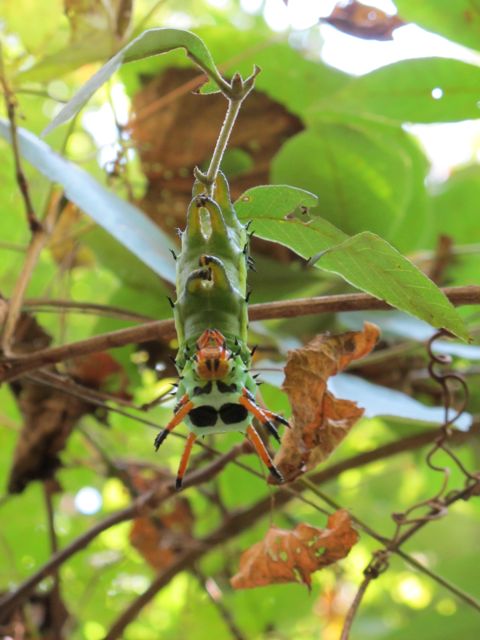
Hickory Horned Devil!


All photos in this post by Bill of the Birds.

Bill of the Birds was off to one side, peering up into the pawpaw branchtes, looking for fruit. Suddenly he hollered, three words, three times in a row, at the top of his considerable lungs. It sounded like this:

HICKORYHORNEDDEVIL!!HICKORYHORNEDDEVIL!!
HICKORYHORNEDDEVIL!!

We peered up where he was pointing and saw something that looked like a thorny hot dog hanging, backlit...how he ever saw it much less identified it in a nanosecond, I still don't know.

When he had composed himself, he held the camera up closer, and the little Canon G-11 did its very best in a difficult light regime. And that best is real darn good.

By this time, the caterpillar--for a hickory horned devil is a caterpillar, though it looks more like the hero of a planet-destroying Japanese horror flick--had composed itself into its most fearsome persona, compressing and drawing itself up into a sigmoid shape. It drew all its kabuki spines and swords--schwinnng! and made itself ready for whatever terrifying battle it might have to fight.

Dig those crazy black eyespots! Devil, indeed! I can't get over them, nor its enormous, leg-like claspers. (The caterpillar's real head is the little orange unit above the fearsome black eyespots). It was making short work of the hickory's leaves, eating each leaflet entirely before moving onto the next, then presumably backing up the petiole to go destroy another.

This is the larva of the royal walnut moth, or regal moth, as it's sometimes called. Latin: Citheronia regalis. We'd found it in its last growth instar, when it turns from brown to green.

We'd found it on a hickory tree, but they're also found on ash, butternut, cherry, lilac(!!), pecan, persimmon, sumac, sweet gum, sycamore, walnut, and other trees, according to David L. Wagner's WONDERFUL Caterpillars of Eastern North America.
This is a book you simply must have on your shelf. It changed my life.


Grab a Bic or a Flair pen off your desk. That's how long this monster is. And it's as big around as Winston Churchill's fattest stogie. You'd have to use two hands to contain it. And, despite its fearsome appearance, you'd come out unscathed.

For the Hickory Horned Devil is harmless: not poisonous, not even itchy. All he's got to defend himself is
BOOGABOOGABOOGA!

You've got to figure he's delicious, or why would he be so thoroughly frightening?

So we photographed him in situ--Bill of the Birds holding the Canon G-11 waay up over his head while I held the end of the branch down enough to get our frightened quarry in range. But for Bill's long arms, we'd have not much to show for our first-ever encounter with the most coveted caterpillar in North America--on our pawpaw hunting grounds, on our land, no less! Not long from now, he'll climb down to the ground, wander about for awhile, and dig in and pupate underground in a silk-lined earthen cell, resting for the winter like an enormous brown seed before emerging next year as a glorious royal walnut moth.

From Wikipedia. Wish it were mine! This huge moth more than covers your hand. This is a very fresh one, probably still drying its soft, limp wings after emerging from the pupal case.

Being a Science Chimp, I didn't get very far down the trail before I smacked my forehead and said, "I've got to go back and find some horned devil frass!" I'd read that one way to find devils is to see their poop and then look up--a neat trick in deep leaf litter, but still...most of us look down in the woods, and I'm likely to spot something like that someday. I wanted to find the poop so I'd know it the next time I saw it. Now Bill of the Birds--he's always lookin' up.

So I went right back under that horned devil and got down on all fours and muttered and rummaged around for a long time while my family kind of chuckled and rolled their eyes and darned if I didn't find me a very nice bit of fresh devilpoop, a little grenade of compressed used up hickory chaw. It was big enough to completely cover my wedding ring which I can assure you after 17 years is still in situ.

As if the pawpaws weren't enough, I had fresh devilpoop. I think the pawpaw/devilhunt was the best expotition we had all summer. That's nature at its top-of-lungs hollerin' best.

And it's all FREE.


BOOGA BOOGA BOOGA!

All photos in this post by Bill of the Birds

Saturday, September 18, 2010

Wearside League Wanderings - part five

258. Eastbourne Sports Complex

Darlington Cleveland Bridge 4v2 Prudhoe Town
Wearside League
Saturday 7th August 2010

Three new clubs entered the Wearside League this season, two of which met on the opening day of the season at the Eastbourne Sports Complex.
This is the fifth season of the current Darlington Cleveland Bridge, having played two years in local leagues followed by two seasons in the Teesside League.
The original club formed in 1903 as a works team for employees only. They began playing at a higher level in 1981 when joining the Northern Alliance, which they won in 1982-83. The following season they stepped up to the Northern League, playing in the Second Division and changing their name to Darlington Cleveland Social in 1993-94. The club folded early in the 1996-97 season after losing all eight matches. The factory closed and their Neasham Road ground where they had played since their formation was sold off for housing.

The Eastbourne Sports Complex is found on the edge of Darlington town centre just off Yarm Road. The players use the changing rooms in the complex building, which means a long walk through the car park to the pitch. The ground has full athletics provisions surrounded by a running track. There’s a storage block which has refreshment facilities and a slight overhanging roof which acts as the only spectator shelter.
At each side of the pitch there is raised grass banks, with the far side giving the best view being closer to the pitch. Cleveland Bridge entertained Prudhoe Town, who have returned to competitive action after a year out after resigning from the Northern League at the end of the 2008-09 season.
The home side only took 8 minutes to score their very first goal in the Wearside League, Ripley pounced with a close range volley after a mix up in the Prudhoe defence.
Further first half strikes from Richardson who finished well after beating the offside trap and a shot from the edge of the box from substitute Wilson but the hosts in a commanding position at the break.
During the first half I noticed a spectator sporting a Plymouth Argyle shirt, I surmised that this could only be one person, as there can’t be that many Pilgrims fans in County Durham. My inkling was correct when I was approached at half time by 100FgC squad#138 Lee Stewart who introduced himself and together we watched the second half.
When Ripley added his second goal of the afternoon it was a case of just how many more Cleveland were going to add to the four goal bagged in the opening 48 minutes.
Prudhoe improved as the game progressed and Best reduced the deficit on 65 minutes, which looked no more than a consolation, but with five minutes remaining he added his second with a close range header after the initial shot came back off the crossbar.
In the last five minutes Town missed numerous chances, creating more in the dying embers of the game then they had in the opening 85 minutes. If the game had gone on for a further ten minutes you would have fancied Prudda to grab a point. Overall the game was quite entertaining and Cleveland Bridge can be pleased with their encouraging start.
Matchday stats
DCB 4(Ripley 8,48 Richardson 12 Wilson 38) PTFC 2(Best 65,85)
Att. 33hc
Admission and programme:none
---------------------------------------------------------------------------------
264. Bishopton Road West
Stockton Town 4v2 Boldon CA

Wearside League

Saturday 18th September 2010

The other new Wearside League club this season are Stockton Town, this being only their second season in senior football after playing in the Teesside League last season.
The club originally formed in 1979 as Hartburn Juniors, fielding their first side in the Teesside Junior Football Alliance at Under-12 level. In 2003 they became Stockton Town having obtained the FA Charter Standard for Clubs the previous year.
The club now runs seventeen sides from boys under-7’s to under-18’s, along with the senior side, Reserves and three girls teams.

The Bishopton Road West ground is found about a mile from Stockton town centre in between Stockton Sixth Form College and Our Lady & St Bedes School.
The entrance is shared with the college, at the far side of the car park is the clubhouse which has a fully licensed bar which has live big screen football (On them dodgy channels…Eddy) and also houses the changing room facilities.
The pitch is at the side of the clubhouse and behind the neighbouring school, which is quite a walk away over two other football pitches at the far end of the field. The pitch is fully fenced off, surrounded by hard standing with a pair of Perspex dugouts.
My second game in the Wearside League this season saw the same score line as my previous encounter, with the home side again coming out on top.
Stockton took an early lead with a header from Scott Hine from eight yards out which went in via both the goalkeeper and crossbar, as they comfortably held on to their one goal advantage until half time.
Boldon started the second half well and early pressure was rewarded with a penalty on the hour from Meak, who was brought down by ‘keeper Swann in a one-on-one situation, although the referee’s decision was very harsh indeed.
The goal was a wake up call for Stockton, within eight minutes they lead 3-1 with striker Hines completing his hat-trick. His second goal was a cool finish, going round the ‘keeper before slotting the ball home and his third was from the penalty spot, the referee levelled things up making it once each in bogus penalty decisions.
The visitors reduced the arrears in the last minute with a fine finish by Hudson, but never threatened in time added on, instead it was the hosts who clinched it with substitute Ballantyne capitalising on a defensive error, allowing him an easy finish to wrap up the three points. During the interval myself and my son James wandered into the clubhouse and after a spot of channel hopping the barman found the Everton v Newcastle game, which I was delighted to viddy during the half time break. The match finished at 4.15pm which gave us a good 35 minutes left of the match at Goodison to watch, so after racing back to the clubhouse imagine our disappointment when we found a blank screen on the wall, accompanied with the words ‘No signal’ (Dodgy channels indeed…Eddy) so we had no choice but to head back home, having to settling on listening in on tin-pot local radio.

Matchday stats
STFC 4(Hines 5,63,69p Ballantyne 90+5) BCA 2 (Meak 64p Hudson 90)
Admission £1
Programme: none
Att.45hc

Thursday, September 16, 2010

Pickin' Up Pawpaws

We've been to Montana, but there is so much wonderful stuff happening right here in Appalachian Ohio I hardly know what to do with myself. If you want to know what makes me completely and utterly happy, read this post. It is hard to write as I have pawpaw processor's elbow from squooshing pawpaws through a colander all morning, getting that rich yellow pulp that makes my heart sing and my guts go OH!

Anyone who has visited our house knows that food is a huge part of our lives. Local food, so, so much the better. Local wild food found on our land: best best best. I found a new grove of young pawpaws blooming deep in our east valley last spring and tied some pink flagging along the oil well road so I could revisit in September. When I started seeing coon and coyote poop full of pawpaw seeds, I knew it was time to go shake some trees.

So on a fine Saturday morning the whole family, Chet Baker too, trooped down the briery slope to the new pawpaw patch. We were not disappointed. The very first thing Phoebe found was a muddy box turtle with blazing red eyes. He was muddy because he'd been soaking in the oil road puddles.
The very next thing she found was a bunch of pawpaws!
Pawpaw hunting is really more pawpaw rustling. You peer up into the canopy, see pawpaws, count them, and then shake the trees. Generally, the bigger the tree, the bigger the fruit. We get very excited when we see the fruit in clusters. We call the clusters "kittens." Um...because a good pawpaw is about the size of a newborn kitten, I guess. We have our own language when we're hunting pawpaws.

Five in this cluster. They fall all around you--ploop! ploop! ploop! ploop!--you hope not on your head. Because the big ones hurt like crazy. And you can't always tell how many pawpaws a tree has. Sometimes it's a big surprise how many plop out of it when you shake it.

See those huge ovoid leaves? There's nothing else like them. And they always grow in patches. Which is probably because there are so many seeds on the ground from all the dropped fruit. Or perhaps they propagate from root shoots. I do know that the pawpaw's dispersal mechanism is simple. Plop to the ground when you're ripe, and something furry snarfles you up right then and there. You hope it's something that's big enough to swallow some of your huge slick lima-bean sized seeds as it's snarfling your delicious yellow pulp. And then to poop them out at an undisclosed location, sometime later. Ow ow ow. That something would be a raccoon, an opossum, a deer, a coyote, even a fox...there are plenty of candidates. Humans are another decent prospect, even though we're too fussy to swallow the seeds. We spit them out as we walk, and that accomplishes about the same thing, minus the dollop of fertilizer.

In our woods, this constitutes a big pawpaw tree, a Daddyshaker. They do attain the size of normal trees, eventually, but being shade-grown, they grow very slowly. And our land has been abused--cut and grazed, cut and grazed, cut and grazed--for so many decades that the neat stuff is just now coming back into it. We've let it rest for 18 years, and it's starting to pay off.

Liam looves pawpaws. May I eat this one?
Yes, of course!
He polished off four that morning. To eat a pawpaw, you just bite right through the skin and you get a mouthful of big shiny brown seeds and sweet pulp. You suck the seeds and skin clean and ptoo them out. And your hands get really sticky.

Phoebe picked up the cluster of kittens.

Papaw got some, too. And Chet Baker ate his own pawpaw. By that time my hands were so sticky I couldn't touch my camera. You'll just have to imagine the cuteness.

Nothing makes the Science Chimp happier than a successful pawpaw hunt in our very own woods with her mate and young. It brings out the caveman in all of us.

monkeycam shot by BilloftheBirds

Did I say nothing makes the Chimp happier? Well, there is something...see the next post for The Science Chimp's Biggest Entomological Adventure.

Tuesday, September 14, 2010

Over Beartooth Pass--More Rodents!

There is something deeply disorienting about climbing high, high up over a mountain pass--let's say Beartooth Pass, between Montana and northern Wyoming--and going from hot hot summer, strip-off-your-shirt summer--to walls and fortresses of lingering snow, to American pipits scrounging snowflies, for Lord's sake, because there's nothing much else to eat.

If the hairpin turns and the million-foot dropoffs on the road weren't enough, that simple dissonance would be scary enough for a person like me, who is so tied to the seasons and the particular light of a particular time of year that I really don't know what to do with myself when everything is upside down and we're making snowballs in mid-June.

Snowfields, just now melting off. And mountain bluebirds, giving their low chortle and floating from boulder to boulder, just to bring me to my knees.

Mountain bluebirds in hard mountain light and thin mountain air, bolts of cobalt and cerulean, straight shots to the heart.


We get back in the car and OK now I'm a little freaked out by this.

I mean, we had a whole winter of this, well, nearly this, and I thought I could put my white knuckles away. Hon, will you please drive? I'm done.

Whoa. Car coming. Let's push on, get down to some altitude that makes sense for an Appalachian Ohio girl. I'm feeling a little woozy, here on top of the planet.

I know what will fix me. More cute rodents.

We offered Corn Nuts and almond bits, but sunflower seeds were the favorite. We looked him up in our Kaufman Field Guide to Mammals of North America.

Wrong page. Them's Californy chiptymunks.

Least chipmunk, Tamias minimus. Mmm, how cute! And teeny. And snappy and bold.

But wait! there's more. A golden-mantled ground squirrel, Spermophilus lateralis, such an arresting HUGE creature that it elicited gasps of "What the heck is THAT?" from us. The thing was at least 10" long and fat, fat, fat. I immediately christened it the Sumo Chipmunk.

No secret how it got that fat.

Gimme a peanut, now.

Dead heat between the yellow-bellied marmot and the Sumo Chipmunk for favorite rodent of the trip. He's just a guinea pig in chipmunk's clothing.

We made it through Beartooth Pass and happily descended into... YELLOWSTONE!!

Before we start wallerin' around in Yellowstone Park, I have a few pressing Ohio matters to share. Pawpaws and a spectacular caterpiggle... Speaking of Ohio matters, don't miss the next Ohio Ornithological Society conference October 8-10 at the Radisson Eastlake (Cleveland). Field trips, crazy great migration birding, even a Lake Erie 'pelagic' trip. People--it's an inland sea! and it has some surprisingly great birds. Go here for details.

Sunday, September 12, 2010

More Adorable Rodents of Montana

Looking at my recent entries, it seems I have developed a preoccupation with rodents. The truth is that I like rodents as well as I like any wildlife. Mostly I just like any wildlife that lets me get real close with my camera.

I'm remembering a Patton Oswalt line. "I like porn. Because I can get porn."

But I do like yellow-bellied marmots, and not just because I can get pictures of them. A marmot is nothing more than a nicely colored woodchuck that lives in a group. And living in groups, yellow-bellied marmots (Marmota flaviventris) are a lot more noticeable than our solitary eastern woodchuck (Marmota monax) is. Eastern woodchucks generally reveal themselves only first thing in spring, when they're ratty and moth-eaten and hungrily vacuuming up clover in tiny median strips, or the rest of the year, when we find them taking dirt naps on highway shoulders. Marmots are also bolder, perhaps because having many eyes watching out makes them feel more secure in revealing themselves. Perhaps they aren't as heavily persecuted in the wild West as woodchucks are back East.

My affection for woodchucks is sincere; I have a number of wonderful woodchuck stories. The people who lived on our Ohio farm well before we bought it used to take in injured and orphaned wildlife. I'm thinking it's something in the water. Anyway, they had a pet woodchuck that loved to play. Its favorite game was to be slid on its back across the kitchen floor, caught, and slid right back, like a hockey puck. You have to love a rodent that likes to do that.

On our way to Yellowstoen, we stopped at Pompey's Tower, a state monument to Lewis and Clark along the Missouri River in Montana.

William Clark's signature, on the rock of a stack called Pompey's Tower. It was named for the toddler son of French-Canadian expedition cook Charbonneau and his Native American wife, Sacajawea. Lewis and Clark took a huge shine to the child, who they nicknamed Pompey, and named this promontory after him. He was the expedition mascot. I would think a toddler would be a bit of a liability on the push into the Northwest Territory, but Sacajawea must've stocked up on disposables and Tupperwares full of Cheerios before they took off. By all accounts Pompey was a happy baby, even though he was probably chewing on a bit of dried bison sinew instead of Pepperidge Farm Flavor Blast Pizza Goldfish.

Wild rock pigeons flapped and moaned from their nests along the flank of Pompey's Tower.


At the park below, we ran into a little colony of yellow bellied marmots.

They had burrows at the base of the huge cottonwoods along the river.

They peeked out and then came out, perhaps to see if we had any food to offer. Note the white brow band--distinctive.

Also distinctive is the pot-bellied profile when the animal sits up to take a look around. Awwww!

At this point, I was jonesing bad for a fix o' Chet Baker, having been away from him for a whole week.
So when a marmot spraddled out in what we call the frogleggin' pose, I melted.

They seemed to know I meant them no harm (or know that I thought they were meltingly adorable) and relaxed visibly after a little while.

At last, a little babeh marmot peeked out from his cottonwood fortress. Melting, complete. Just another bit of fauna I would love to have in Ohio. Magpies and marmots.