Saturday, October 22, 2011

My Matchday - 300 Priestfield Stadium

Gillingham 1v0 Oxford United
League Two
Saturday 22nd October 2011
My penultimate ground on this long journey towards the completing the 92 takes me to the only ground in the football League which is set in the Garden of England - the county of…(wait for it)..Kent!
Gillingham is a town in the unitary authority of Medway which includes the settlements of Brompton, Rainham, Hempstead, Rainham Mark and Twydall.
The name originates from the Gylla's family, followed by the Old English words; ingas (family, followers) and ham (village, homestead) and was first recorded as Gyllingeham in the 10th century.
Gyllingas was a war lord named from the old English word "gyllan" meaning "to shout". He was a famous man in Kent history as he led his fighters into battle screaming and shouting. (If a biopic was made Brian Blessed would be perfect for the role…Eddy)

New Brompton FC formed in 1893 originating from a team called Excelsior which played on the Great Lines. The new club proceeded to purchase a ground on Priestfield Road for £600, which had a wooden stand and a pavilion.
In 1899 a stand was built by a group of dockland workers on the Gordon Road side, made up of wooden benches under a thin roof that remained robust and survived until 1985, being the oldest remaining stand in senior football at that time.
The club changed their name to Gillingham FC in 1913 and the following year built a new stand which was damaged in a gale, having its roof ripped off and most of the ironwork damaged. The structure only lasted one year due to its poor design, pity the dockland workers weren’t around to build another sturdy stand in exchange for beer and tabs!
The Gills were elected to the newly formed Football League Division Three in 1920 which was followed by extensive ground work over the next decade with new terracing and cover to the Rainham End.
The club lost its league status in 1938 and as a Southern League club the renamed Priestfield Stadium witnessed a record crowd of 23,002 for an FA Cup tie with QPR in 1947. Gillingham again became Kent’s only League club in 1950 and more ground improvements followed at a cost of £28,500. The pitch was levelled with a new perimeter wall, as well as new terracing and cover added on Gordon Road.
In 1963 Priestfield became one of the last League grounds to install floodlights at a cost of £14,000, switched on for a League Cup tie with Bury, which was the last noteworthy development until the Taylor Report in 1985.
The Priestfield Stadium as we know today was developed after Paul D.P.Scally took over as chairman in 1995.
The first new stand was built in 1997 on the unused Gordon Road side. The 2,400 capacity stand cost £2m, kept as a single tier due to row of houses on the street, with only 12-15 rows of seats. Above there’s a TV gantry and electric scoreboard central with the club name on the facia in white capital letters.
The main stand at the north side is the Medway Stand opened in 2000. The two tiers are split by a row of 20 executive boxes with two rows of seats outside each box. The stand also housed the changing rooms, media centre, fitness facilities, offices, club shop and the Blue Rock Café nightspot.
The Rainham End terrace was replaced with a single tier cantilevered stand in 1999 and like the other completed stands is decked out in blue seats with white lettering.
The Town End terracing was removed in 2003 and replaced with a temporary seated stand named after the late legendary football commentator Brian Moore who was a former director and Gills supporter. The away end has 3,400 uncovered green seats and depending on the away following only one section of seating is open to spectators.
In the north-east corner is the Conference and Banqueting Centre and the players enter the pitch from here. The ground is completed by a set of four tall corner floodlights which I spotted from the train station and due to a sponsorship deal the ground has been rebranded as the MEMS Priestfield Stadium with a capacity of 11,582
Even though I attended the match as a neutral, I favoured the home side because like a vast majority of football fans on Tyneside, we have a soft spot for the Gills as they were the team that sent SAFC into Division Three in 1987.
As the game progressed my favouritism diminished in desperation to see some goalmouth action from either side, as neither keeper had a save to make in a dire opening 45 minutes. Then when least expected, just on the stroke of half time, the best effort on goal found the back of the net with a spectacular effort from 25 yards from Lewis Montrose.
The U’s dominated after Joe Martin was sent off for a second booking early in the second half with Davis, Potter and Hall all going close for the visitors.
Goal scorer Montrose was shown a late red for a rash challenge on United substitute Asa Hall, then deep into injury time James Constable missed a sitter when clean through on goal, chipping his effort well wide of the post.
The nine-men held on and the result leapfrogged Gillingham above Oxford into fifth spot as the U’s drop down to seventh after their eight-game unbeaten run came to a disappointing end.
The journey from Newcastle to Gillingham is quite a decent trip, once arriving at Kings Cross there’s no clart on with the tube, just a simple stroll around the corner to St. Pancras International to catch the South Eastern connection to Kent. So after departing on the 0630, I arrived in Gillingham bright eyed and bushy tailed by 11.15am.
As Priestfield is a short 10 minute walk from the station I decided to head straight there to take some photos plus I thought while I was on, I may as well enquire about a press pass, because like wor lasses granny use to say “shy bairns get nowt”
On arrival the on duty steward allowed me through the players entrance to the media office where I eventually met a very nice helpful club official called Ray Foord, who on my behalf tried to contact the press officer on his mobile. Unable to make contact he took me up into the players lounge to wait, telling me to help myself to a hot drink and a sit down after my long journey south.
Just then an elderly club official approached me telling me off for wearing jeans as there’s a dress code in the players lounge. He also mentioned that apparently I’ve got him into some kind of trouble, that was until Ray piped up to tell him that I’m not the man he thought I was, seemingly I have a doppelganger in Gillingham!
I decided to decline the offer of a drink and a seat and head into town instead. “Why do you want to do that” said Ray “There’s nothing there!” Of course there were some things in town that I found interesting - Medway Records which is a cracking music store and two GBG listed pubs; Will Adams and the Frog & Toad. When I returned at 2.15pm there was a press pass with my name on it at the desk, so many thanks for your help and hospitality Mr. Foord you’re a genuine gent.


I had planned to meet up with squad#68 Jonathan Elton when I eventually came to tick off Priestfield, as he lives in nearby Chatham, but unfortunately it was badly timed as he’s currently on holiday.

I received an email from squad#153 Mark Chatterton this week saying he would love to meet for a drink to celebrate my 300th ground, but he text me that morning saying he couldn’t make it due to car trouble.

Last week I had my annual bevvy with squad#31 Steve Dobson prior to his beloved Spurs playing at Newcastle, he was in the company of football blogger Richard Bysouth who said he hadn’t been to Gillingham. But guess what? I didn’t meet him either, as he was running late so we didn’t have time for a drink, although luckily I bumped into him at half time and we also had a quick word after the match.

Overall I had a great day, the only downer being engineering works between Peterborough and Doncaster which put an extra 2 hours on the journey home, so it was nearly midnight when I arrived back at 100FgC HQ. Nevertheless that couldn’t spoil my good mood after completing another expedition from The 92 tour, which leaves me with just one left to go and that final destination is a club with a brand new stadium that coincidently once used to play home games at Priestfield.


Matchday stats GFC 1(Montrose 45) OUFC 0
att.5819
Admission:Press (£21-£24)
Programme £3


Flysouth Bysouth(report to follow)


Saturday, October 15, 2011

299. Stark's Park

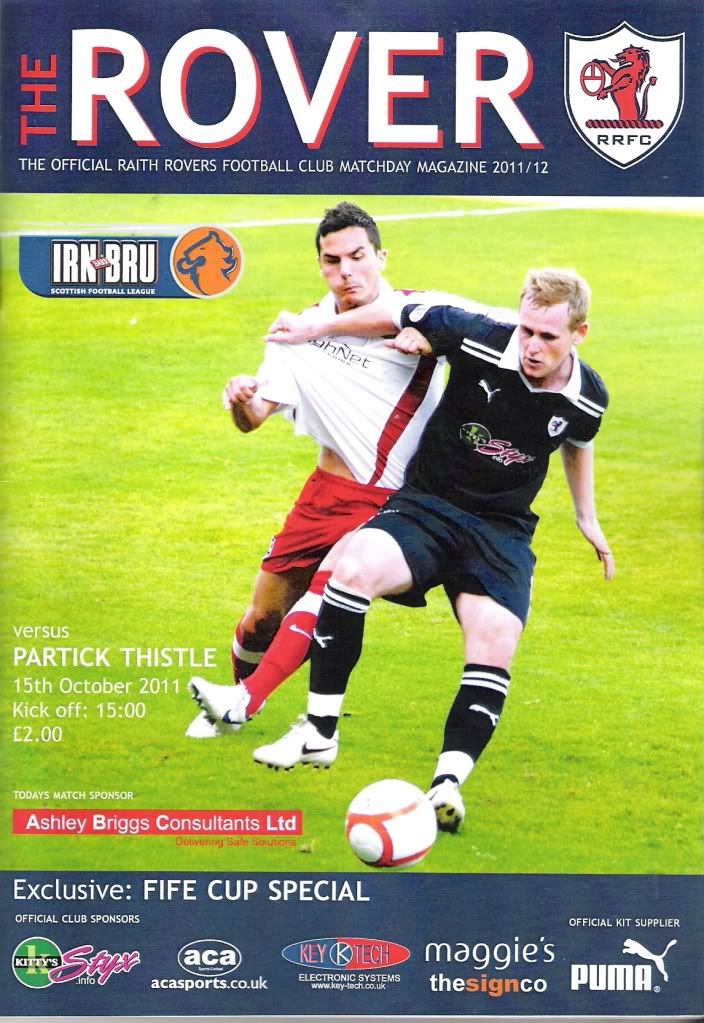
Raith Rovers 2v0 Partick Thistle
Scottish League First Division
Saturday 15th October 2011

I first clapped eyes on Stark’s Park whilst travelling on the east coast line from Edinburgh to Dundee and since then its been a ground that I’ve been looking forward to visiting, not just for its unique appearance but because it’s the only ground with a rhyming name in senior fitba.


Raith Rovers formed in 1883 in the former royal burgh of Kirkcaldy on the northern shore of the Firth of Forth, the largest populated town in Fife. The town takes its name from the Pictish words Caer and Caled which translates as "place of the hard fort" or "place of Caled's fort". Kirkcaldy has long been nicknamed the Lang Toun in reference to the nigh mile long main street, which eventually stretched to four miles when the burgh boundaries were extended to the neighbouring hamlets of Gallatown, Linktown, Pathhead and Sinclairtown in 1876

Raith isn’t actually a settlement but an area of land that once stretched from south of Loch Gelly as far as Kirkcaldy. The Battle of Raith is said to have taking place here, when invading Angles forces defeated an alliance of Scots, Britons and Picts under King Áedán mac Gabráin of Dál Riata. There is also a Raith House and Raith Tower which sit on Cormie Hill to the west of the town and several parts of the town are build upon the Raith estate.


Although there were other football clubs in the shape of Kirkcaldy United and Kirkcaldy Wanderers, Rovers were the most successful team in the town, turning professional in 1892 and became the first club in Fife elected to the Scottish League in 1902/03


The club played at two previous grounds until settling at Robbie’s Park, then in 1891 were forced into a move when the land was incorporated into a new public estate called Beveridge Park, named after Provost Michael Beveridge. The team moved a short distance, transported their pavilion along Pratt Street to Stark's Park named after and run by councillor and licensee Robert Stark.
The Archibald Leitch Grandstand was built in 1922 and was partly funded by the sale of Alex James to Preston North End, replacing the original main stand which was destroyed by fire in 1918. The L-shaped structure still stands today, its main feature being the gable roof with the RRFC and club crest an the facia. The stand runs from the corner of the ground to half way which leaves the other half filled with unused terracing. The players emerge from a proper tunnel as the changing rooms are under the stand with the team dugouts pitchside. The stand is furnished with a mixture of old and new, with wooden flip seats and a section of bucket seats. The pavilion remains largely unchanged apart from remedial work and upgraded seating and a new metal roof in 1999.


Major developments were made to Stark’s Park during the 1950s after a record gate of 31,306 against Hearts in February 1953, with new concrete terracing and partial cover behind each goal, which along with the "coo shed" opposite the main stand meant there was cover to all four sides of the ground. Shortly afterwards four large floodlight pylons were added with the cost of the improvements mostly subsidised by the sale of star players like Jackie Stewart to Birmingham City, Jim Baxter to Rangers and Jimmy MacEwan to Aston Villa.


The Railway End shed was replaced with a new roof and seats in 1981 which also ran half pitch length, which was later extended in 1996. It’s now easy to see the two separate stands as there is no seats in the empty stand, which is unused apart from the TV Gantry and a large Rovers supporters flag.


Raith won their first major honour in 1994 after lifting the League Cup(Coca-Cola Cup) by causing a major upset in defeating Celtic 6-5 on penalties after the final finished in a 2-2 draw. This success meant to club qualified for the UEFA Cup and with the extra revenue two new 3,370 all seated stands were built behind each goal by Barr Construction.
The stands are decked out in dark blue with white lettering amongst the seats, with the main feature the floodlights perched in each corner of the stands. The McDermid Stand is set aside for away supporters and the overall capacity stands at 10,104.


During the clubs UEFA Cup campaign they faced eventual winners Bayern Munich at Easter Road due to their own grounds limited capacity with the Germans returning to the San Starko when the all-seated stadium was complete.
The Scottish Division One clash with Partick Thistle got off to a drab start, looking like of a potential nowts each draw which wouldn’t have pleased the three special guests in attendance. Those being myself, Squad#155 James Little and former PM Gordon Brown, who seemed to spend the game sitting in the pavilion checking his phone. (Probably checking on the Heed score as well…Eddy)


Raith took the lead on 31 minutes when a corner kick to the far post was nodded back across goal into the path of Laurence Ellis who tapped the ball home to score on his 300th appearance for the club.
The second half was much better with Rovers doubling their lead on 56 minutes through John Baird, giving plenty of time and space to nod home from six yards. The hosts won comfortably and could have expanded the score line, while Thistle depending on long range efforts, lacking a cutting edge in front of goal.


So it wasn’t exactly a vintage performance from Raith, nothing to get the Rovers fans so excited that they’ll be "dancing in the streets of Raith tonight" (in tribute to Sam Leitch)
After enduring long journeys south so far this season, it was nice to take a short trip north, leaving Newcastle on the 1144 direct train to Edinburgh. On arrival I met up with James the Hearts fan (I refuse to call him a jam tart!) for the rest of the jaunt across the Forth which took about 40 minutes.
On arrival we planned to call for a pint in the Starks Bar, but the boozer is now closed and boarded up. However we spotted three gents walking at a swift pace meaning they must surely be heading to a pub, so we followed them until the big red capital T emerged in the distance, which in these parts is a sign of a pub which sells Tenants Lager. The Estuary pub is on Links Street and had a mixture of Rovers and Thistle fans watching the football on TV.


Afterwards we were back in Edinburgh by 5.30pm which gave me an hour before my train home, so we had time for a pint in the Cask & Barrel(Swannay 'Orkney Best' 3.6%***) before James dropped me at the train station where I still had time for a drink in the Halfway House (Barneys Beer 'Pale Ale'3.8%***).


I was nice to be home early, back in 100FgC HQ by 8.15pm, but unfortunately there always has to be a fly in the ointment! I finished the ‘My Matchday’ report on the train which I was due to publish when I got home until it suddenly disappeared from my laptop and into cyberspace, which meant I had to write this whole article again from scratch. Also to make things worse and rub salt into my wounds, the breadknife was watching that effin X-Factor on TV, which all resulted in a disappointing end to the days events.
However these trivial things couldn’t spoil a great day, which was mainly due to Squad#155 for make the trip possible by picking me up at Waverley and driving across to Fife. My mission of finishing the English 92 is almost complete and I look forward to more trips north of the border in the spring when I’ll start chipping away at the Scottish 42.


Matchday stats
RRFC 2(Ellis 31, Baird 56)PTFC 0
att.1769
Admission £17
Programme £2


Ground no.299 Stark's Park - Matchday webalbum (24 pictures)

Sunday, October 9, 2011

Wearside League Wanderings - part six

The sixth part of my wanderings around the Wearside League features two new clubs who were accepted into the league for the 2011-12 season, both coincidently faced north-east Non-League legends Willington.

293. Hill Top Ground

Gateshead Leam Rangers 2v0 Willington
Wearside League
Wednesday 17th August 2011


Leam Rangers formed as a youth football club in 1993, the brainchild of current Club Secretary Rob Houghton. The club secured a lease on council land at the top of the Wealcroft on Leam Lane Estate in the southern end of Gateshead. The Hill Top Ground was transformed from an overgrown grassed wasteland to a canny little ground with good facilities, which is now suitable to host Wearside League football.

The club now run 22 boys and girls teams from ages 6 to 18 as well as two senior sides. The Leam played in the Durham Alliance between 2009 and 2011 until a successful application to step up to the Wearside League last summer. The club still have a youth side in the Durham Alliance which is used as a stepping stone to the senior squad.

The redevelopment of the ground is due to the hard work and dedication of Mr Hughton with the help of willing volunteers. He even took a bricklaying course to build a dressing room, as the kids were using metal storage containers without the use of a washroom or toilet.
The ground now has a pleasant club house in between new changing rooms and refreshment bar after a successful application for funding was made to the Football Foundation. The entrance has the club name adorning the metal gates and the pitch is fully fenced off with new hard standing on the nearside. The far side has a pair of stone dugouts and the grass bank is a popular spot for spectators.


Gateshead Leam Rangers opened their first Wearside League campaign with two away defeats and I was in attendance as the Hill Top Ground hosted its very first game at level 7 of the Non-League pyramid against Willington.

The Leam produced a gritty and determined performance to mark the occasion with a first victory of the season. A goal in each half by David Lucas secured a comfortable win, the opening goal coming after only 7 minutes, the striker nodding home a peach of a cross from Liam Barnett(see pic below), then the duo again combined on the hour mark when Barnett was tripped in the box and Lucas despatched the penalty kick to chalk up the Leam’s first three points.

The Leam have a great set up and the club’s progress means that Rangers are now the closest club from my home at Gallowgate View, so I’ll be able to frequently pop down and check on the team’s progress.

The 100FgC was again in attendance on Non-League Day on the 3rd September, with both Michael (Squad #119) and Andy Hudson(squad#173) watching the game with Peterlee Town.
You can read the lads in depth reports on Leam Rangers at;
The Accidental Groundhopper (Michael)
Ganning Away (Andy)


Matchday stats
GLR 2(Lucas 9, 60pen) WFC 0
att.70approx
Admission £2
Programme 50p


-----------------------------------------------------------------------------
298. Ford Quarry

Sunderland West End 2v3 Willington
Wearside League
Saturday 8th October 2011


Sunderland West End formed just this year when The Jolly Potters merged with Wearside League outfit Houghton Town. The Jolly Potters were a successful side in the Wearside Combination League, winning a hat-trick of league titles and the Alan Hood memorial trophy twice, since forming in 2006.

The club play at Ford Quarry which is in the South Hylton district of Sunderland The ground is off St Lukes Road, where a road bends down the bank and leads you to the ground entrance. The junction isn’t easy to spot as I drove past it a couple of times until I noticed the pitch at the bottom of the hill.
The Ford Quarry ground was officially opened by Sunderland Council Leader Paul Watson on the 3rd August, when a charity game took place between Sunderland West End and Northern League side Sunderland RCA in aid of The Peter David Lane Trust Fund. The ground has large changing room facilities, a fully fenced off pitch with a pair of metal dugouts.


After I saw Willington lose at Leam Rangers, they suffered a heavy home defeat against Ryhope in the following match. Since then they’ve won eight league fixtures off the belt and stretched it to 9, but only just, after snatching a late winner to deny West End a point.
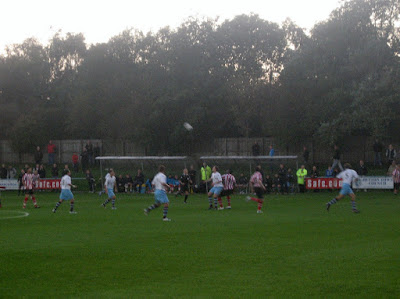
West End took the lead in the 9th minute when Stubbs capitalised on a defensive mix up to shoot home from a tight angle, but Willington quickly responded, seven minutes later Yorke nodded home from close range, then just before half time Lee beat the offside trap and having plenty of time to pick his spot with a neat finish.
The second half saw West End have plenty of possession with the visitors leaving their two main strikers mooching around the half way line, relying on the long ball tactic to catch the home side on the break.
There was a long stoppage after 75th minute when one of the West End players went for a 50-50 ball and fell over and banged his head against one of the stone posts on the perimeter fence. After a 5 minute delay the player got to his feet and thankfully was ok - “I’m alreet, I just knocked me’sell oot that’s aall” was his insouciant response as the game went on without him.

Just as it was looking as if we had witnessed a goalless second half, the match finished with a dramatic climax. West looked to have grabbed a well earned draw in the 90th minute when a cross shot from Coomber found the top corner off the net, then in the 6 minutes of added on time the game swung back and forth with both teams desperate for a winner.

The winning goal duly arrived in the second minute of stoppage time. The home keeper who played a blinder all afternoon produced two terrific saves from close range, until the ball was unfortunately parried into the path of Lee who was left with an open goal to simply walk the ball over the line to make it nine league wins on the bounce for the men from County Durham.
Sunderland West End are another good addition to the league and matches like this one are a credit to the Wearside League - a cracking game and well worth the two quid admission fee!


Matchday stats
SWE 2(Stubbs 9,Coomber 90) WFC 3(Yorke 16, Lee 42,90+2)
att.47(HC)
Admmission £2
programme:none


Saturday, October 1, 2011

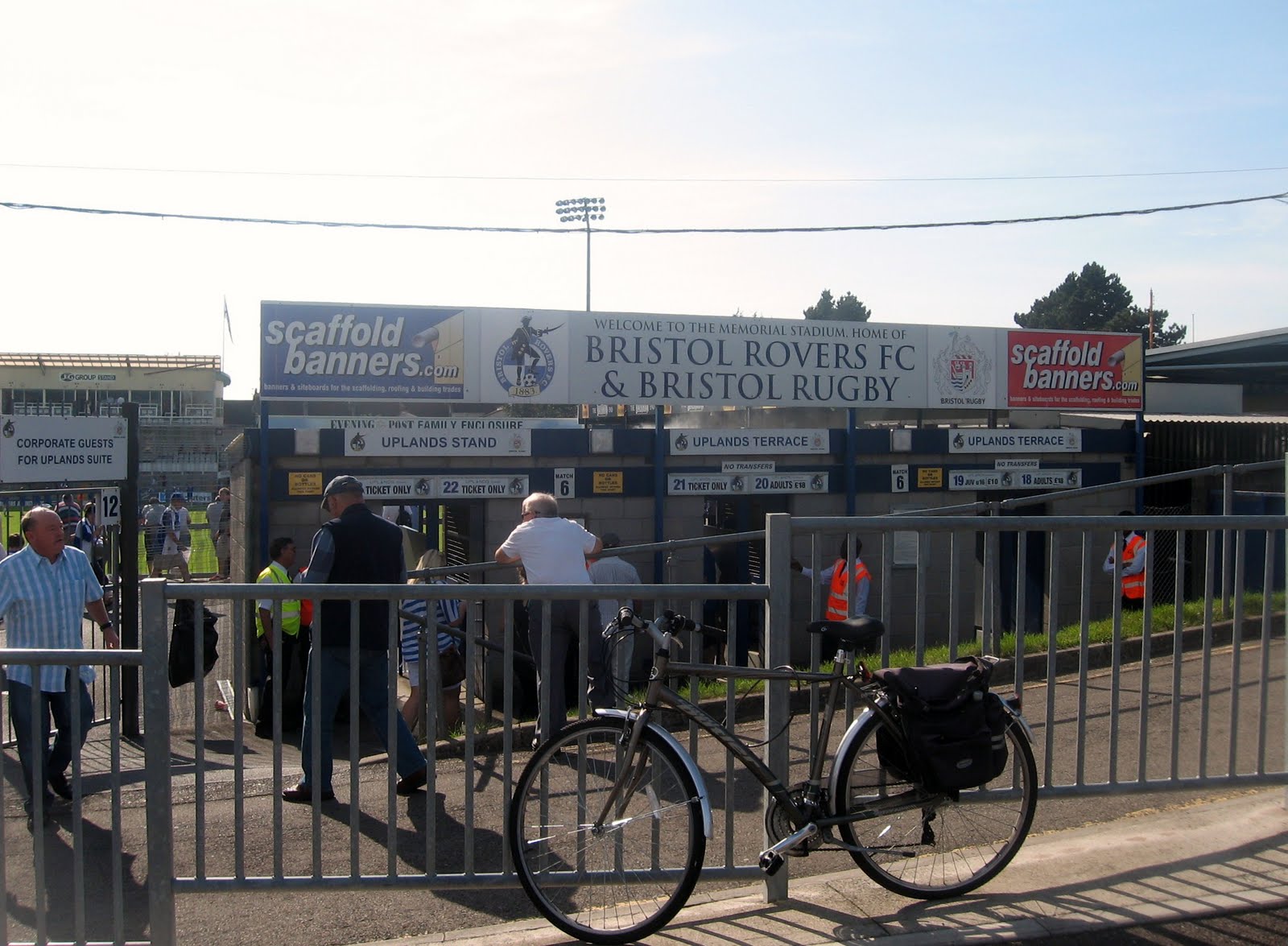
My Matchday - 297 Memorial Stadium

Bristol Rovers 1v3 Cheltenham Town
League Two
Saturday 1st October 2011


For the second week running I ventured across to the opposite side of the country, heading from the north-east to south-west for my first ever visit to Bristol Rovers.
Over the years I’ve seen The Pirates in action on numerous occasions, but I’ve never seen them play as hosts. I did intend to visit Eastville in 1980, but at the time the club were sharing at the home of their City rivals after the South Stand was destroyed by a fire.
Newcastle played at Ashton Gate in successive away matches early in the season and we decided we would rather make the 600 mile round trip to Bristol to see the landlords rather than the tenants play at Ashton Gate.


I also missed out on watching Rovers play at Twerton Park in 1992, as I was on a beer, sex and souvlaki holiday on the Greek island of Rhodes. The Magpies made a blistering start to th
e 1992-93 season, and a 2-1 win gave United their fifth in a sequence of eleven consecutive wins at the start of that season. On that sunny afternoon the Toon were led out by a 5 year old mascot, who at the time was visiting his 13th ground and some 15 years later became Squad#79 in the 100FgC.

The customary early start for your truly, which meant getting up in the middle of the night and walking across to the town via the High Level Bridge to Central Station. I boarded the 0645 Cross Country service to Plymouth, arriving at Bristol Temple Meads station at 1145.
Bristol is the sixth most populated city in England, built around the River Avon with a short coastline on the Severn Estuary, which flows into the Bristol Channel.
Historically the city was an important port, handling trading goods to the likes of Ireland, Iceland and Gascony and became a centre for shipbuilding and manufacturing. Bristol’s chief sea port has a long history in trade, where deals were personally struck in the former trading area around The Exchange in Corn Street over bronze trading tables, known as "The Nails". It’s said that maybe this is where the expression "cash on the nail", meaning immediate payment, may have originated from.
Bristol Rovers FC originally formed in September 1883 as Black Arabs, in association with the Arabs rugby club, initially playing friendly matches on a pitch at Purdown in Stapelton.

The following year the club were renamed Eastville Rovers playing at Ashley Hill, Horsfield Downs and also the Ridgeway in Upper Eastville. In 1897 the club joined the Birmingham & District League and finally found a settled base at the former ground of Bristol Harlequins RC in Eastville.

The renamed Bristol Eastville Rovers became a professional outfit in the 1897-98 season, dropping the middle name in February 1899, before joining the newly formed Southern League where they played until 1920, when they were accepted into the Football League.

Eastville Football & Athletic Ground was purchased for a measly sum of £150 and remained Rovers’ home for the next 89 years until 1986, when financial problems resulted in the club being forced into a temporary ground share at Twerton Park in Bath.

Bristol Rovers were tenants at Bath City for 10 years until taking up another tenancy with Bristol Rugby Club in 1996 at the Memorial Ground in the Horsley area of Bristol.The stadium was opened in September 1921 on an area of land named Buffalo Bill's Field that was previously occupied by allotments. The ground is named in honour of the Rugby Union players from the city that died during World War One.
Bristol RFC redeveloped the ground, replacing the old Shed with the Centenary Stand to mark the club's 100th anniversary in 1988 and the West Stand, which had stood since the ground was built, was demolished and replaced in 1995. The Memorial Ground was also renamed with the Stadium suffix around this time.

The rugby club suffered major financial difficulties after relegation from the Premiership in 1998, resulting in Bristol Rovers taking over the ground ownership. The roles reversed with the rugby club becoming tenants in their original home.

On one side is the striking looking West Stand, which has a unique look to it, split into three sections with 10 hospitality boxes at the top, terracing at the bottom and 710 white seats in between. There’s also a TV gantry at the top with an electric scoreboard on the gantry’s facade. Next to the stand on the other side of the players’ tunnel is the South West Stand which is a small covered terrace, which is used as the family enclosure with space for 720 spectators.
At the opposite side is the Uplands Stand which has covered seating to its rear and terracing at the front. The stand is quite high in height with a good view over Bristol, one of my colleagues in the press box mentioned it’s the coldest stand in the country, my reply being that he mustn’t have been to Gateshead Stadium! The stand is prominently blue with staircase access to the seats at the sides and the front. There is open terracing at each side and the dug outs are located in front, which means that team staff have to trail across the pitch to the changing rooms in the West Stand.
The South Stand was originally erected as a temporary stand, having just over 1,000 green seats with a gazebo type covering, decked out in blue and white patched squares. The stand runs for just over half the width of the pitch and is shared with the away supporters.
Behind the opposite goal is the Blackthorn North Terrace, which is a covered terrace for home supporters with a capacity of 3,710, which brings the overall stadium capacity for football purposes to 11,750.
The Carrot Crunchers Derby or better still; The Cider Swiggers Derby was won by the club from 40 odd miles up the road, who produced a solid and confident away performance, giving the Gashead fans a frustrating afternoon.
In the opening half Cheltenham looked dangerous when pushing forward while Rovers struggled to string two passes together, the only threat coming from Zebroski, who created a couple of half chances for himself but failed to hit the target.
Town took the lead on 34 minutes. Kaid Mohamed ran half the length of the pitch before poking the ball home, then within ten minutes the lead was doubled when Luke Summerfield thumped the ball home from the edge of the box from a corner kick.
The three points were guaranteed just after the restart. The Cheltenham players must have worked hard in training on corner kick routines this week, this time the corner was
played to the near post where James Spencer flicked the ball home for another clever goal.
Rovers pulled a goal back on 64 minutes. The ball was cleared from a corner kick, which fell nicely for Lee Brown, his first time shot from 25 yards taking a slight deflection, giving the keeper no chance.
The home side rallied to get back into the game but it never looked likely as Cheltenham had chances themselves to catch the Rovers defence on the break. Overall a good game after a slow start, maybe the injury to Danny Woodards, stretchered off in the opening minutes knocked the stuffing out of Rovers, but take nothing away from The Robins, a good performance so the cider will be flowing on the edge of the Cotswolds after this “derby” win tonight.
To be honest I wasn’t really looking forward to this trip. I’ve got nowt against Bristol, but a five hour each way journey didn’t give me a tingle in the loins or have me rubbing my hands with glee. I had problems booking decent trains with the only sensible journey home being the 1740 from Bristol Parkway, changing at Derby, so the time span from match to train station was tight.
On arriving I had time for a couple of pints in the city centre, ticking off a couple of ‘Spo
ons at The Knights Templar and Commercial Rooms, as well as the GBG listed Old Fishmarket.
I wanted to get to the ground early so I decided to head to Parkway station, then get a
taxi so I could book my return in advance, arranging to get picked up at the bus stop on the end of Filton Avenue at 5pm.

After the game the taxi arrived spot on time so I was safely back at the station for 5.15pm. Then as I waited for my train, I received a string of text messages from an irate taxi driver informing me he couldn't wait any longer and wondering why I hadn’t shown up, so his fare had been “bumped” by a rival taxi firm.
On the long journey back home I had half an hour to spare between connections in Derby, so I had time to visit the excellent Brunswick Inn on Railway Terrace. The pub has a huge choice with 16 handpulls with a selection from its own Brunswick Brewery, unfortunately I only had time for a quickie before catching the train back to Newcastle.
I’m delighted to get this ground ticked off and to finally see Bristol Rovers play a home game, I enjoyed my brief visit to Bristol and I’ll hopefully return one day for a much longer stay. I finally arrived back home at 11pm, my train crossing the Tyne via the High Level some 16 and a half hours since I walked over the same bridge in the early hours of the morning when this daytrip kicked-off.

Matchday stats
BRFC 1(Brown 65) CTFC 3(Mohamed 36,Summerfield 43, Spencer 48)
att.6,108
Admission:Press(between £16-£24)
Programme £3

Saturday, September 24, 2011

My Matchday - 296 Kassam Stadium

Oxford United 1v1 Accrington Stanley
League Two
Saturday 24th September 2011


My main objective for this season is to finish off the current 92 before the arrival of our brutal winter which looks set to force an unwanted mid-season break. So for my latest solo train journey, I boarded the 0622 Cross Country train service to Reading, alighting in the picturesque city of Oxford.
The city is renowned for its famous university, the oldest in the English speaking world. There are two rivers flowing through the city, the Cherwell and the Thames which meets at the south, this stretch of the Thames is known as the Isis. The Oxford skyline demonstrates every English architectural period since the arrival of the Saxons, with its churches and university buildings as well as the mid-18th century Radcliffe Camera.
Oxford is known as the "city of dreaming spires", which is credited to poet Matthew Arnold, however the term I would use is “city of bloody good bands” with three of my favourite groups over the last 20 years, namely Radiohead, Ride and Supergrass, formed out of Oxford

A vicar and a doctor met in a pub (no this isn’t the beginning of a joke) in 1893 and formed Headington FC, using players from the Headington Cricket Club. The club added the United bit to their name the following year and later joined the Spartan League.
In 1960 they were renamed Oxford United and within two years were in the Football League after winning the Southern League title for a third time.
The golden era for the U’s was during the 1980’s, winning consecutive league titles and promotion to win a place in the top tier of English football in 1985, then lifting the ’86 League Cup with a 3-0 win over QPR in the final at Wembley.
The club were relegated to Division Two in 1988, which started an 18 year downward spiral that ended with relegation from the Football League in 2006. This was the first time in the history of English football that a team which had won a major trophy were relegated to the Conference.
After a four years gap the club regained their League spot through the play-offs, overcoming York City 3-1 in the final at New Wembley.

Headington United started life at the Quarry Recreation Ground, before moving to Wootten’s Field in 1898. During the early part of the 20th century the club led a nomadic existence, playing on various pitches in and around Manor Park including a return to the Quarry, before securing land on Matlock's Field in 1925 which became known as the Manor Ground.

The Club announce in 1995 that by the end of the decade they were moving to a purpose built stadium at Minchery Farm in the Blackbird Leys area of the city, leaving behind Manor Ground their home for the previous 76 years.
I visited the Manor Ground twice during the 1980’s with Newcastle United. Both matches played midweek under lights in the same competition; the League (Milk)Cup, both resulted in disappointing and inept displays from the Magpies, by and large two unforgettable nights of misery.
The first tie took place in 1983, goals from Neal Whatmore and Andy Thomas gave Oxford a two goal lead at half-time with a late consolation goal from Keegan not enough to give the U’s a 3-2 aggregate win.
I was back again two years later and yet another pretty shitty night. The only highlight being we had time for a couple of pints before kick-off, which lightened our moody slightly before a 3-1 hammering as Oxford were on route to Wembley. Trevor Hebberd scored and another two from Thomas, which must have prompted Newcastle to fork out £100,000 for his services the following summer.

The new stadium meant the club left behind their spiritual home in Headington for the first time. Building work began in the summer of 1996 by Taylor Woodrow, but due to financial constraints construction ceased in December 1997.
Following the arrival of Firoz Kassam as chairman in 1999 work on the stadium recommenced in February 2000 by Birse Construction. The new owner ironed out the on-going legal problems, cleared a large percentage of the debt and squared up financially with Taylor Woodrow.
The ground is owned by the Firoka Group Company and was designed by ACP Architects with the overall construction costing £15m. The first game took place on the 4th August 2001 with a friendly against Crystal Palace, with the first competitive match the following week against Rochdale in the Third Division. United lost the game 2-1 in front of a crowd of 7,842 with Jamie Brooks scoring the Oxford goal.

The stadium has three separate all-seated cantilever stands filled with blue seats with an open end on the west side onto the car park and Vue complex.

The main stand is the South Stand, which has a capacity of 4495 over the two tiers, which are split with 28 executive boxes in between. The central façade wall is decorated with significant dates in the clubs history, similar to what they’ve done at the Emirates, but done in a more discreet way and not an arrogant in your face way like the Gunners.

Opposite is the North Stand which is similar in size and design, with just a single tier of 5026 seats, which are shared with away supporters. The stand also has floodlights mounted on the roof.
Behind the east goal is the Oxford Mail Stand which is also has a parallel appearance, but with less capacity with room for 2879. There’s also a basic electric scoreboard behind the west goal.
I do have one gripe about the stadium, which is the appearance of the walls around the turnstile areas which looks an eyesore, covered with graffiti and desperately in need of a tidy up and a good lick of paint.

The current capacity is 12,500 with the biggest attendance being just short of a full house when 12,177 witnessed the 3-2 defeat against Leyton Orient in May 2006, which sealed the clubs fate and sent them crashing into the Conference.


The spoils were shared between Oxford United and Accrington Stanley in this League Two clash, a fair result with maybe the visitors just shading it. The despondent chorus of boos from the U’s supporters on full time tells the story of a frustrating 90 minutes.
Accrington could have been three goals up before McClaren gave Oxford the lead on 35 minutes; a free kick from 20 yards took a wicked deflection to totally wrong foot the ‘keeper to give the hosts a fluke lead.
Before then, Murphy had a goal chalked off for offside after netting the rebound from a Winnard header, which came back off the post. United keeper Ryan Clarke pulled off two great saves, tipping over an effort from Fletcher, and then denying Murphy with a point blank save.
The equaliser came just after the hour mark when the ball fell into the path of Peter Murphy on the edge of the box, hitting a first time shot which nestled in the bottom left corner of the goal.
Both sides huffed and puffed for a winner but it didn’t look likely as the match fizzled out into a draw, which pushes Oxford out of the play-off positions.

Needless to say my brief previous visits to Oxford weren’t enjoyable, so I made sure I made up for it this time, by arriving early so I could have a good toby around and a good pub crawl.
I arrived just after 1030 and headed straight to Wetherspoons for breakfast. This JDW pub is inspired by the famous Two Ronnies sketch, hence the name - Four Candles. I also frequented the Swan & Castle, Royal Blenheim, Bear Inn and Far From the Madding Crowd before catching the bus to the ground at around 2pm.
The bus fare was £2.90 return and the regular service meant I was back in the town centre in good time to catch the 1807 back to Newcastle.
As soccer Saturday’s go this one was just about perfect, not only did I have an enjoyable day in Oxford, but good news from elsewhere as both my teams in black and white had good wins courtesy of hat-trick heroes.
My target to finally finish off the 92 is getting closer with just three more to go, hopefully if my plans come together then the set can be achieved before winter calls, when my footy travels grind to a temporary and impetuous halt.

Matchday stats

OUFC 1(McClaren 35) ASFC 1(Murphy 62) att.6472

Admission £20.50 Programme £3


Ground no.296 Kassam Stadium - Matchday Web album (19 pictures)

Wednesday, September 21, 2011

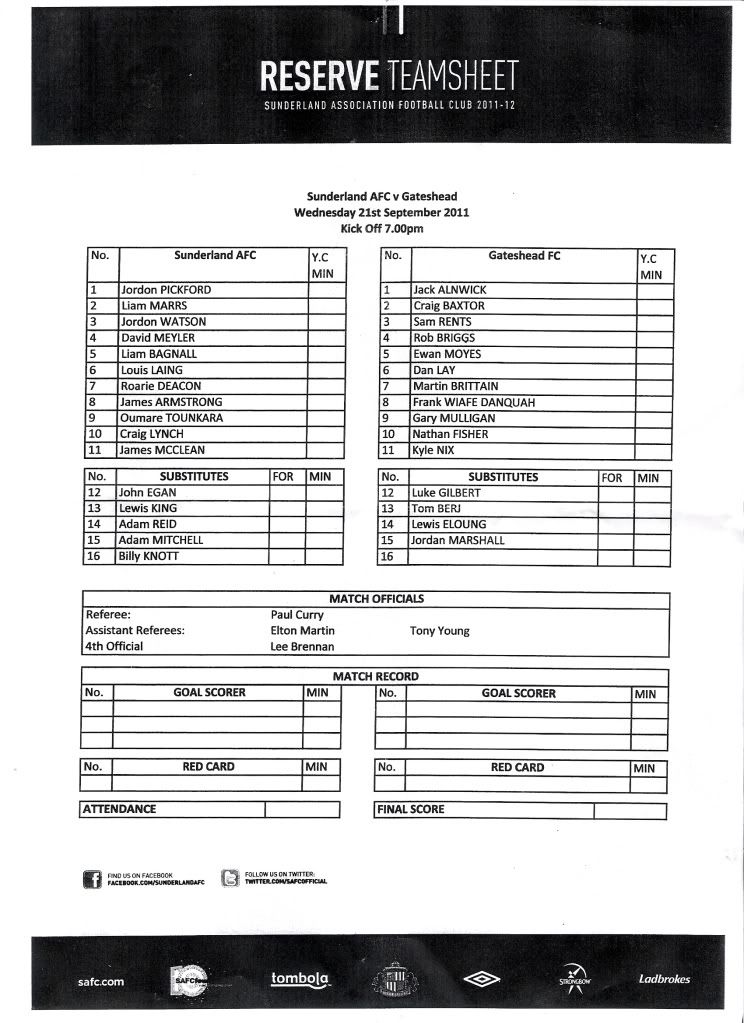
My Matchday - 295 Eppleton Colliery Welfare Ground

Sunderland Reserves 1v0 Gateshead Reserves
Tote Cup (Group C)
Wednesday 21st September 2011

Eppleton Colliery Welfare is the only major north-east football venue still in existence that I was still to visit. The ground hosts the annual Durham Challenge Cup final and as the game usually takes place on Good Friday, I always miss it because I’m usually away during the Easter holidays.
Eppleton Colliery Welfare Ground is in the former mining village of Hetton-le-Hole, situated between Durham and Sunderland. The ground also hosts chief residents Sunderland Reserves, Sunderland Ladies and local Sunday league side Hetton Lyons, FA Sunday Cup winners three times in the last five years.


The ground was of course home to former Northern League club Eppleton CW, who formed back in 1929. The club entered the North Eastern League in 1947 before joining the Wearside League in 1951. After a spell in the Houghton & District League they returned to the WL after a ten year absence in 1974. Successive league titles at the turn of the ‘90’s saw a step up to the Northern League Second Division in 1992-93, winning promotion in their debut season.

The club lasted three seasons in the top flight but after relegation they became annual strugglers, eventually dropping into the Northern Alliance in 2003 and unfortunately within two years the club were no more.
The Welfare Ground was originally shared with cricket, having a pavilion and a stand behind the goal. The pitch lay east of its current position until the 1970’s, when the cricket field moved northwards, with the cricket outfield adjoining the top end of the football pitch.
Ground improvements were made to coincide with the club’s promotion to the Northern League. Cover was added to the central section of the banked terrace, including a section of wooden benches and a new four pylons floodlight system.

In 1993 Sunderland Council embarked on a £3m revamp of the ground, which saw the old stand replaced with a smart looking two tier cantilever stand, the bottom tier has 250 blue seats split into four sections, with standing room at the top for a further 350 spectators.
The other three sides is open with hard standing and grass banking with large Perspex dugouts opposite the stand.


The ground is overshadowed by the Hetton Centre building which houses the community organisation ‘The Hetton Town Trust’ which rose from the former Eppleton Colliery Welfare. The centre includes the Bob Paisley Bar, named after the legendary former Liverpool manager who was born in Hetton-le-Hole.

Missing out on the Durham Cup final every year, the only way I could visit Eppleton Colliery Welfare Ground was by having to suffer watching the mackem reserves on the odd occasion they use the ground instead of either the Stadium or Academy of Light. But thankfully this ground was picked as the location for the Tote Cup fixture against my beloved Gateshead, the Heed reserves returning to the venue of their triumphant DCC victory last season.

The first round of the Tote Cup is regionalised into a group stage. Gateshead and Sunderland grouped together with Hartlepool United, Hull City and Scunthorpe United.
Current Tote Cup holders Sunderland got off to a winning start in defence of their trophy as Roarie Deacon’s second half strike settled the tie. The mackems had good chances in the opening half, all falling to Oumare Tounkara who hit the post, headed over from close range and blasted two efforts into the Hetton Centre car park.

Gateshead battled well but never seriously tested the home ‘keeper, while between the other posts, Heed’s Jack Alnwick, on-loan from Newcastle United looked unbeatable. That was until the 74th minute, the Tynesiders defence finally breached as Deacon latching on to a right wing cross, having time and space to pick his spot to give the Wearsiders a rare win over a Tyneside club.

Eppleton Colliery Welfare is a tidy little ground and despite the slight slope, the pitch it’s probably one of the best playing surfaces in the region. It’s a shame that Eppleton CWFC went to the wall just as the ground was developed as it would be a welcome addition amongst north-east Non-League football grounds in either the Northern or Wearside League.

Matchday stats

SAFCres 1(Deacon 74)GFCres 0 att.330

Admission with team sheet £3

Ground no.295 Eppleton CW - Matchday Web album (15 pictures)

Saturday, September 10, 2011

My Matchday - 294 Highbury Stadium

Fleetwood Town 3v1 Gateshead
Blue Sq.Bet Premier
Saturday 10th September 2011


Fleetwood Town’s Highbury is a ground I’ve put off visiting until now. Don’t get me wrong, it’s not as if I’m anaphylactic to fish or anything, it’s just I’ve waited until the redevelopment of the stadium was completed, so I can capture the ground in all its glory.


The 5,663 capacity stadium has been totally revamped since 2007, with the finishing touch being the smart looking £4.5m Parkside Stand which was opened to spectators in April. The stand has a 2,000 all- seated single tier with a shelf-like executive area at the back, having two rows of seats in front of seven hospitality boxes. The stand is completed by a semi-circular wrap around roof with large glassed walls at each side.


Opposite is The Highbury Stand which opened in 2008, with 550 red seats divided into six rows and runs half the length of the pitch, the other half has the building that was used as dressing rooms with a video screen scoreboard and there’s also a TV gantry box on top of the roof.


There is covered terracing behind each goal, the Percy Ronson Stand was the first stand built in the revamped ground in 2007 and is usually set aside for away supporters with room for over 600 fans.

The Memorial Stand replaced the old Scratching Shed at the Park end, named in honour to those who lost their lives in service and in memory of the trawlermen lost at sea from the port of Fleetwood. The stand holds 1473 and opened in August 2008 and unlike the Percy Ronson stand the roof covers the whole end.


A rare treat of a bit of a lie in for this trip, as it’s usually an early start and a canny hike when travelling away with the Heed. Our coach left Gateshead at 10.15pm and after being millimetres away from dunshing a car on the A685, we arrived safely at 1.30pm


Fleetwood is a town on the Lancashire coast in the Wyre district in North West Fylde, an eight mile tram ride north of the bright lights of Blackpool.

The town is built on a Peninsula and was once a productive deep sea fishing port until fishing restrictions were made after the Icelandic Cod wars in the 1970's. The port is now a tourist attraction with a retail shopping park and the picturesque seaside resort is a quieter alternative to the noisy neighbourhood down the road.


We drove past the old fishing docks and the local McDonalds, with Squad #26 Alan Price suggesting we should stop off for a Fleetwood Big Mac! Thankfully we didn’t, the coach driver dropped us off at the JDW pub - The Thomas Drummond instead.


Drinking in Fleetwood is a very cheap day out. I had 2 pints in the ‘Spoons; Northern ‘Casino’(3.8%) cost £1 and Franklin EXP(4.2%)£1.99. On route to the ground I went to seek out the Strawberry Garden which is owned by the local Fuzzy Duck Brewery, where I had a pint of ‘Feathers’(4.0%) priced at £2.30 with 50p off a pint for CAMRA members. So overall I had three pre-match pints for under a fiver.(That’s 1994 prices…Eddy)

Similar to the visitors for today’s Blue Sq.Bet Premier game - Gateshead F.C., Fleetwood too has a history of disbanded and reincarnated clubs.

The first of many were Fleetwood Rangers back in 1887 playing at the Corpse Ground for 10 years before Fleetwood Amateurs formed. The club dropped their surname in 1908 joining the professional ranks, playing at Warrenhurst Park before a moving to a pitch on land at the rear of the North Euston hotel in September 1909, joining the Lancashire Combination League.


The North Euston ground was limited with little room for expansion so after one year the club relocated one mile out of town to a piece of land opposite the Queens Hotel. After the club folded in 1927 Fleetwood later returned to North Euston until the local Council purchased four acres of land on Highbury Avenue adjacent to the Memorial Park in 1936.

The first match at Highbury Stadium took place on 26th August 1938, but due to the outbreak of World War 2 another ball wasn’t kicked until 31st August 1946, equipped with a freshly built covered terrace opposite the Main Stand.


The majority of the club’s history was spent in the Lancashire Combination, winning the title once in 1923-24, until becoming founder members of the Northern Premier League in 1968. In 1971 they lifted the League Cup but struggled in the division and after consecutive years at the foot of the table they folded in 1976.


The club reformed the following year in the Cheshire League and progressed to the North West Counties League in 1982. There was also a trip to Wembley in the FA Vase in 1985(lost 3-1 to Halesowen Town) but again the club folded in 1996.


The present and most successful rebirth formed in 1997 as Fleetwood Wanderers in the North West Counties 2nd Division. Due to a sponsorship deal the club were immediately renamed Fleetwood Freeport until the current and traditional Town suffix came in 2002.

Town rapid progress has seen promotion through both North West Counties and Northern Premier leagues, reaching the Conference North in 2008. In the 2009-10 after finishing runners-up to Southport, the Cod Army celebrated reaching the Conference beating Alfreton Town 2-1 in the play-off final at Highbury Stadium.

A Record Attendance of 4,112 was set last season against AFC Wimbledon as The Fishermen reached the play-offs, finishing the regular season in 5th spot but lost the two-legged semi-finals to the eventual promotion winners.


The Tynesiders unbeaten since the start to the season faced the biggest test so far, with Fleetwood producing their best display with a 3-2 win at Kettering last Saturday


The first half was a tight affair, the best opportunity falling to Jamie Vardy just after the half hour mark, his close ranger effort produced a great save from Farman.

The second half was more entertaining. The deadlock broken on 51 minutes with a magnificent strike from Andrew Mangan, who unleashed an unstoppable drive from over 30 yards which crashed in off the underside of the bar.

Viera went close to doubling the lead with a close range header before man of the match Robert Atkinson saw his headed effort cleared off the line.

James Curtis had a shot blocked as Gateshead put on the pressure in search of an equaliser, but were undone on the break. Substitute Brodie played a good ball into the path of Vardy, who ran on to round the defender and finish well.


In the final minute Gateshead halved the deficit with a 25 yard Beckham-eque free-kick from Odubade, but again the home side caught the visitors on the breakaway, Brodie again combined with Vardy, the striker grabbing a brace with another neat finish which had the Captain Pugwash tune blasting over the PA for a third time.


So Gateshead’s unbeaten start comes to an end, while Fleetwood will be buoyant after back-to-back wins and six goals after a stuttering start to the season in front of goal.

The Blue Sq.Bet Premier league looks pretty open this season which should see plenty of highs and a only a few lows for the Heed this campaign.

There doesn’t seem to be a stand out team that’s going to run away with the title this season, which makes for a competitive league and a thrilling eight months ahead.


Matchday stats
FTFC 3(Mangan 51 Vardy 80 90+4)GFC 1(Odubade 90)