Showing posts with label Dunston Fed. Show all posts

Sunday, January 22, 2012

My Matchday - 306 Fenland Stadium

Wisbech Town 2v2 Dunston UTS (a.e.t.)
FA Vase 4th Round
Saturday 21st January 2012
Away trips with Dunston in the FA Vase are amongst the highlights of my season, and I once again I enjoyed a good day out with the Fed Lads for the 4th Round clash at Wisbech Town.

We departed the UTS Stadium at 9am and after two (one would have been sufficient) stops we arrived in the Cambridgeshire town at 1.30pm. There was much debate over what today’s destination was actually called. I’ve always thought the town was pronounces as Wiz-beck, however my travel companion Lee Robbo declared it’s Wiz-beach, which was later confirmed by the locals. However if it is Wiz-beach then where is the A and where’s the Sea? (Did you C what I did there?)


Wisbech is a market town and inland port on the River Nene in the Fens of Cambridgeshire. The town’s main feature is Wisbech Castle built in 1071 by William I, which in the late 16th century became a notorious prison. Amongst those inmates were political Catholic priests and bishops, many of which died due to the jails unhygienic conditions. The Norman castle was destroyed in a devastating flood in 1236 and has been rebuilt several times throughout the centuries.

On arrival the club stewards pointed us in the direction of the nearest boozer. The ‘Black Bear’ was just a short walk away, so we also had time for pint in ‘The Locomotive’(Should be renamed “The Filthy Looks Saloon”…Eddy) before heading back to the clubhouse. As I waited to get served at the bar, I overheard one of the home supporters making an disparaging remark about people who live in the top end of the country, which quite frankly annoyed me. After travelling for over 4 hours and 200 miles this isn’t the kind of welcome I’m used to, and that I would expect at a respectable non-league club. I made the culprit aware that I was unhappy about the incident then disregarded it - determined to see a Dunston win which would wipe the smile of his smug face.


Wisbech Town formed in 1920 after the merger of three local clubs, originally joining the Peterborough & District League which they won on five occasions during the 1920’s and early ‘30s. The club formed a Limited Company and turned semi-professional in 1935, progressing to the United Counties League, becoming champions three times after the Second World War. In 1950 The Fenmen switched to the Eastern Counties League before joining the Midland League two years later.


In 1957-58 they reached the second round of the FA Cup, beating Colchester United 1-0 in the first Round, coupled with achieving promotion to the Southern League after finishing league runners-up. The club played within the Southern League set up for twelve seasons until returning to the Eastern Counties League in 1970.
Wisbech finished runners-up and won the League Cup in their first season back in the ECL and won the double the following season and lifted the league title again in 1976-77 and 1990-91.


In 1995-96 the club reached the first round of the FA Cup for the first time since 1966 and also finished second in the league winning promotion to the Midland Division of the Southern League. The club continued to produce good performances in the FA Cup reaching the first round again in 1996-97 and the following season they reached Round Two, losing 2-0 at home to Bristol Rovers.
Town had a second spell in the Southern League for five seasons until returning to the Eastern Counties League in 2002.
Fenland Stadium is a relatively new ground, opened in August 2010. The club previously played on several different grounds until moving from Harecroft Road in 1947 to Fenland Park, a former orchard in Walsoken. The record attendance at their former home was 8,044 against local rivals Peterborough United in August 1957.


Wisbech played there final game at Fenland Park in September 2008 and secured a temporary move to Outwell Swift's Nest ground after installing a seated stand, floodlights and terracing.
Construction began on the new 9-acre site ground in January 2010, with the first match on August 14th for an FA Cup extra-preliminary round tie against St Andrews which The Fenmen won 5-0.
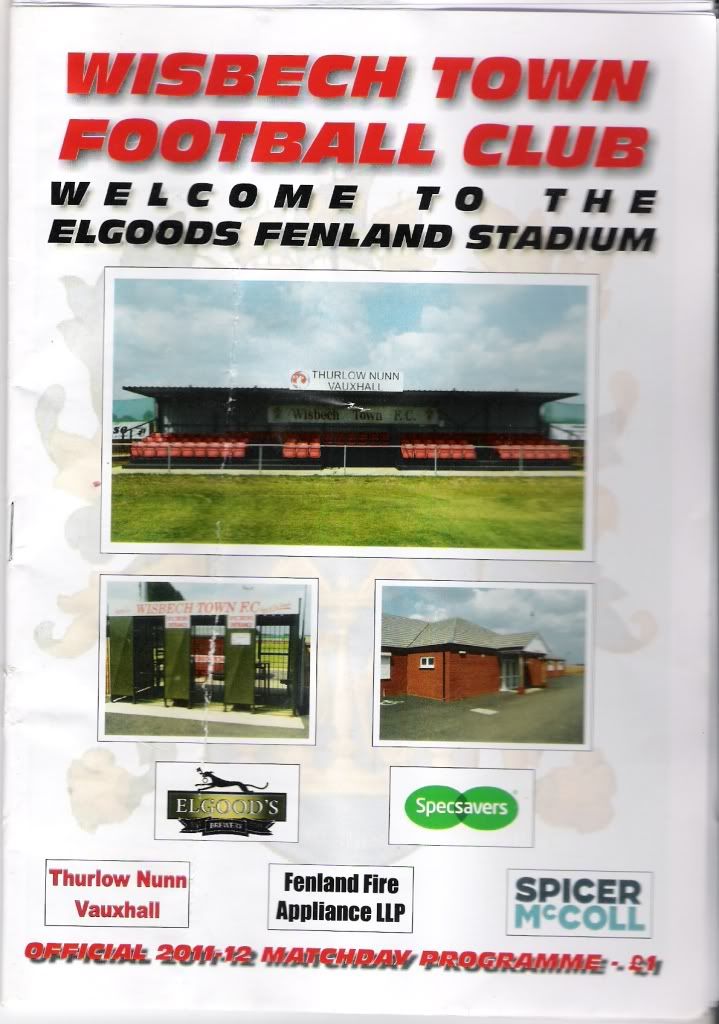
The 118-seater stand which relocated from its brief home at Outwell is a basic structure filled with red seats. The stand is situated at the far side and is flanked by open hard standing. Behind each goal are fully covered single step terraces, named the Spicer McColl Stand and the Fenland Fire Stand.
Next to the turnstile entrance is the main building block which provides a large clubhouse, changing rooms and refreshment bar. The near side also provides more terrace space and the team dugouts. There’s also a club shop in one corner(£4.50 for a pin badge!) and the ground is finished off by a set of thin six lamped corner floodlights.
The Fenmen’s best performances in the FA Vase came in the mid-80s reaching the semi-final stage two years running. In 1984-85 they lost to Halesowen Town in a semi-final replay after a draw over the original two legs, and then the following year they again missed out on Wembley losing out to Southall. If The Fenmen are to progress towards the later stages in this year s competition they’ll have do it the hard way after this 4th round tie finished all square after 120 minutes.


Wisbech deservingly lead at the break after a disappointing first half performance from the visitors. The goal arriving on 25 minutes when a low cross from the right was sliced home by Nick Davey finding the roof of the net.
The Geordies produced a more positive performance in the second half, as they turned the match around courtesy of two scrappy goals. A free kick from 25 yards was crossed to the far post where Young nodded back across goal, where Bulford was on hand to get a faint touch that wrong footed the ‘keeper. Then on 76 minutes a free kick from the left from McAndrew, missed everyone and found the far corner of the net, although initially I though Swailes got his head on the cross.
Dunston looked set for a place in the fifth round but on 81 minutes it was all square, Matt Lunn picked up the ball on the right and darted into the box, then from a tight angle his cross shot found the top corner, if he did mean to shoot (I couldn’t tell from behind the opposite goal) it was a great goal to take the match into extra time.


The hosts almost took the lead after the restart hitting the foot of the post, but extra time was dominated by a monsoon which swept across the pitch which limited any clear cut chances and a crucial winner for either side. On 110 minutes a game which was littered with yellow cards produced a second booking for Michael Dixon, but Dunston’s ten men comfortably held on, which means The Fenmen will have to do the reverse journey to Tyneside next Saturday.

Unfortunately I’ll not be in attendance next week, but I can guarantee that followers of Wisbech Town can look forward to an enjoyable and hospitable afternoon at the UTS Stadium, because that’s just the way we are, as we understand how to treat visitors to our part of the world.

Squad #10 Tim Rigby attends the last match at Fenland Park. – Tims 92 Tims 92


Matchday stats
WTFC 2(Davey 24 Lunn 81) DUTSFC 2(Bulford 50, McAndrew 76)
att.548
Admission £7(but I paid a fiver)
Programme £1


Tuesday, April 12, 2011

My Matchday - 278 Heritage Park

Bishop Auckland 0v0 Dunston UTS
Northern League Division One
Monday 11th April 2011
At long last Bishop Auckland ended a nomadic eight years by moving into their brand new home, south-west of the town in Tindale Crescent.
Bishops played at one of the country’s oldest football grounds - Kingsway, which they shared with the town’s cricket club between 1886 and 2001.
The sale of the “Two Blues” home of 115 years was meant to proceed the club moving into a brand new ground, however disputes with the local council meant the Tindale project remained unresolved, resulting in Bishops having to ground-share with fellow Northern League clubs around County Durham.
The club shared with Shildon at Dean Street for two spells between 2002-2004 and 2006-2008, with a stint at Spennymoor’s Brewery Field in between, with the last two seasons spent at Darlington Road, the home of West Auckland Town. The current ground plans were submitted to Wear Valley District Council in September 2008, with planning permission granted two months later and building work beginning in November 2009.
The stadium was named Heritage Park prior to the official opening which took place on 24th October 2010. Sir John Hall had the honour of performing the opening ceremony, attended by season ticket holders, sponsors, shareholders, and VIP's along with 230 children from Bishop Auckland St Mary's Juniors and their coaches.
The stadium capacity of just over 2,000 includes 250 seats in the Main Stand. The stand is similar in design to the one at Penrith, having a cantilever roof with no supporting pillars with the clubhouse at the top of the stand overlooking the pitch. The stand is decked out with bright cream walls and blue flip seats with the club crest on each side of the stand and also includes a club shop.
There’s full cover at the west side goal, the terrace is seven steps high and has shelter for 472 spectators. The rest of the ground is open with hard standing and grass banking, the far side in front of the Sainsbury supermarket is named Terrace Hill.
The stadium has been awarded an FA Category C grade, meaning it is suitable for use up to the Northern Premier League - Premier Division.
Bishop Auckland are famed in Non-League football, winners of the FA Amateur Cup a record ten times with and losing finalists on eight occasions.
The club formation dates back to 1882 when theology students from both Cambridge and Oxford Universities whilst studying at Auckland Castle, formed a team known as Bishop Auckland Church Institute.
In 1886 a club dispute saw the formation of a breakaway team called Auckland Town, which eventually saw the birth of Bishop Auckland Football Club. The team name changed in 1893 with the club wearing the two shades of blue which represent their Oxbridge origins.
Auckland Town became one of the 10 founder members of the Northern League in 1889, playing the inaugural season before joining the Northern Alliance the following season. The newly named club rejoined in 1893 going on to win the league title 19 times coupled with winning the League Cup on 7 occasions.

In 1988 Bishops stepped up into the Northern Premier League Division, winning promotion in their debut season in the First Division after finishing runners. The club’s best seasonal performance came when finishing second to Leek Town in the Premier Division in 1996-97, before subsequent relegation saw the Two Blues return to the Northern League in 2006.


The stadium’s opening game took place on the 2nd November with a friendly against Middlesbrough in front of a crowd of 1,341, followed by the first competitive game in the Northern League against Consett.
Both games ended in defeat and I originally planned to be in attendance for Heritage Park third match against former landlords West Auckland on the 23rd November. Unfortunately that match which was postponed as it fell in the week when the north-east winter officially commenced, then a second attempt against Dunston UTS in January fell victim to a frozen pitch.
So my visit to Bishops new home comes in the crazy season, when clubs play four games a week in a mad attempt to finish the season by the 30th April, this fixture being Dunston’s fifth game out of a total of 13 to be played during the month of April.

Both teams have recently been in good form and involved in high scoring games so it came as a shock that this game turned out to be Heritage Park’s first goalless draw.
Due to the problems with the ground’s drainage system, the pitch was covered with more sand than grass and with the recent dry weather as rock hard as Jimmy Nail.
The draw was just about the fair result with Bishops probably just shading the second half mainly due to a diligent effort from Wayne Gredziak (Didn’t he play Ice Hockey?…Eddy) The striker twice outpaced the Dunston defence only to see his efforts go narrowly wide, he also went close with a spectacular over-head kick and late in the game brought out a fine save from the visitors keeper.
The result moves Bishops up into 12th position while it’s now 11 games unbeaten in the Northern League for Dunston.

Matchday stats
BAFC 0 DUTSFC 0
att.195
admission £5

Saturday, February 12, 2011

My Matchday - 274 Hargrave Park

Stansted 0v2 Dunston UTS
FA Vase 5th Round
Saturday 12th February 2011
Previous visits to this part of Essex have obviously been to catch flights from BAA Stansted Airport, the UK’s third busiest airport. Jetting off to the likes of Italy and Germany to watch European football isn’t a patch on watching some proper football and it doesn’t get more “proper” than the 5th round of the FA Vase.

Stansted F.C. are based in the village of Stansted Mountfitchet, situated near the Essex/Hertfordshire border, just north of Bishop Stortford and only two miles from the airport.
The Airportmen play in the Essex Senior League, the only club to be ever present in the league since it was formed in 1971 and current league champions winning the title for the very first time last season.
Formed in 1902 they established themselves in the Herts County League from 1956, following periods in the East Herts League, which they won in 1935, before playing in the Spartan and London Leagues
During the 1980’s the club enjoyed their greatest era winning various cup competitions in the eastern counties, as well as going on to lift the FA Vase at Wembley in 1984. Stansted beat Dunston’s near neighbours Whickham in the semi-finals before winning a memorable final against Stamford 3-2.

Stansted moved from the previous ground at Green Meadow to their present home at Hargrave sports ground for the 1937/38 season.
Hargrave Park is found on the main Cambridge Road, which runs through the village. Admission is taking at the road junction into the main entrance, which leads up to the main car park and clubhouse.
The impressive clubroom was built in 1982 and has a barbeque area, which constantly serves hot food on the patio, as well as an outside seating area. The bar also benefits from having a few friendly Essex girl barmaids!
Inside the ground all the amenities are on the entrance side, a refreshment bar, toilet block and the main stand with changing rooms.
The stand sits on the halfway line and has a capacity of 200, filled with a mix of blue wooden benches and bucket seats, set inside a white wooden frame. There is also two separate tunnels with match officials having a separate entrance to the players.
The ground has a capacity of 2,000. The other three sides of the ground is open standing with the dugouts on the far side in front of the cricket pitch. There's aluminium temp fencing which isn't fixed, learning the hard way by nearly going arse over tit when I leaning on it!
There’s floodlights which were installed in 1983, but overall the ground needs a lot of work and TLC, meaning at the moment the club can’t gain promotion to the Isthmian League.
The four and a half hour coach trip to Stansted Mountfitchet was made on the Dunston supporters coach, departing from the UTS Stadium at 8am.
Last season I had an enjoyable trip away to Glossop with the Fed, but this season I missed out on the only away tie so far in the last round at Runcorn, so was pleased to get another chance to jump on the Vase bandwagon.
We had a trouble free journey to north Essex arriving at around 1.15pm, which gave us plenty of time for a pre-match drink, starting off in the side splittingly named ‘The Cock’ before myself and Lee Robbo headed off in to the main part of the village to seek out the GBG listed ‘Dog & Duck’
The Dunston players and committee prepared for the big game by heading south the previous afternoon, while the forty odd of us who made the long trip from Tyneside on the day were rewarded with a place in the last eight of the Vase with an impressive win in Essex.
The game was evenly matched in the opening period, the deadlock broken just after the half hour mark with a cracking goal from Fergal Harkin. The Stansted defence initially failed to deal with a long ball through the middle, which was cleared wide into the path of Harkin, who hit a first time shot close to the right touchline which sailed unaided into the net - a superb strike.
Dunston doubled their lead ten minutes after the restart, Bulford latched onto a fifty-fifty ball to outpace the defender before lobbing the ball over the advancing keeper from the edge of the box, which knocked the stuffing out of the young Stansted side and booked Dunston a place in the quarter finals for the first time in 18 years.
The supporters celebrated with the players in the clubhouse afterwards, staying back until 6pm, which would have delighted the Stansted committee, who must have made a bomb in takings at the bar due to our merriment.
After the game I also bumped into David Bauckham, someone I’ve knew for a few years but never actually met, knowing him/knowing me through our individual websites and through Friendface. David travelled up from Eastbourne to take snaps of Hargrave Park, for his new blog - Non League Photo Diaries and his Flickr site.
We arrived back in Dunston at 1045pm after a very enjoyable and rewarding day, however there’s another ground further south which I still haven’t visited - our national stadium. This is because there’s only three clubs which I would want to see playing under Wembley Stadium’s big arch and two of those clubs are only three games away from an FA final.
So I have a twin assault of finally making it to Wembley this season and you never know, the impossible dream could come true with both Gateshead based clubs reaching Wembley over the same weekend come early May.

SFC 0 DUTS 2(Harkin 32 Bulford 56)
att.453
Admission £5

Saturday, November 14, 2009

My Matchday - 232 Surrey Street

Glossop North End 1v0 Dunston UTS
FA Vase 2nd Round
Saturday 14th November 2009

Glossop is a former mill town, situated in the north-west corner of Derbyshire in the Borough of High Peak. The gateway to the Peak District National Park.
The name derives from Glott’s Hop and thought to come from Saxon origin - Glott is believed to be a chieftains name, while ’Hop’ is a small valley.
The town has produced many famous and noteworthy people. The likes of Man U’s European Cup winner John Aston, Shaun Ryder and Bez from ’90’s drug fuelled popsta’s the Happy Mondays.
Those dolce tones of broadcasting legend Stuart Hall grew up in the town, while fashion (if that’s what you wanna called it!…Eddy) designer Vivienne Westwood was born nearby.
Glossop also gave the world novelist Hilary Mantel and let’s not forget publisher Paul Raymond, who was educated in the town and gave us our favourite read while coach travelling to away matches - the legendary Razzle.
Glossop North End formed in 1886, originally played four years in the North Cheshire League until joining the Combination in 1894, finishing second and third over consecutive seasons.
After turning professional they spent two seasons in the Midland League, again finishing league runners-up. The following season after a sixth place finish the club were elected to the Second Division of the Football League for season 1898-99.
Local businessman and politician Sir Stanley Hill-Wood was the club’s main patron. His financial backing saw them gain promotion to the First Division in their opening season, after finishing runners-up to Manchester City.
The following year a basic name change to Glossop FC ended with relegation, the club finishing bottom of the First Division, although that historic season gave the club the honour of being the smallest town to have a club in the English top flight.
Glossop played the following 15 years in the Second Division, until failing to gain re-election on the eve of the First World War.
After the war the club reappeared in the Lancashire Combination, then dropped into the Manchester League, winning the title in 1927-28, as well as the league’s Gilgryst Cup on four occasions.
In 1957 Glossop returned to the Lancashire Combination and reappeared in the Manc League in the mid sixties until becoming founder members of the Cheshire League Second Division in 1978-79.
The club won promotion in their third season, then finished sixth in the Cheshire League’s last season before merging with the Lancashire Combination. Glossop becoming founder members of the North West Counties League in 1982.
In 1992 the club reverted back to their original name, when the present board of directors saved the club from going out of business the previous year. A season which saw them win promotion back to the NWC Division One after a four year absence.
North End have enjoyed success in both the Derbyshire Senior Cup and the Manchester FA Premier Cup, however last season saw the club’s highest league finish of fifth and a visit to Wembley, losing 2-0 to Whitley Bay in the final of the FA Vase.
The Hillmen navigated nine rounds in the Vase, including a thrilling two legged semi final with Chalfont St Peter. The teams finishing 5-5 on aggregate over both games, with Glossop overcoming their opponents 6-5 on penalties in front of a Surrey Street attendance of 1,582.


In there formative years the club had a nomadic existence, played at a variety of ground in the town; Pyegrove, Silk Street, Water Lane and Cemetery Road, before settling at North Road.
The North Road ground was primarily a cricket ground and is still in use today by Glossop Cricket Club. The record gate was 10,736 for an FA Cup 2nd Round tie with Preston North End in January 1914.
The club moved to their present home in 1955 on land which had been used as a admiralty tip and stores depot during the war.
Although best known as Surrey Street, the grounds official name is the Arthur Goldthorpe Stadium, named after a local estate agent who covered half the grounds cost, donating £700 towards the construction of the stadium.
The ground is easy enough to find with the chimney from the neighbouring Ferro Alloys factory, dominating the town’s skyline.
All the grounds facilities are found towards one half of the pitch. Once entering the turnstiles, the Chris Ringland Lounge clubhouse with souvenir shop, toilets and refreshment bar (which serves a superb Chicken Balti Pie and big cup of gravy tea for £2) and two steps of covered terrace are all situated behind the goal.
The main stand replaced the original which was burnt down in the ‘70’s. The stand runs from the corner flag up towards the dugouts, with a blue frame and just over 200 red flip seats.
The Surrey Street end has standing cover in the middle third with a small PA box parallel with the half way line. The far end is open with another FC next door, not a football club, but KFC with Colonel Sanders smiling face looking in enjoying a free view of events on the pitch.
Twin lamp floodlight pylons on each side were added in 1992 thanks to the hard work of the local community, donating materials which brought the ground up to the required NWC First Division standard.


Glossop progressed into the 3rd round of the FA Vase but had to hang on to claim a narrow victory over Dunston UTS.
The home side started brightly and took an 11th minute lead through Danny Yates. A long free kick from the right saw Yates loose his marker, his initial shot was well saved but the rebound fell kindly for him to poke the ball past Connell.
Two minutes later North End had the chance to get a stranglehold on the tie after being awarded a penalty after a push inside the box. Dave Young stepped up only to see his effort brilliantly saved by Liam Connell, diving to his right hand side.
Dunston felt harshly done by when the referee failed to give a penalty after a similar incident on Steven Preen, his appeal to the ref falling on deaf ears or should that be blind eyes!
The second half saw The Fed dominate possession with North End having their backs to the wall for long periods of the half. However Dunston didn’t seriously trouble Glossop keeper Cooper, with most of their goal attempts failing to hit the target.
The home side could have wrapped up proceedings late on, Dave Hodges was clear through on goal with only the keeper to beat, but agonizingly saw his shot go wide.
So Glossop North End go into tomorrows 3rd round draw in their pursuit of a return to the final, however they’ll have to dramatically improve on this performance for their Wembley dream to become a reality.

I booked a seat on one of two coaches which headed down to Derbyshire for this FA Vase tie at a credit crunching price of only £12, thanks to work colleague and mate Lee Robbo.
We left Dunston’s UTC Stadium at 10.30am (no longer Federation Park, I promise to do a feature on this sometime this season) The journey via A1, M1 and the picturesque Pennine setting of the A628 took only two and a half hours, no pissing about for toilet stops or fag breaks, straight there, arriving at 1pm, Champion!
I headed straight to the GBG listed ‘Star Inn’ where, within five minutes, four likeminded Dunston fans arrived in pursuit of a decent pint.
We then headed to The Oakwood on the main High Street where the barman greeted us with the immortal line..“I’m afraid your going to be disappointed, we’ve got no beer!” there was only Guinness and lager to be had. A pub with no beer = Alcoholics sacrilege!
We then headed across the road to the splendidly named ‘Corner Cupboard’ where they did have beer and a room full of Dunston fans.
There was still time to call into the Robinsons ‘The Friendship’ where I finally met up with another Robinson - Lee, who was on the other coach with the players and had arrived later.
Apart from the result, I had a great day, making new friends and enjoying a good little pub crawl. It’s a shame The Fed’s (as far as I’m concerned it’ll always be The Fed) Vase run has came to a premature end as I was already looking forward before kick-off to another Vase trip away with Dunston, but as the old football clichĂ© goes - There’s always next season!

Matchday stats
GNE 1(Yates 11) DUTS 0
Att.378
Admission £6
(15 pictures)

Tuesday, May 8, 2007

My Matchday - Federation Park

Newcastle Benfield Bay Plastics 1v0 Sunderland Nissan
Arngrove Northern League Cup Final
May 7th 2007
att. 304

(Revisiting Ground no.88 -1st visit Dunston Fed 1v3 Newcastle United XI,9th September 2002,Friendly)


I’ve been meaning to revisit Federation Park and do a feature on the home of ‘The Fed’ all season, so with the club playing hosts to this seasons Northern League Cup Final it was the ideal opportunity to see how the ground has developed since my last visit,and to see the battle for silverware in a classic Tyne v Wear clash as Newcastle Benfield Bay Plastics faced Sunderland Nissan.
Dunston Federation Brewery Football Club have played at Federation Park since 1986 after the club acquired the land from Gateshead Council and approaching the neighbouring local brewery to back the club with sponsorship and help with the clubs growth,they willingly agreed and renaming the club and ground after the brewery that gave us such beverage delights as LCL Pils Lager and the hangover phenomenon which is ‘Fed Special’
The clubs humble beginnings began back in 1975 when a group of workers at a factory on the Team Valley Trading Estate formed a football team and played in the Newcastle City Amateur League,after a good start the club set up base at the Bay Horse pub in Whickham under the title of Whickham Sports FC playing in the Northern Amateur League on a public park in Dunston,the club then decided to move closer to their pitch and set up new headquarters at the Mechanics Club in Dunston,so changing their name to Dunston Mechanics FC,joining the Northern Combination League in 1982.
With the new ground and the backing of the brewery behind them the club made rapid progress,winning the league and cup double in their first season and taking the step up into the Wearside League,where they enjoyed four successful seasons becoming champions twice along with winning the League Cup.
In the 1991-92 season the club took the next step up the football pyramid when they joined the Northern League Second Division,winning promotion in only their second season along with a quarter final appearance in the FA Vase.The Fed established themselves as one of the top clubs in the ANL and this came to a pinnacle in the 2003-04 season when the club won it’s first League title and cup double,and better still the same feat was also achieved by the Fed the following season.
Dunston is in the west end of Gateshead next to the world famous Metrocentre,Federation Park lies in between the residential and industrial parts of Dunston,access is gained via two entrances in the corners behind both goals,the main entrance has the clubhouse,changing rooms and ‘The Kabin’snack bar,where there is also a picnic type seating area,behind the opposite goal is an open standing area which has a lawn which spectators can use to have a lie down and watch the game at their leisure.
When I last visited the Fed the ‘Paul Gascoigne Stand’wasn’t built.this is a neat little stand which has a mixture of 120 brown bench and flip red seats,it also houses the PA System,Gazza is of course a famous son of Dunston and the club was proud to name their main stand after him,I always thought that the Geordie football genius had put his hand in his pocket and financed this stand,but when I enquired if this was the case I was surprised to find out he didn’t put a penny towards it,so Gazza still owes the club big time.
Adjacent to the main stand is ‘The Shed’ which mirrors in it’s appearance,but this is a standing terrace which has the dugouts in front of it and is a popular viewing area for Fed fans.
The pitch was in immaculate condition and worthy to host a cup final,Benfield were appearing in the League Cup final for the first time and the majority of the crowd (about 99.95%) were either supporters or lending their support to the team in all Blue,their opponents Nissan were coming off the back of the dissapointment of losing out on the league title on the last day of the season,they only needed a home win over Billingham Synners but lost 2-1,hence handing the title to Whitley Bay,so a win in the League Cup would be some consolation to what’s been a very good season for them.
The match was a tense encounter with Benfield showing the initiative early on with a couple of good chances,but as the game went on it was the defences that came out on top and the possibility of a stalemate and extra time loomed (which was no good to me as I had a date with Spiderman3 at the Metrocentre Odeon with the breadknife and kids at 3.15) it took the one piece of class in the game to clinch it as Benfield captain Alu Bangura struck a sweet free kick from the edge of the box to clinch the cup for the Tyneside club,on the final whistle the Benfield players celebrated as if they won the FA Cup,many congratulations to them on winning their first piece of silverware.
LINKS-


Saturday, February 17, 2007

My Matchday - 128 - Darlington Road

West Auckland Town 1v1 Dunston Fed
Arngrove Northern League Division One
17th February 2007
att.69

Darlington Road is the home of Northern League club West Auckland Town,a club which will remain forever immortalised, as they are renowned as the first ever winners of the ‘World Cup’.

Founded in 1893,they spent their pioneer years playing in local leagues around County Durham until their election into the Northern League for the first time in 1909.
Their famous
‘World Cup Campaign’ was made into a TV film by Tyne-Tees ‘A Captains Tail’ was narrated by Dennis Waterman(in a very dodgy County Durham accent)he played the part of team captain Bob Jones,who skippered his team mates and fellow coalminers to the Sir Thomas Lipton Trophy in 1909.
The club returned to Turin two years later in 1911 and retained the trophy, which made them outright winners meaning the trophy was theirs for keeps,but the second trip lead to severe financial trouble and the club sadly disbanded in 1912,even the sale of their winning trophy wasn’t enough to save them.
The club were back in business two years later,but spent 20 years playing local league football until 1934,when they finally got their Northern League status back,re-elected into the league replacing Esh Winning.
West Auckland went on to become Northern League champion twice at the turn of the sixties,this was the best period in ‘West’ history as this coincided with their only appearance at Wembley, narrowly losing out to Walthamstow Avenue 2-1 in the 1961 FA Amateur Cup in front of a crowd of 45,000.
You enter the ground via a back lane with the main entrance along with the turnstiles in the corner of the ground,behind the goal is a small built up terrace which runs towards the café and the club house,the main stand has five rows of amber benches with black plate seats,sandwiched in between is a diminutive covered terraced stand,the other two sides are left open with the opposing side to the main area acts as a car park for club officials.
Obviously it goes without saying,the pitch has a slope,which seems to run down across and back around again,the pitch is surrounded by white walls which certainly brightens the place up a bit, apart from behind the goals which are painted amber,to evidently help the strikers find their target.
The match was entertaining to say the least,but not for events on the field more for the action off it with good banter between supporters and players,both referee and linesmen had a torrid time from players, fans and from both dugouts,(referees in the ANL must be the bravest of all)with the highlight being ‘The Fed’s’manager taking off his glasses and offering them to the linesman after a dodgy offside decision and Wests keeper(is he the oldest goalie in the world…probably) constantly arguing with everyone,which finally resulting in a booking after some unkind Rooneyesque words to the referee.
By and large a smashing day out in County Durham with a bit of groundhopping history for myself,as my 128th ground along with the old Wembley is now my second ground which is a home to winners of a world cup.
West report/
More match photos