Showing posts with label Macclesfield Town. Show all posts

Saturday, March 5, 2011

My Matchday - 275 Vale Park

Port Vale 2v1 Macclesfield Town
League Two
Saturday 5th March 2011

Vale Park is a ground that should have been ticked off years ago. Newcastle visited the potteries in two consecutive seasons at the start of the 1990’s, but for one reason or another, I twice missed out seeing United win 1-0.
The explanation being… well, I honestly don’t know, because even back then without fail, I would jump at the chance to watch United at an uncharted ground. Looking back I have a vague idea why I wasn’t available circa 1990-92, but I’ll keep my ink dry on that for the time being until my autobiography is published.

Port Vale are one of a few clubs not to be named after a city or town, playing in Burslem, one of the six towns which forms the city of Stoke-on-Trent.
The Staffordshire town has the proud title of the "mother of the potteries." In the early 17th century Burslem was at the forefront of the production of the best classes of pottery made in this country. The town was the birthplace of the greatest exponent of the potters' art - Josiah Wedgwood, who was born in Burslem in July 1730.
The club name is believed to derive from Port Vale House where the club were formed and various landmarks called Port Vale around the Longford area of the Potteries.

Vale played on various grounds after their formation in 1876, including a site close to Burslem Station on Moorland Park, when they were known as Burslem Port Vale, becoming a professional outfit in 1885.
The following year they moved to Corbridge Athletics Ground, where Vale joined the Football League, only to resign, before rejoining two years later before completely going out of business in 1907.
A church team took over the ground and the Port Vale name before moving to the Old Recreation Ground in the centre of Hanley in 1913, where they settled for just over 30 years until plans to relocate in 1944 on the site of a former clay pit on Hamil Road.
The new super stadium was to be the Wembley of the North an ambitious 70,000 capacity ground built on 14 acres of land. The ground took six years to build at a cost of £50,000, a lack of funds meant only two stands were originally build with two sides of open terracing, giving a reduced capacity of 40,000.
The first match took place on 24th August 1950, a crowd of 30,042 witnessed a 1-0 victory over Newport County.
The ground developed over the next decade, a new playing surface the most expensive ever laid at the time cured the troublesome drainage system. The seating capacity was raised and floodlights erected at a cost of £17,000, switched on before a 5-3 victory over West Brom on 24th September 1958.
The capacity increased to 50,000 by 1959 as Vale Park reached its peak with a record attendance of 49,768 for an FA Cup Round tie against Aston Villa on the 20th February 1960.
The Railway Stand was originally a large open terrace when the ground opened in 1950, with 600 seats installed the following year. The stand was rebuilt in 1954 at a cost of £25,000 split between 4,500 seats with a standing paddock at the front.
The stand is now all seated, the two tiers split by a brick wall. The top tier has white seats and is reached by a long steep path with turnstile access at the back of the stand, the bottom tier has a separate entrance next to the car park.
The Bycars Road End was the other original stand, built with only 350 seats at the rear. In 1959 new terracing increased the capacity to 6,500, the traditional 'home' end stood until 1989 when declared unsafe following the Taylor report.
The present stand was built in 1992 and is a bank of seats decked out in amber with black lettering.
In between in the corner section is the Family Stand, which was fenced off and unused from 1973 until 1989. The stand has two tiers, the top blue seated section is used while the bottom section looks closed.
When built, the Hamil Road End was a vast open terrace and highest part of the ground before the top point was levelled off in 1978. An electronic scoreboard costing £20,000 was installed in 1988 and cover finally added in 1992. The stand was fully seated in 1995 and is currently known as The Sneyd Stand for away spectators.
Lorne Street Stand originally consisted of two separate terraces either side of the players tunnel with the unique feature of the Directors Box perched on top.
The new Lorne Street Stand still isn’t finished after work initially started in 1998. Building work on the £3m stand came to a halt due to lack of funds with one half of the terrace still to be filled with seats. There’s two rows of executive boxes with the directors seats central. The stand also contains sponsors lounges, club offices, dressing rooms and the club shop. One corner has a disabled stand next to the Hamil End opened in 1989, believed to be the first of its kind in the League. The current overall capacity is just short of 19,000.

Port Vale maintained their position in the play off places after making hard work of what should have been a convincing victory over struggling Macclesfield.
Vale took the lead when a Kris Taylor corner missed everyone and fell nicely to Lee Collins with a diving header at the back post.
The home side were twice denied by the woodwork, Taylor hitting the post with a free-kick and Adam Yates saw a close-range shot rattle the crossbar.
Louis Dodds curled in a wonderful shot from 20 yards to seal it three minutes from time before Tyrone Barnett pulled one back in injury time, which was too little too late for Macc.
My recent trips haven’t gone according to plan, it’s getting to the point where I’m getting really sick of rushing to catch trains. Even a fixture at York City last Tuesday night, saw yours truly so rat arsed that I got myself lost, meaning I had to run like Seb Coe in his prime, catching the train with only seconds to spare.
So for my latest venture to Port Vale I allowed myself plenty of time. I departed Newcastle on the 0733 Cross Country service to Manchester, where I met up with my old indie pal Pete - the Too-Too driver from Crewe. We did a mini Wetherspoons tour of Manc before I caught the 1315 Virgin Train to Stoke-on-Trent.
Once I arrived in the Potteries it was a case of simply catching the 21 bus, just around the corner from the station, which according to FGG takes around 15 minutes. But as my travel luck would have it, my bus journey took nigh on three quarters of an hour, crawling through the lowlights and low points of which must be the scruffiest city within our green and pleasant land. I alighted the bus just as the players were lined up awaiting the referee’s whistle to kick off the League Two fixture, so yet again, I had to run like buggery to the ground only missing the first two minutes of the action.
There was no problems returning, the 21 bus seemed to be waiting for me after I took some photos and visited the club shop after the match.
I was back in the city which has so much to answer for at 6.30pm, which gave a good hour to return to The Manchester & County on Piccadilly to use up the remainder of my Wetherspoons vouchers before my 1942 rattler back to the Toon.
A good day out was spoilt with football news from elsewhere. Newcastle lost at home which wasn’t a surprise as we haven’t won a 3pm game in the Prem at SJP since August 2008. The Heed only drew at Alty, but my biggest disappointment was Dunston going out of the Vase, so my dream of a Wembley double is now diminished.
On the whole a pleasant day, good to see Peter the Engine again and finally ticking off Vale Park (be it 20 years late) which has been redeveloped into a smashing little stadium.

PVFC 2(Colins 28, Dodds 87) MTFC 1(Barnett 90+1)
att.5,459
Admission £19.50
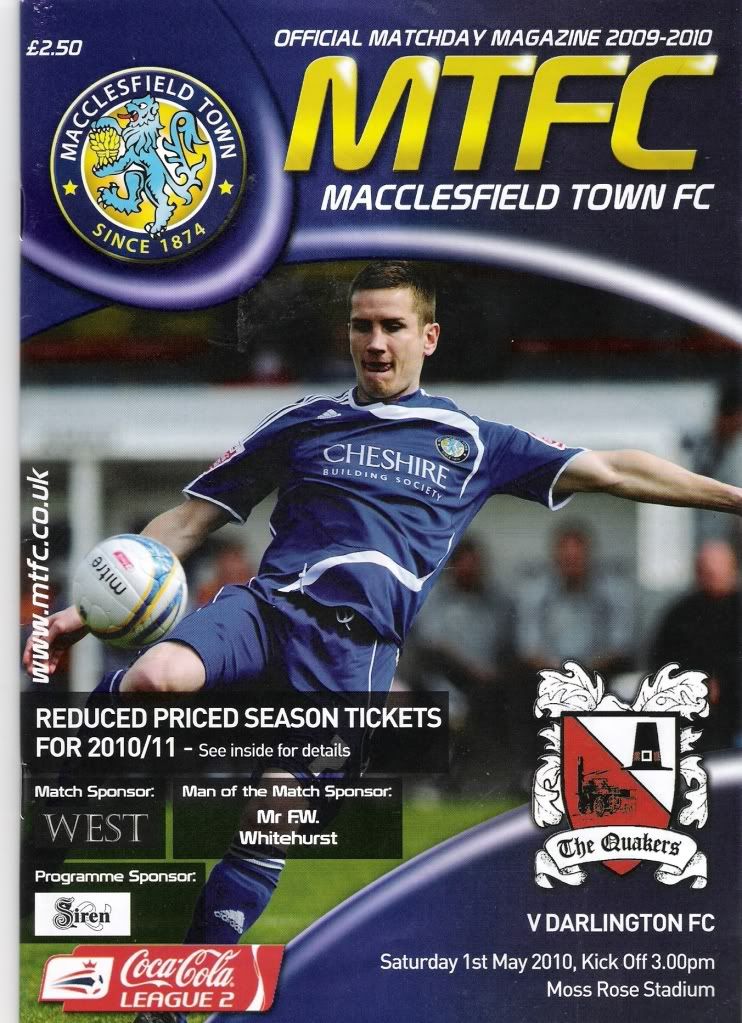
Programme £2.50

Saturday, May 1, 2010

My Matchday - 251 Moss Rose

Macclesfield Town 0v2 Darlington
League Two
Saturday 1st May 2010


Macclesfield is a market town in the east of Cheshire on the River Bollin, located close to the county borders of Greater Manchester, Derbyshire and Staffordshire.
Macclesfield is know as the “Silk Town” as it was once the worlds biggest producer of finished silk but it is also nicknamed “Treacle Town” The treacle link is believed to come from an incident when a wagon overturned spilling a load of treacle on Hibel Road, the town folk rushed out to scoop the treacle off the cobbled street into jugs and bowls. Another treacle explanation is that mill-owners used to provide barrels of the brown sweet sticky liquid to the unemployed weavers.


I’ve always known the town as “Macc” due to the infamous local punk/rock ban
d The Macc Lads, the self acclaimed " rudest, crudest, lewdest, drunkest band in Christendom",
If your unaware of The Macc Lads music, I would describe them as rude, filthy, sexist, homophobic and politically incorrectable, but they do bang out one hell of a cracking tune! Their lyrics mainly involve around pulling crack(women) chips and gravy and drinking lots of beer, particularly Boddingtons Bitter (Boddies) as in one memorable lyric from Barrel’s Round “You've got veins in your bodies but we've got Boddies in our veins, we‘ll out drink anybody then we‘ll go and do it all again”
.
The person responsible for getting me into such a vulgar band was Pete, a lad from Crewe who I met while on holiday in the Costa del Sol in 1989. We, as in ourselves and our female partners at the time stayed in touch, swapping visits between Cheshire and Tyneside over the next four years, before life changing events meant we lost touch with one another.
The beauty(or curse)of www. is the possibility to reunite with lost friends and family. So with special thanks to Pete’s ex-wife Anne I was delighted to receive an email on Friday night from Pete, arranging to meet up in Macclesfield for - as The Macc Lads would graciously express it “Give me alcohol, Give me alcohol, Don't want a pie or a cornish pasty, Give us a pint or I'll turn nasty, Gimme gimme gimme gimme gimme gimme alcohol”

After catching my train connection from Manchester I arrived in town at 12.45. I headed straight to the GBG recommended Market Green Tavern, before meeting Pete (after a bit of a mix up) in the Society Rooms Wetherspoons pub. It was great to catch up after all these years for a bevvy and hopefully we’ll meet again next time I’m in the north west. Unfortunately there was no “Boddies” to be had, but some great ales in the pubs and especially the Nags Head after the game.
Macclesfield originated from a rugby club in 1874 and began playing in The Combination league at Moss Rose from 1891. The original club went bankrupt in 1897, so Hallfield FC took over the ground, subsequently taking over the town’s name in 1904 and later joined the Lancashire Combination League.
Moss Rose first major work came in 1906 with the construction of a timber main stand with cover added on the opposite terrace and a dressing room block situated in the pub corner of the ground.
The Silkmen became founder members of the Cheshire County League in 1919, winning the first of six titles in 1932 with further honours in the League and Senior cup competitions. It was in the Cheshire Senior Cup which produced the grounds biggest attendance of 9,003 on February 4th 1948 for a 2nd Round tie with Winsford United.

The club had the Town suffix added in 1966 and one year earlier the ground’s first floodlights were installed, switched on for a fixture with Northwich Victoria which attracted a crowd of 3,200.
The old grandstand was replaced in 1968 as the club became founder members of the Northern Premier League after winning their final Cheshire League title. The club became inaugural winners of the league, then the following season they retained the title and added another first to the record books, as FA Trophy winners at Wembley in 1970. The club are currently celebrating the 40th anniversary of being the first winners of the competition, honouring which is regarded as The Silkmen’s greatest ever side.
Promotion to the Conference was achieved after winning their third NPL title in 1986-87, but further promotion to the Football League was denied when winning the league in 1994-95 due to ground grading guidelines. The only work undertaking during this period was new offices, changing rooms and in 1988 the grass banking was replaced with terracing behind one goal and around the stand, also a new Social Club was opened in 1990.
Moss Rose was deemed fit for League football only three years earlier after only minor alterations allowed Chester City (RIP) to ground share after vacating Sealand Road, while the Deva Stadium was under construction. However new tighter ground grading rules meant Macc had to wait another two years, after securing a second Conference title, following on from a second successful trip to Wembley the previous year.


Macclesfield Town hosted League Football for the first time with a 2-1 win over Torquay United in August 1997, a season which concluded with instant success as runners-up and promotion to the third tier of English football.
The Silkmen were relegated the following season but have managed to maintain their League Two status, even though it’s been an annual struggle to survive.
In February 2008 Keith Alexander replaced Ian Brightwell as boss until the end of the season, steering the club clear of the drop with four wins and three draws in the nine remaining games and was rewarded with a 2 year contract.
Keith Alexander suffered a double brain aneurysm in 2003 when manager of Lincoln City.On 2nd March 2010 Keith arriving home from the League Two match at Notts County feeling unwell, he collapsed and was taking to Lincoln Hospital where he died shortly afterwards at the age of 53.
The club and team responded positively to such tragic circumstances, winning what would have been Keith’s 100th game in charge at Hereford the following Saturday and have continued to pull together with a string of good results, which is an honour to his memory and which would have made “the gaffer” proud.


This season Town have had a stress free end of the season as far as flirtation with the bottom two is concerned, while opponents Darlington have remained as the strongest club in the Football League (as they hold the rest up…Eddy) staying rock bottom throughout the campaign, but surprisingly relegation was only just officially confirmed in their recent away fixture at Rochdale.
It was the visitors who won the game at a canter in a typical end of season game, a headed goal in each half and even a missed penalty didn’t but a dent on such a confident performance.
Darlington took the lead in the ninth minute, a free kick from the right was headed home by skipper Miller via the underside of the bar.
The best Macc-attack in the first half came just before the break, a Tipton cross was met by a powerful header from Brown who should have done better from close range.
Darlo had a chance to double their lead early in the second half after a soft foul on Mulligan gave Convery a chance from the spot. The penalty taker tried to be clever by trying the old John Aldridge hesitant shuffle trick, but the keeper got down well to save at his left post.
Macc tried in vain the grab an equaliser, the best opportunities falling to Hessey and Sinclair but Darlington sealed their fourth away win out of the last six games when Smith got on the end of a Convery cross the round off a good days work for Darlo.


I agree with the consensus that Moss Rose still has a Non-League feel about it, but that's part of its charm. As you approach the ground from the town via London Road, you can clearly see the spectators at the back of the terrace and in the Main stand.
The Silk FM Stand has 563 red and black seats. The blue frontage roof has MFC in large white letters and the clubs lion crest. The stand has glass wind shields with terracing at each side. In the corner is a police control box with an electric scoreboard perched on top.(which on this occasion wasn’t working)
The Alfred McAlpine Stand was opened in 2001 and has a single tier of 1,550 blue seats with executive boxes running full length. The stand has a suspended TV gantry and the club shop, main offices are situated within the stand.
The Silkmen End is a bit different, a mixture of seats and terrace, five rows of blue seats with the standing area at the back. The reason for the added 486 seats was to bring the ground up to the minimum seating requirement for the Football League, with a total of 2,599 amongst the total capacity of 6,335.


The Star Lane end is a basic open terrace with blue crash barriers. Even though I have no real affection for Darlington, for photography reasons I stood on the away terrace amongst the Darlo fans.
Next season Darlington will be north east derby rivals with my non league team Gateshead in the Conference. The new rivalry seems to have already got underway with Darlo fans chanting “If your going to Gateshead clap your hands” quickly followed by “We hate Geordies and we hate Geordies” Although they did make me laugh after the official attendance of 1,716 was announced responding with “Your grounds too big for you (repeat to fade)” Well I suppose it takes one to know one!
I had an enjoyable day out in Macclesfield, which was made that extra special by meeting up with a long lost friend who I hadn’t clapped eyes on for 18 years. I suppose the only disappointment of the day was the legendary Macc Lads pub ‘The Old Bears Head’ is no more and there was no sign of Hectic House Records on Sunderland Street either. But I’ll leave it to The Macc Lads to sum up my matchday
"The weekend is coming and its time for a bath We're going to sup some Boddies and we'll have a good laugh" (I'll have to stop there, as the rest is unprintable.)


Matchday stats
MTFC 0 DFC 2(Miller 9 Smith 78)
att.1716
Admission £14