Showing posts with label Yeovil Town. Show all posts

Tuesday, April 26, 2011

My Matchday - 282 Huish Park

Yeovil Town 2v2 AFC Bournemouth
League One
Saturday 23rd April 2011

The second leg of my Easter treble was a day trip to the vibrant market town of Yeovil situated on the southern tip of Somerset.
The town was first recorded in the Domesday Book as Givle, a thriving market community with a population of around 1,000. In 1205 the town was granted a charter by King John and by the 14th century had gained the right to elect a portreeve.
From the nineteen century Yeovil became a centre for the glove making industry as the town’s population rose, achieved borough status in 1854 and electing its first mayor.
In recent years the town has achieved a few firsts, being the pioneers in launching biometric fingerprint scanning in nightclubs and the first Council to ban Heeleys roller shoes, as well making skateboards, roller blades and skates illegal. (spoil sports!)

Yeovil Football Club formed in 1890, sharing their original home with the local rugby club before relocating to Pen Mill Athletic Ground, however the present club originated from Yeovil Casuals who formed in 1895.
The club became Yeovil and Petters United when amalgamation with Petters United before finally adopting the Yeovil Town name from 1907.
The club played at The Huish between 1928 and 1990, which was famous for its 8 foot side-to-side slope and the scene for the biggest FA Cup giant killing of all time, when the Southern League side beat First Division Sunderland in the FA Cup 4th Round in 1948/49 in front of a 16,318 record crowd.

The Glovers won the Southern League title on three occasions and in 1979 became founder members of the Alliance (Conference) League. The club had spells in the Isthmian Premier after suffering relegation, but after winning promotion in 1996-97 the club made rapid progress culminating in a place in the Football League after clinching the 2002-03 Conference title.


Built in 1990, at the time Huish Park was the country’s largest new non-league ground in decades, set in the Yeovil suburbs with the old slopping pitch at The Huish covered by another Tesco superstore.
The Cowden and Agusta Westland Community stands are similar in design, both cantilever single tiered stands decked out with green seats with white lettering. The differences are the former has a control box, press area and disabled sections while the later has executive boxes along the back, players tunnel and dugouts.
Away fans are housed in the Copse Road Terrace which is an open terrace and opposite is the Blackthorn Terrace which is fully covered. I stood on this terrace for the game and must mention the in house band that generates a good atmosphere in the ground, amongst their ranks is a very impressive trumpet player, who does a great rendition of the ‘Rocky’ theme.
There’s electric scoreboards on three sides of the ground with the largest behind the away terrace and in each corner there is a set of tall floodlight pylons.
The current capacity is 9,665 (Seating 5,212) and the record attendance is 9,527 v Leeds United for a League One clash on 25 April, 2008.

Yeovil came back from a man down and a two goal deficit to clinch a point with an injury time equaliser from Shaun MacDonald.
The Glovers faced an uphill battle after ex-Toon defender Paul Huntington was sent off for two bookings early in the second half
Bournemouth took command, going in front through a Danny Ings' penalty after Nathan Smith fouled Adam Smith, then Ings looked to have clinched the win when he swept home a Liam Feeney's cross on 68 minutes.
With ten minutes remaining the visitors confidently made three substitutions in readiness for the pending home fixture with Bristol Rovers in 48 hours, but somehow collapsed in the final five minutes
Yeovil's Adam Virgo converted a penalty after Harry Arter's handball, then sub Fletcher could have restored the two goal cushion at the other end. before conceding a corner a minute later. From Craig Alcock's corner kick MacDonald rose highest to head the ball home and earn The Glovers an unexpected draw.

The drive up from Dorset took around an hour. I dropped the breadknife and the kids off in Yeovil town centre then headed straight to the ground to secure a decent parking spot, giving plenty of time for a pint of ‘Green and White Ale’ and a deliciously filling Cornish pasty in the marquee beer tent at the stadium.
I also met another member of the 100FgC for the first time before kick off - Squad#151 Jon Blake. Jon is a Bournemouth support who now resides in South Shields but was down visiting family in Christchurch, and like me, was also going to Dean Court on Monday.
Debra(aka the bread knife)thought that Yeovil was a smashing little town and apart from a mini riot involving Bournemouth fans outside Wetherspoons, they had a pleasant afternoon(..and not a skater boy to be seen…Eddy) It’s a pity I didn’t get the chance to see the town for myself but I still had a smashing afternoon in Yeovil, where I saw an entertaining game of football at Huish
Park.


Matchday stats
YTFC 2(Virgo 86pen MacDonald 90+3) AFCB 2(Ings 55pen 68)
att.6,150
Admission £18(terrace)

Tuesday, April 6, 2010

My Matchday - 247 Roots Hall

Southend United 0v0 Yeovil Town
League One
Saturday 3rd April 2010

Southend-on-Sea is a district borough and seaside resort in Essex. The borough covers the districts of Chalkwell, Eastwood, Leigh-on-Sea, Shoeburyness, Southchurch, Westcliff-on-Sea, Thorpe Bay and of course Prittlewell - which is where you’ll find Roots Hall - the home of Southend United.
The town has the worlds longest pleasure pier, stretching 1.34 mile and is a popular destination for “chirpy cock-a-nees” looking for a day away from the smoke for a spot of sand, sea air and fresh jellied eels.


Southend United have played at Roots Hall since 1955, although they originally played on the same site almost 50 years earlier.
The pitch was within the grounds of an 18th century house called Roots Hall, first used by Southend Athletic until the ground was taking over by the newly formed United in 1906.
Plans for United to purchase the ground were halted by World War I, the land was used for storage to aid the war effort, so when the club reformed after the conflict they moved to a new home on the sea front beside the amusement park, known as The Kursaal.
United joined the Football League in 1920, playing at the Kursaal until 1933, leaving after the opportunity arose to move to The Southend Stadium, the town’s newly built greyhound stadium.
When the lease was due to expire at the greyhound stadium, the club looked at a return to their roots at Roots Hall, which was now a being used as a rubbish tip.


A trust fund was set up in 1950, involving the mayor, the club board and supporters club with the aim of raising £11,258 to purchase the land from the local council.
In March 1953 work finally began, mainly thanks to donations of building materials and voluntary labour from the local community. After five years of negotiations and hard work The Shrimpers finally played their first game at Roots Hall on the 20th August 1955. The Division Three South fixture against Norwich City was watched by a crowd of 17,700.
The ground once opened became a work-in-progress for a number of years. The West Stand roof became double-barrelled and extended in length in 1956, floodlights were added in 1959 and the man made 72 step South Bank kop was finally completed in 1964.
In the early days the main problem was the drainage of the pitch, which was built upon thousands of tonnes of rubbish which meant the surface became a swamp in the winter months, so prior to the 1956-57 season the pitch was re-laid with a new drainage system which is still in use today.

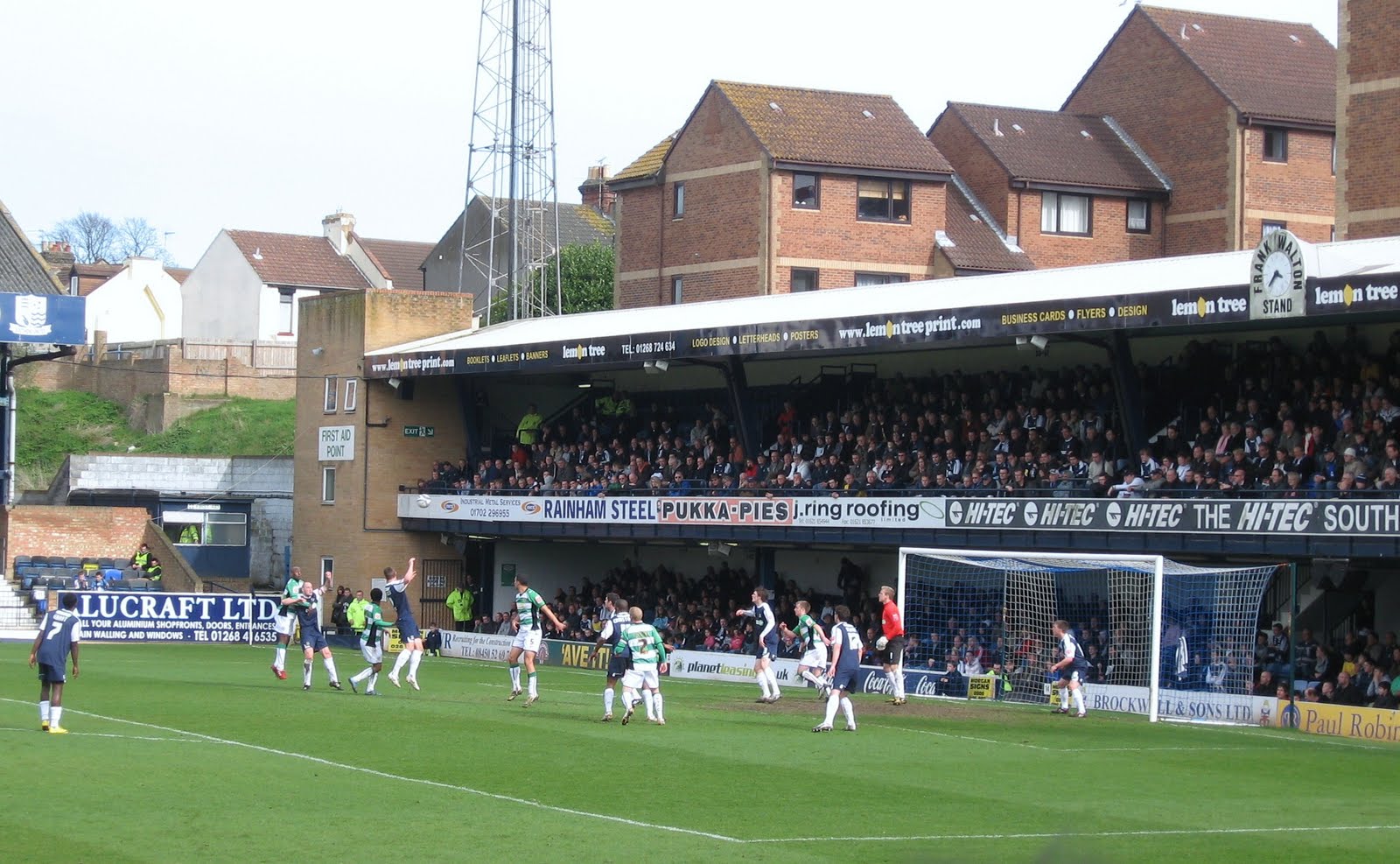
The Main East Stand didn’t run pitch length until 1967, the lower standing paddock was replaced with seats in 1992. The stand has a pitched roof with executive boxes along the back and two glass press boxes in the centre above the pitch entrance. There isn’t any dugouts, just a few seats with a small section of seats for subs behind a brick wall.
I sat in the West Stand which became all seated in 1992 with blue plastic flip seats with SUFC picked out in yellow. The stand has its own bar at the back and once inside you can clearly see the two sections of barrelled roofs and how it was extended in 1995 to meet the North and South Stands.
In 1988 the South Stand terrace was reduced to make way for a property development with 86 flats going up behind the terrace. The flats look over towards the North goal but I never noticed anyone taking advantage of a free view of the game. In 1994 it became all seated with a new double-decker stand. The seats are equally divided between blue and yellow with the top tier slightly overhanging the bottom section with the Frank Walton Stand clock perched centrally on the top deck roof.
The North Stand had seats bolted on to the terrace in 1995. The stand is shared between the Southend singing section (and drummer) in the yellow seats and the away fans in the blue seats, there’s also an electric scoreboard directly above the goal.
Roots Hall at its peak catered for 35,000 spectators, with over 15,000 on the old South Bank Kop, the record attendance stands at 31,090 for an FA Cup third round tie with Liverpool in January 1979.
I arrived in Southend at around noon. As I approached the ground from the south end I bumped into a club official, who let me take a short cut through a locked gate next to the neighbouring flats. I asked him if it was at all possible to gain access into the ground to take pictures. He said he’d see what he could do but I told him to tell whoever was in charge to use the “I’ve come all the way from Newcastle” line, which never fails.
Minutes later a gentleman appeared from the office who looked like he was ‘the gaffer’ saying “Are you the one from Newcastle?” before letting me into the ground to snap away at my hearts content before meeting in front of the Main Stand, taking a picture of me in the stand and walking back through the exit via the players tunnel.
My ten minutes free time inside the ground was my Roots Hall highlight as the action on the pitch a few hours later failed to live up to the big relegation six pointer.
Southend’s good scoring run of eight goals in the last three games dried up in front of your truly. The game was open with both teams trying their best to play good football, however it was in the last third where it all went wrong as both defences had a trouble free afternoon.
Southend’s biggest threat came from Johnny Herd’s long throw-ins and substitute Francis Laurent did his best to open up the Yeovil defence with his long mazy runs. The best chances fell to the visitors late in the game with efforts from Welsh and Smith producing good saves from Mildenhall.
The Shrimpers won’t be happy dropping valuable points at home with their last remaining fixtures including some tough away games, but there’s also some winnable home ties where maximum points are a must in their bid to avoid the drop.


This years Easter break was spent in a part of the country which was previously unexplored by the Smudgers. We travelled from north-east to the south-east down to the Essex coast, staying in Clacton-on-Sea. As we were in the area I thought it would be a good idea to bag the two League grounds in that part of Essex; the two United’s in Southend and Colchester. So did these two games over a family weekend away happen to be a coincidence or maybe a piece of good planning on my part? …Well what do you think? Those who know me will know. ;-)


Matchday stats
SUFC 0 YTFC 0
Att.6,854
Admission £22

Saturday, July 29, 2006

My Matchday Pics 2006 -109 Recreation Ground

Chesterfield 0v3Yeovil Town
March 4th 2006
Football League One

att.4843


Formed in 1866,Chesterfield are the fourth oldest football league club,and have played at Saltergate's Recreation Ground since 1884 having moved from their previous residence nearer the town centre called Spital,but football has been a feature on the Recreation Ground as way back as 1870.

Saltergate was the last league ground to install floodlights after an appeal fund was set up in 1964 to raise £10,000,with the aim to have them installed for the clubs centenery in 1966.The Spirites purchased pylons from Sheffield United but were found to be unsuitable for Saltergate so these were sold on to Stafford Rangers and new floodlights were purchased,and the Recreation Ground were finally switched on in October 1967.

The Recreation Ground has a capacity of 8504 and is a bit of a blast from the past,which I'd describe as a good old fashioned ground.After a few pints of local Derbyshire bitter I arrived at the ground in need of the toilet.I found a sign saying 'Toilet' but what I entered was a wall to pee on,with a slight slope to help your wee on it's way down to the drain!!

I sat in the Compton Street end,which is also known as the Popular Side which is now an all seated stand,and is partly covered(if you sit at the back)and has supporting pillows which can restrict your view,depending where the action is on the field.

To my right is a terraced 'cow shed type' Spion Kop where the Spierites are housed.To my left was the Cross St. Terrace where the away supporters are left open to the elements and facing me is the Main Stand,which is a bit of a rust bucket and could do with brightening up a bit.

After being treated to the delights of Peter Kay's(or was it Tony Christie's?) version of 'Is This the Way To Amarillo 'as the players entered the field,I was then treated to an entertaining game,in which the away side came away with a convincing 3-0 win,much to the annoyance of several irrate fans sat around me.

There are plans to relocate to a 12000 capacity purpose built stadium at Wheeldon Mill in 2007,so I was pleased to cross the old ground off my list while I still had a chance to attend there.Saltergate is a bit of a 60's throw back,and a reminder of what football grounds used to be like,and due to this fact I absolutely loved the place.