Showing posts with label birding in Honduras. Show all posts

Thursday, April 28, 2011

Birds of Cerro Azul Meambar


 Oh, that cooperative collared trogon. What a beauty he was. The first painting I saw that made me want to be a bird painter, that made me think I could really do it, was by my friend Alex when I was a freshman in college. It was of a collared trogon. So, while appreciating the bird, I blasted back in memory to that moment, seeing the way he'd laid a shadow across its tail, and realizing I could probably do that, too.
A lot has rolled out from that little epiphany.


There were some mighty fine smaller birds at Cerro Azul, too, and we had nice sunshine and drier air to enjoy them. Here's a golden-hooded tanager, Tangara larvata. 


Let's have another look at that little beauty.


He was eating some tiny green fruits, balancing on the hair-fine twigs.

One of the big attractions of Cerro Azul Meambar is its hummingbird feeding station. Feeders are rigged up under the eaves of the visitor center. And we parked ourselves there and feasted our eyes.


Byron snaps a long-billed starthroat at close range.


White-bellied emeralds were confiding and common.


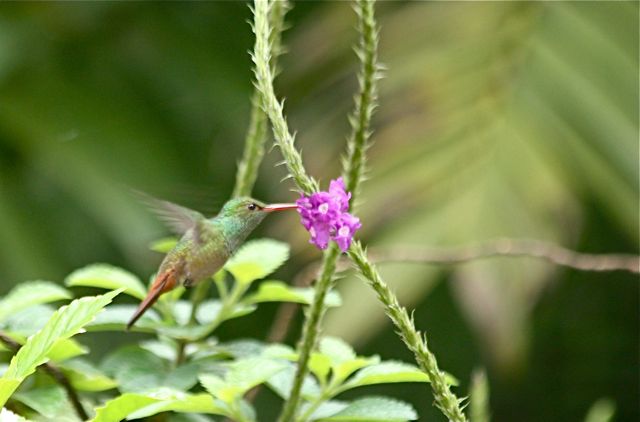
Much as I loved banging away at the feeder hummingbirds, I yearned to capture images of them in natural surroundings. So I wandered off to a patch of verbena and was well-rewarded by a cooperative rufous-tailed hummingbird.


Ahh. There's the shot I was after--feeding at real flowers!

A devilishly quick and difficult bird to capture is the long-tailed hermit, with its spectacular streamers. When it flies by, your brain just can't figure out what you've just seen, with these white dingies streaming out behind it and that scimitar bill before. It really wouldn't need the bandit mask.


But the jewel of Cerro Azul Meambar, the one they all come for, is the spectacular Violet Sabrewing. It comes thrumming into the feeders like a chimney swift, and by some miracle of iridescence it is purple in all lights and at all angles, not that frustrating blackish that so many hummingbirds seem to show.


This is a huge montane hummer, something like 6-7" long. Its wings make a correspondingly impressive low hum, so you know when it's around, and your heart just leaps.

I maneuvered around until I had the violet sabrewing against a soft green background; I wasn't wild about the babypoo yellow of the building as a backdrop for that glittering jewelbird.


Thank you, Violet Sabrewing.

Not far from the visitor's center, we ambled over to see the deluxe guest cottages under construction at Cerro Azul Meambar National Park. They were lovely, and the new lights outside attracted the most fabulous orthopterans and moths, a phenomenon that had not escaped this turquoise-browed motmot. He was cleaning up after the night's luminary siren had called innumerable large insects to bash themselves against the wall.


Mmm, katydid.


 glug glug glug

Works every time. Ahhhh.

The next day, on the way down, I grabbed one of my favorite shots from the trip through the bus window. Catch the ears on that little boy.


Tuesday, April 26, 2011

Corey and the Trogon

 I told you all that I was a real snapshot artist on this trip. Because I am easily nauseated when conveyed in diesel buses on winding mountain roads while fighting dysentery, I usually score a front seat. The cost of not giving me a front seat on a diesel bus on a winding mountain road is steep.

So I amuse myself and try to take my mind off my periodically rising gorge by shooting snapshots out the windshield. It's also a good place to spot birds. On this morning we were headed to Cerro Azul Meambar National park, a fabulous montane forest habitat just full of great birds. First, though, we had to negotiate an extremely steep road that was in the process of being paved. They only pave two tracks, where your tires go. I'm not sure what the advantage is--using less cement? It seems like having to make four forms would cancel that out, but what do I know? These dogs figured we weren't going to make it for awhile, so they were free to rest on the track.


Of course, we got stuck and everybody had to get out and help push the bus. Corey Finger and I had already gotten out to walk up, since we were more interested in birding than sitting on a stuck bus.

I was pleased to see that Homo sapiens var. Bubba  is distributed not only through the American South but all the way to Honduras. Bubbas are attracted to car trouble, and there is a lot of that in Honduras, hence a lot of Bubbas.  Floridacracker, this one's for you. Because it makes me laugh every time I look at it.


The one thing that struck me most about Honduras was that everyone walks. No matter where you are, how far out in the middle of nowhere, there are people gamely walking to destinations unknown. They can't afford cars. The lucky ones might have a horse or donkey, or grab a ride in an overstuffed pickup bed. There are very few cars per capita in Honduras. You'll see commercial vehicles like this truck, but very few personal cars.


There would have to be a street fair going on in the US for a road to be this deserted, peopled only by...people. It is amazing, and I never really got used to being whisked by people patiently walking in the hot sun. I wanted to give them all a ride in our bus.


Especially this man, who was carrying a chainsaw on his shoulder.  Up a mountain. Ye gods. We are sooo soft in America. So soft. Note that he also has a bumbershoot, because he can virtually plan on getting rained on before he gets to wherever he's going. He doesn't even have a pad between the metal and his flesh.


We passed plantations of tropical houseplants, like these red variegated dracaenas.


Children played in the yards, and I wondered where or even whether they attended school.  I'm telling you, Honduras is a whole different scene. It is well worth seeing--it will blow your mind.


Finally we reached Cerro Azul Meambar, having thoroughly enjoyed the sights along the way. The first bird to greet us in the parking lot was a collared trogon! Corey Finger did almost lose his mind. It was his first trogon on his first Neotropical birding trip, and he may be forgiven for jibbering. The collared trogon is a jibberworthy bird.


I caught him pole-dancing with his tripod, trying to get a good digiscoped shot. Oh my.


 Like I said, the sights along the way were worth the trip alone. 

 Less lambada, more trogons and hummingbirds anon.


Thursday, April 21, 2011

Shade-Grown Coffee Birds


 So many birds flitted and foraged through the shade-grown coffee plantation it was hard to focus on any one, but this black-throated green warbler got right up in my grille, so he won for awhile. I took so few truly decent bird photos in Honduras, thanks to rain and generally dark conditions, that I reveled in having a cooperative subject in good light. 

 Ironically, I wouldn't have been in this shade coffee plantation had I not been struck by Montezuma's Revenge (probably from brushing my teeth in tap water, duh duh duh). 
Why did I think toothpaste had antibacterial properties? It doesn't. So y'all, when you travel in Latin America, brush your teeth and rinse your toothbrush in bottled water. And take Immodium with you.

At any rate, I was actually happy to stay behind from the field trips at the first MesoAmerican Birding Festival, and potter around (well, that's an unfortunate choice of words) near the hotel.


I was floored by the beauty of this keel-billed toucan with the sun coming through his underdrawers.


 He showed off that acrobatic toucan stuff I love so much. Two other birders staying at Hotel Las Glorias witnessed workers in the shade coffee plantation using slingshots to shoot large rocks at the toucans overhead, which may explain why this bird was scolding me so lustily. I was horrified when I was told that one had succeeded in hitting a toucan in flight, which dropped several feet but kept flying. Their intent? To injure one and bring it to earth, where they could catch it and sell it to a zoo or for a pet. 


What greater abomination could you visit on a bird of the treetops and hot blue sky? Displayed for sale in the gift shop at Hotel Las Glorias were slingshots exactly like those I saw tucked into the knapsacks of its coffee plantation workers. Honduras, as a country, needs to be shown that its birds are worth far, far more on the wing than in filthy cages. If you go, and I hope you do, check that gift shop and ask the proprietors why they have slingshots for sale, if they still do. We did, and our festival participants made a lot of noise about their toucan-shooting employees. We made it clear that's not cool if you want to cater to birdwatchers. Bad form for a host hotel of a birding festival. 


I hope this big beautiful bird still has the sun shining through his wondrous bill.

Another malevolently sweet ferruginous pygmy-owl basked in rare sunshine on a long branch.


I watched and waited, wanting to photograph the back of its head.


Finally I got a profile, but not quite what I was after.


Here's the best I could do. FEPO's, like several other small owls, have marvelous false eye spots on the back of their heads. The "eye" even has a white eyebrow! This is thought to help the little owl when it's being mobbed by other birds--maybe they back off if they think both sides of its head are looking at them. Because the FEPO includes songbirds in its diet, it's not well-liked among the feathered tribe, and being a diurnal hunter, it gets a lot of mobbing grief from its prey. 


That prey might include "our" magnolia warblers, which are common as beans in the shade coffee plantations. Again, I had the distinct feeling I was being petitioned to spread the word about buying and drinking shade-grown coffee. Although I've not drunk coffee since before Phoebe was born (you don't put caffeine in a shrew, do you?), I was blown away by the velvety-smooth, rich taste of shade-grown coffee in Honduras.


Want to find certified bird-friendly coffee for sale near you? Follow this link to the Smithsonian Migratory Bird Center's map of US retailers.

Tuesday, April 19, 2011

Shade-grown Coffee

I'm sure most environmentally conscious readers have heard of shade-grown coffee; know it's better for birds and the environment. But I'd bet that not many of y'all have walked in a plantation. I'd like to take you along on my morning in a Honduran shade coffee plantation at Finca Las Glorias, near Lake Yojoa in Honduras. What fun it is to be able to do this!

Coffee, a shiny-leaved tropical shrub, was originally a shade-tolerant plant. Artificial selection produced a sun-tolerant plant with higher yield, and the traditional method of growing coffee under an understory of native shade trees was largely abandoned in favor of widescale deforestation for sun coffee plantations. Oh, and heavy pesticide use, since the sun-grown coffee was thought to require that. This was devastating to migratory and resident tropical birds, which had been happily foraging and living in shade coffee plantations all along. Migrants returning to their shady haunts were greeted with green ecological deserts of sun-grown coffee and nothing else.


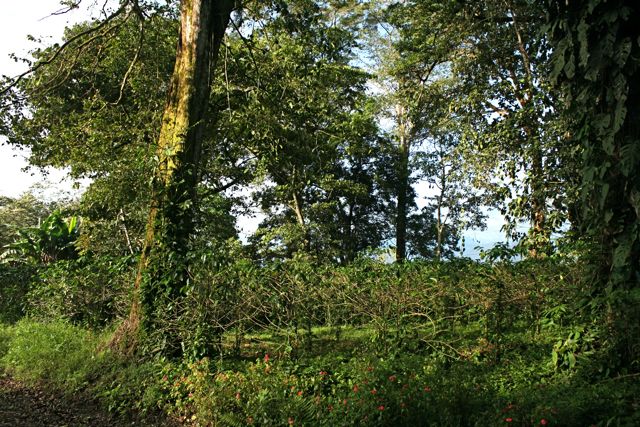
Does this look like a desert to you? Does it even look like a farm? Well, it doesn't to the birds, either. This is a shade coffee plantation and as a birdwatcher, I can attest it's a wonderful place to be.

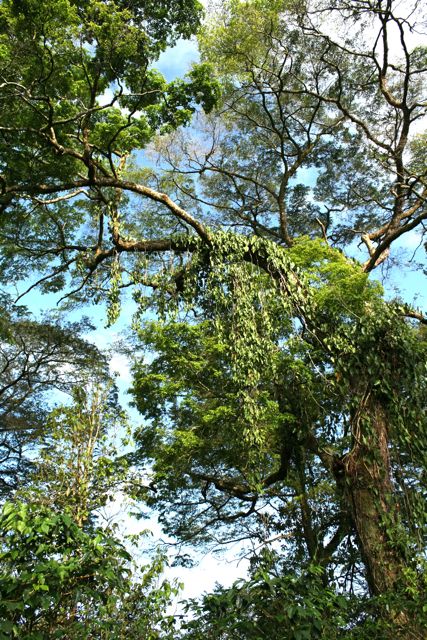
 Look up, and there are towering forest trees making a broken canopy


Look down, and there's a heavy understory of fruiting coffee.

 You can just make out the rows of coffee shrubs in this shot. Look at the size of those trees! They were growing here originally when the understory was cleared and planted to shade coffee.

 This is one of the most enticing birding roads I've ever walked.

 I kept looking up and spinning slowly around, seeing resident tropical birds in the canopy overhead


 and sweet North American migrants like this black-throated green warbler in the coffee underneath.


 They seemed to be asking me to tell everyone that shade-grown coffee isn't just a "green" catch phrase. It's the real deal. The plantations are useful--vital, even, to many North American migrants--orioles, tanager, warblers, gnatcatchers, vireos. I'm not sure why "our" birds use shade coffee plantations so heavily. Sometimes I wonder if they have been forced into them by deforestation elsewhere, and being migrants, have to be more flexible in their habitat requirements than Neotropical resident birds.


Which are also well-represented in the plantations. This fine brown jay screamed lustily, a percussive pow! in each call. It sounded like somebody was hitting him with a hammer, forcing the YEAH! out of him.


A fine-looking giant cowbird, nest parasite of oropendolas.  Get this: Neal G. Smith's 1968 study of giant cowbird parasitism on oropendolas showed that oropendola babies with baby giant cowbirds in the nest with them had better survivorship than those in unparasitized nests. Exactly the opposite of what you'd expect, with the cowbirds hogging the food and all... This was because the giant cowbird chicks are, for altricial birds, born quite a bit more with it than are oropendola chicks, and they are able to repel adult botflies and preen botfly larvae off themselves and the baby oropendolas, too. Botflies are true parasites, burrowing into the flesh of oropendola nestlings and weakening or killing them altogether.  The snapping and preening behavior exhibited by giant cowbird chicks toward invading botflies and their larvae is unique among altricial passerine birds.  But, like many stories of tropical biology, it gets weirder. 

Oropendolas that nest near colonies of social wasps and stingless bees get protection from botflies by some unknown mechanism. They don't need cowbirds in their nests. Oropendolas in those colonies  are discriminators, and will toss out any egg that isn't identical to their own. So the cowbirds that attempt to parasitize those oropendolas nesting near wasps and bees have evolved eggs that closely mimic the oropendola eggs, and the female cowbirds that lay those mimetic eggs sneak around and lay them when the oropendolas aren't around.

Female giant cowbirds parasitizing oropendolas that aren't protected by wasps and bees lay nonmimetic eggs, and they barge right in and lay those obviously different eggs in the oropendola nest after chasing off the rightful owner of the nest! These unprotected oropendolas don't discriminate, or throw out the eggs, even though they look different.  And the cowbirds "thank" their hosts by leaving eggs that will hatch into babies that will preen the botfly larvae off the host's young. 

Such is tropical biology, where parasitism can evolve into commensalism in this hothouse of amazing adaptation, where every bug's got a bug on him, which has a bug on him...


Having delightful trouble staying on topic. I never know what's going to come out of me in these posts. More shade coffee anon.

Want to find certified bird-friendly coffee for sale near you? Follow this link to the Smithsonian Migratory Bird Center's map of US retailers.