Showing posts with label box turtle. Show all posts

Thursday, August 4, 2011

Feeding Sluggo


I am delighted to say that after taking his first two slugs on June 26,  Sluggo has expanded his dietary horizons from slugs to fresh cantaloupe, 
strawberries, blueberries, bananas, black raspberries, peaches and Repto-Min turtle sticks (the green things in this photo).

 I encourage him by soaking the Repto-Min in cantaloupe juice, or by pushing the dry sticks into fresh cantaloupe, where he can't help but devour them. Repto-Min is a wonderful complete food, that raises some mighty nicely shelled baby box turtles for me. Every day I put more Repto-Min in his fruit. He cleans it up!


Sluggo's housed in a 20 gallon long aquarium, with moist peat and sphagnum moss and some groovy shallow rock-like dishes just for reptiles. He's right under a south window, which gives him sun for basking. It's important to have water always available. Hurt box turtles often soak all day and night. It makes them feel better. You really have to stay on top of them, though, and keep that water clean, because they like to poopify their water. Choosing to poop in their water actually makes caring for box turtles easier, if a bit disgusting. Overall, it keeps their limited artificial environment a lot cleaner. About twice a day I'm taking sloshy poopified water outside to throw it off the deck. Ick. Worth it, though.


More than a month after finishing his injections, Sluggo's still not using his hind legs much. That's all right. They seem to work, in that he can extend and retract them. He'll get around to it eventually, and I'm not going to rush him. He's had a rough summer. And he still doesn't trust me to mess with his hinders. It takes box turtles a long time to trust someone who's once hurt them (with Baytril injections) but he'll get there. Every day he's a little more outgoing, and he'll eat from my fingers now.


 He can stay here as long as he needs to. I'll take care of him. If that means a year or two, that's fine with me. But we all look forward to the day when I can call the folks who brought him to me and tell them he's ready to come home. He'll be released right where he was found. Minus the lawnmower.


Many thanks to those who chipped in on Sluggo's treatment costs. I wasn't expecting that. Y'all paid for his Baytril, his Repto-min, his Tegaderm, his Silvodine cream and some very nice cantaloupe, and for that I thank you sincerely. You always surprise me, in the nicest ways, and fill my heart.


Sunday, July 31, 2011

Sluggo, You Have to Eat!


One of the scary things about reptiles, at least to me, is that they can go a very long time without eating. And they do. It's never good when a patient won't eat. For someone like me, who loves her charges and her babies, her friends and family with food, it's doubly upsetting.

Every day for two weeks I put tempting food right in front of that turtle. Twice a day. He'd look at it, sometimes even crane his neck, but he stolidly refused to take a bite. I tried bananas, peaches, watermelon, mealworms, earthworms, black raspberries, blueberries and slugs. Slugs are like candy to box turtles.

I went out with my headlamp, breathing the clouds of midges and gnats who were attracted to it, and hunted slugs at night. I put melon rinds out as bait and gathered them, keeping them in a little slug farm in the living room. You have one, don't you? I feed mine lettuce and spent daylily flowers.


These are Arion subfuscus, an imported European slug. Don't ask me why we have imported slugs here. We just do. Not surprisingly, they vastly outnumber our old gray slugs. 

And the turkle would look at them and let them crawl right by. Until the day when I offered two slugs on a nice piece of bark from the forest floor, which was covered with fresh earthy-smelling loam. The turtle's head shot out and he craned his neck and bam! he grabbed a slug. And then a second.


I was so excited I took these photos from across the room with my 300 mm. lens, just to document this Gandhi of turtles, digging in. He was so skittish I couldn't let him see me.

After that magic moment, no slug was safe around Sluggo. My theory is that the scent of fresh loam reminded him of home, and stimulated his appetite. 


Goo-byeeeee!

I was one relieved turtle nurse when Sluggo finally lived up to his name.


Thursday, July 28, 2011

Meet Sluggo


I have kind of an unusual Ohio wildlife rehabilitator's permit. It's for songbirds, bats and reptiles, specifically box turtles. Boxies get on the wrong end of our machines more often than I'd like to see. Cars, well, they usually don't survive an argument with a wheel. Lawnmowers are bad, too. Turtles' shells often save them, but lawnmowers can inflict some truly grievous injuries.

This handsome older gentleman came to me in late June 2011 from a wooded yard in Athens, Ohio, where the caller had accidentally hit him with a rider mower. I hate getting turtle calls because it's so hard to gauge how badly hurt the animal is from a verbal description. Is he bright? Crawling? How big is the wound? Where is it? Any limbs missing? That kind of thing. I still shudder when I remember the female boxy a couple of sweet young hippies brought me. They were very vague on the phone. Her shell was in pieces, apparently. "Yes, all the pieces are there." What they neglected to tell me, because they wanted so badly for me to somehow wave my wand and magically fix this hurt animal, was that the pieces were no longer connected to the turtle. They were rattling around in the shoebox with her. 


I could instantly see that this turtle had a better prognosis. Hey, he had a prognosis. What you're seeing here is not exposed flesh but pink shell bone, crushed and compressed, with the colored scutes knocked off. Oh, it had to hurt. The callers had done just the right thing--cleaned him up with some disinfectant and put Band-aids over the wound until they could bring him to Marietta. I took the Band-aids off and soaked a paper towel in Betadine, and let him crawl around  while the disinfectant soaked the grass and dirt loose.


Part of the protocol for turtles with bad shell wounds is eight days of Baytril (antibiotic) injections, at about $10 a day. Ouch for turtle and rehabber. These are administered in the back legs, one every other day, with a very fine needle. Still, it hurts, and the turtle purely hates it. This is the second boxy I've had who learned within a day to keep his hinders tucked and to crawl away from me using only his front legs.  That's what he's doing in the photo above--booking with his hind legs tucked.


I picked all the grass and dirt off, washed him, disinfected him again, and let him dry. I couldn't even budge the smashed-in shell pieces so I decided to let them heal as they were. He still had control over his back legs, though they and his tail were quite bruised, and I thought I could probably do more harm than good by messing about with the shell. 

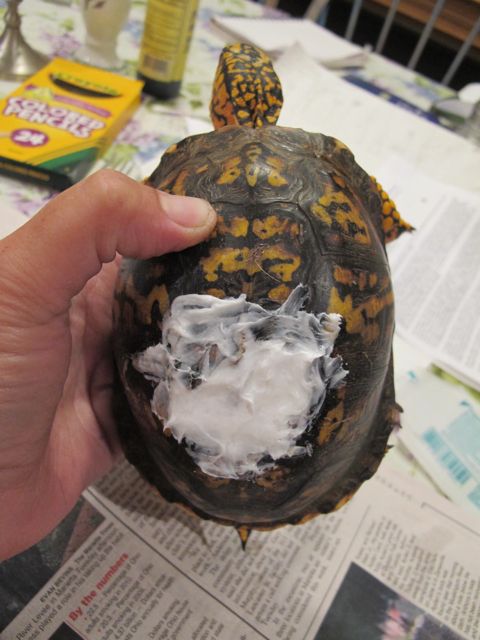
Time for some spackle.


The white Crisco-like substance is Silvodine cream, an antibiotic cream for burns and deep wounds. I packed the wound with cream and got some Tegaderm, which is a surgical membrane that acts a bit like skin. Silvodine, unfortunately, needs a prescription, but Chet's veterinarian, Dr. Lutz, was happy to help with that and the Baytril, too.

Peeling off the white backing and laying the clear Tegaderm over the cream. It's adhesive.


Smoothing the Tegaderm.


Better. Not all better, but on the road to recovery without risk of infection.


Next: Sluggo, you HAVE to eat something.


Friday, July 8, 2011

The Golden Turtle


Run in the rain and
You'll find the golden turtle
Treasure of treasures.

Those of you who follow me on Facebook know that for the past year I've been writing a lot of haiku. They're direct outgrowths of the process of running. I'll have been running a year on July 30. I run 7 days a week, weather and travel permitting. I'm on my third pair of running shoes. I liken the Runner's Haikus to work songs. They take my mind off the heat and humidity, off the deerflies and the weight of my body as I force it up the hills and down the hollers.


 There are rewards for the running. This morning as the rain dripped off my hat brim and soaked my shoes I found The Golden Turtle, an old female who's weathered some hardship. All the toes but one are gone from her hind feet, probably courtesy of a short-tailed shrew while she was hibernating. Shrews do worse than that; she was lucky her head and front feet were tucked in.

This calls into question her viability as a breeder. Could she dig a proper nest with soft stubs for feet, without claws? I don't know. I suppose if she found soft sand or very wet soil, she might be able to dig a nest of sorts.

Damn shrews.


I don't like to pick up or move turtles unless I have to, to get them out of harm's way.  It seems disrespectful. So these photos aren't the best, but they're the best I could get without disturbing her unduly.  In this photo you can see her eye, a dull red, hallmark of an older female. 

I left her there by our driveway, and when I came back she was gone. Soft soil and shrewless winters to you, dear Golden Turtle.


Tuesday, May 3, 2011

Morel Hunting: Turtles and Dogs Like It, Too!

In the exquisite timing of spring, morels come up just as the asparagus is ready for cutting--the last week of April.
This patch has been growing for 19 years and we have more than a dozen big feeds off it each spring. It gives and gives and demands little but good mulching.
Last summer I used endless stacks of newspapers, topped and layered with fresh grass clippings. The clippings, raked off the lawn, held the newspapers from blowing away and disguised them from view. Quite a lovely system!  It all melted into the soil, and the spears were a snap to find this spring. 


Of course the chirren aren't the only people who love hunting morels. Chet Baker comes along. He likes to look for turkles in the morel patches, and we have found three this spring.


Here's the turkle Chet found in our sideyard. We'd never had morels come up there before. What a thrill to find 15 of them raising proud heads in a neglected corner of the yard! and the requisite Guardian Box Turtle to go along with them.


Of course Chet is always on the lookout for squirtles and chiptymunks, too. If there is a log, Chet Baker is on it, scanning the woods. 


Bill spotted this gorgeous old gent just crossing a rotted log in a big patch of morels. 
This is not a coinkydink.


Here is a photo of turtle depredation on a half-free morel. Chunks are bitten out of cap and stem. We are never annoyed at this, nor have we ever considered taking action. In fact, when we find turkles in our patches, we leave a morel in front of them as a gift to eat after we've gone.


How wonderful it is to have both in our woods, and both at the same time.


We only rarely pick turtles up when we find them. We watch them through binoculars and let them think we never saw them, then walk on. We treat them like Hollywood movie stars, play it cool; we don't run right up to them and gawk or ask them questions. Unless one seems to have a problem, and then it gets a full exam.


Aftermath of a fine afternoon, prelude to a feast!


Thursday, November 12, 2009

Horse, Turtle, Spider, Beaver

We came upon these friendly horses, and luckily Chet Baker was weary enough at that point to have little desire to round them up for us. Lovely animals. From the decrepitude of their non-electric fencing, we realized that they are free to roam the entire road, and that the piles of horse bockie we'd been seeing were probably from them and not from some local equestrians using the road as an obstacle course.

How nice, free-roaming horses. The best pasture was right here, and they weren't going anywhere.
I find most of my box turtles by hearing them, oddly enough. A steady soft crunching resolves into a turtle, determined to find a few more earthworms before frost.

Its eyes were bright red, traditionally a sign of a male, but its overall impression was of a lady turtle. I debated long and hard over whether to disturb it by picking it up. But the Science Chimp's curiosity won out over respect for its dignity.I noticed that it had had some damage to the rear scutes on its shell, some years ago. They looked either like forest fire--a light burn on the rear part of the shell, which might have been exposed when the flames went over--or perhaps the chewings of a mouse while it was hibernating. Whatever it was had long healed over, leaving only some irregularity and discoloration.

I warned it, spoke gently to it, apologized, and lifted it into the air. Aha! the plastron, only barely scooped out. A female, as I'd suspected.


I can't really explain why this red-eyed turtle looked like a female, even before I saw its plastron. It just did. Darker, smaller, more delicate head; small size, even at this very advanced age (discernable by the completely smooth shell). I was so glad she'd live out her years along this impassable road. All turtles should be so lucky. I left her right where she was, and wished her a good hibernation.

The common mullein was ready for hibernation
with its warm woolens on

and so was the wolf spider, with next year's babies in a ball of eggs behind her


The old familiar beaver pond hove into view

and we found where the beavers had been using a black cherry tree for medicinal purposes. Shila says cherry bark is good for coughs. That sap has got to have powerful properties!

Jewellike hornets tussled on New York asters

a miniature moss landscape rose

and a tiny red maple kept its party dress on well past midnight

Chet Baker was ready to go home at last

but I had to stop to photograph a computer keyboard in the stream, made into a relic by silt and the distortion of wavelets...Fred Flintstone's Mac...

One of my favorite images from the trip. As is this one, crooked horizon and all:


I can't wait until the next hike.