Saturday, March 3, 2012

My Matchday - 309 Pittodrie Stadium

Aberdeen 1v1 Celtic
Scottish Premier League
Saturday 3rd March 2012


For a second successive Saturday, Aberdeen were giving the noon TV slot, this week entertaining champions elect Celtic at Pittodrie. Last week I saw the Dons in action at St Mirren as part of a Scottish groundhopping double and again I was back in northern Britain to take advantage of another early kick-off to bag another two new grounds.


Aberdeen is the third most populous city in Scotland, situated between the rivers Dee and Don on the North Sea coast line. Aberdeen is traditionally home to fishing, textile mills, shipbuilding and paper making. The city is nicknamed the “Granite City” in relation to the grey granite which was quarried at Rubislaw for over 300 years until production ceased in 1971. The stone was used for paving setts, kerb and building stones, and also monumental and ornamental pieces, seen at the likes of the terraces at the Houses of Parliament and at Waterloo Bridge in London. Aberdeen is also known as the Silver City with Golden Sands and also the Oil Capital of Europe since the discovery of North Sea oil in the 1970s.


Pittodrie was opened in 1899, the original tenants being the first Aberdeen club, which amalgamated with Victoria United and Orion to form Aberdeen FC on the 18th April 1903. The land, situated only 500 metres from the North Sea, was leased from Mr Knight Erskine of Pittodrie(a village 20 miles north-west of Aberdeen) although the origin of the name may well stem from the Celtic interpretation meaning ‘ a place of manure’ as the ground was built upon a former dung mound for police horses.
The first game at Pittodrie Park took place on the 2nd September 1899, when the original club hammered Dumbarton 7-1, with the integrated club drawing 1-1 with Stenhousemuir on 15th August 1903 in front of 8000 spectators. The ground also held a Scottish international in its early days, with a match against Wales in February 1900.
Pittodrie came to prominence once the club purchased the ground outright in December 1920. The Main Stand including club offices, dressing rooms and trophy room was built in 1925 and the land opposite on Pittodrie Street was purchased in 1928.The ground became a football pioneer in this decade with the first ever dugouts introduced by club coach Donald Coleman, built to study the players footwork from a lower level to the pitch.
During the 1950’s a record attendance of 45,061 was set in March ‘54 for a Scottish Cup tie against Hearts, cover was added at the Beach End and then in October 1959 Luton Town provided the opposition in a friendly match as floodlights were switched on for the first time.


The Main Stand became all seated prior to the 1968-69 season with seats installed in the paddock as part of £100,000 worth of ground improvements, which coincided with the renaming from a Park to a Stadium. In February 1971 part of the Main Stand was destroyed by fire which also gutted the dressing rooms and club offices, this mini-disaster was the catalyst for the eventual conversion to an all-seated stadium. The restoration work on the stand cost £140,000, and then as a cost cutting exercise, expensive crash barriers with replaced with bench seats, so by 1973 both the Merkland Road End and Beach End became seated stands. The final stand to be transformed was the uncovered South Side making Pittodrie Britain’s first all seated stadium in 1978.
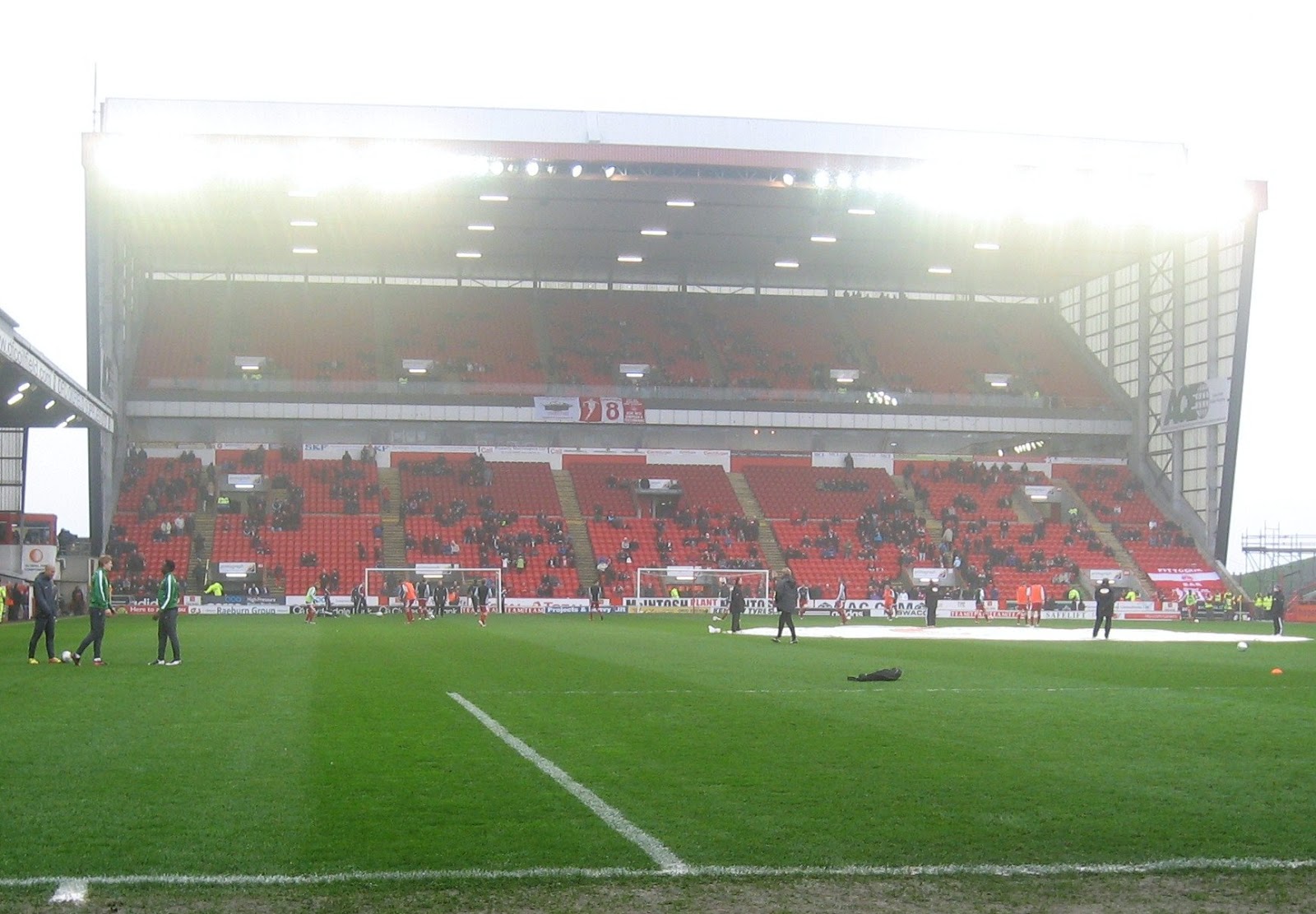
The Main stand still looks in good shape for a structure which is approaching its 90th birthday. The stand has a number of supporting pillars which has restricted views amongst the 3,655 red seats. You’ll notice where the roof was extended after the fire, now covering the former paddock. At the rear of the stand are 24 executive boxes installed in 1985 and at the front are the historic dugouts at each side of the tunnel.
The south side became the South Stand in 1980, following the construction of a cantilever roof covering the majority of the stand, with the benches replaced by individual seats the following year. The stand has 8,400 seats with the east part of the stand housing the away fans and just over half the stand put by for matches with the Old Firm. The television gantry is suspended centrally and the stand is filled with both red and amber seats.
Named after the club’s former player, manager and long serving chairman, the £4.5m Richard Donald Stand is the stadium’s most recent development replacing the Beach End stand in 1992-93. The two tier structure towers over the rest of the ground, almost twice the size of its three mates with 6,064 red seats split by a row of 12 executive boxes, which brings the overall ground capacity to 22,199.

Behind the west goal is the Merkland Stand which is now the club’s family stand and also has a section for disabled supporters near the pitch. The stand entrance façade constructed from local granite stone has stood since 1928 when the club bought the land on Pittodrie Street.  The stand has 3,545 red flip seats and a new low roof was built in 1985. In between this stand and the South Stand is the only section of uncovered seating in the corner.


My day started early on the 0630 from Newcastle to Edinburgh, from where I caught the 0828 Scotrail service to Aberdeen, where on-board  I met squad#173 Andy Hudson for the first time, who introduced himself to me via a tweet!  We arrived in the Granite City just before 11am and marched straight to the nearest ‘Spoons for a swift pint before jumping a taxi to the stadium. Our approach to the ground was accompanied by rowdy Celtic fans, who also provided a good atmosphere within the stadium.
The match itself took a while to get going, what the game desired was Aberdeen to take lead to give the match more of an edge, but it was Celtic who broke the deadlock on 28 minutes. A Kris Commons through ball was played into Anthony Stokes who showed good control to round the keeper before slotting home from a tight angle.
Celtic looked set to boss the game and extend their lead, but just before the interval the Dons equalised. Scott Vernon’s pass found Rae whose effort took a wicked deflection off Andre Blackman to give Foster no chance.

Aberdeen played much better in the second period and had chances to win it, going close with a Rory Fallon effort, before Vernon headed narrowly wide and a golden opportunity was wasted by Mitchel Megginson. The Dons battled well in the closing stages as Celtic pushed for a winner, but on the whole the draw was a fair result. The hosts can be satisfied with ending Celtic’s 17 game winning streak and both clubs remain unbeaten in 2012.
Andy made a sharp exit from the press box to catch the train to Arbroath, missing the closing stages but thankfully no winning goal. Gayfield was also part of my original plan for the double, until a text message on Friday night meant a plan B was required. So for my second new ground of the day I left Pittodrie and took a leisurely stroll up Ardarroch Road to Aberdeen Sports Village, arriving with time to spare for a 2pm kick off at Lewis United.


Matchday stats
AFC 1(Blackman 44OG) CFC 1(Stokes 28)
att.13,127
Admission:Press (normally £20)
Programme £3


Ground no.309 Pittodrie Stadium - Matchday Web album (18 pictures)

My Matchday - 310 Aberdeen Sports Village

Lewis United 4v6 Banchory St. Ternan
SJFA North Superleague
Saturday 3rd March 2012


After the match at Aberdeen my original plan was for myself and Squad#173 Andy Hudson to travel down to Arbroath with Squad#68 Jonathan Elton who was hiring a car from Edinburgh Airport. Unfortunately Jonathan was stuck in the America, his flight to London was cancelled meaning he was unable to catch his planned flight to Scotland the following day.
On receiving the news I scanned the internet looking for Scottish Junior fixtures with hopefully a 2pm kick off. It didn’t take me long to find a game, as Aberdeen based Lewis United were at home in the North Region Superleague. I looked on Google Maps to find the distance between the two grounds and you can imagine my upmost delight on finding that it’s 0.3miles and a 6 minute walk, basically just around the corner.


The Chris Anderson Stadium (formerly the Linksfield Stadium) is part of the Aberdeen Sports Village. The complex includes an indoor football pitch and athletics area, hockey pitch, squash courts and also includes a seminar and office centre. The stadium was rebuild between 2007 and 2009 and during this period Lewis United played all their games away for one season before ground sharing with neighbours East End F.C.


From 2009 Lewis United agreed a ten year lease to use the main outdoor pitch which is surrounded by an 8 lane running track. There’s a neat looking 500 seated stand which backs onto the main building at the village, which is fitted with silver plastic flip seats and a flat Perspex aided roof. The stand is the only spectator point in the ground, there’s also standing room on the balcony which leads out to the exit. Refreshments are found in the Village Centre, with a café area in reception and there are also hot drinks machines.
Over the far side next to the hockey pitch is New Advocates Park, the home of East End, where you can see the action in one half of the pitch. If I was the kind of groundhopper who briefly visits grounds and still counts them, then I could have done a treble today, watching the first half at Lewis and the second at East End. The Richard Donald Stand at Pittodrie can also be clearly seen, in fact if both clubs were at home at the same time you would probably viddy both games from the stand’s top tier.


Lewis United formed as a Juvenile side out of John Lewis & Sons shipbuilders in Aberdeen in 1942, becoming a Junior outfit in 1947 and nicknamed “The Hoops” because of their Celtic style green and white shirts. The club are very much a cup winning team gaining many honours between the 1950s and 1970s in most notably the Archibald Cup, McLeman Cup, North East League Cup and lifting the Duthie Cup seven times.
The Hoops won the North East Division One League title in 1996-97 and the Morrison Trophy three times, the last of which came in 2002-03. Despite being homeless at the time, promotion was achieved to the Northern Region Superleague in 2008.


The (deep breathe) North Region Junior FA PMAC Group Superleague clash with Banchory St Ternon produced ten goals and amongst them one of the best strikes I’ve seen this season. Instead of a proper full detailed match report, which would take up at least 1000 words I’ll just make do with a summary of proceedings.
The Hoops took the lead on nine minutes through centre-forward Law, before the visitors got a foothold on the game and eventually equalising on 33 minutes. A corner kick was cleared out of the danger zone and picked up by right back Burke who unleashed a raker of a shot from at least 35 yards which flew into the top corner of the net. An absolutely stunning goal, it’s a pity that a crowd of only 24 and the players and managers were the only fortunate ones to witness such a strike.

McRae headed the visitors into a half time lead, then two goals early in the second half by Watt and Carroll put Banchory 4-1 ahead, but Lewis wouldn’t lie down, hitting back through Bescott and McCormack to make it 3-4 with only an hour played. But any hope of snatching a draw were diminished as the Saints added a further two goals to their tally and a consolation from United resulted in a final score of four goals to six.


Instead of watching this ten goal thriller I could have still have made it to Arbroath, but this meant leaving Pittodrie early and rushing to catch the 1404 train. Then once arriving in Arbroath I would have missed the kick off and also the end of the match, having to leave early to head south. However I’m not too bothered as there’ll be other opportunities to visit Gayfield, plus I would have missed out on an entertaining encounter and going to a ground that I otherwise wouldn’t have thought of visiting. So yet again, I have to announce that I enjoyed another cracking day out whilst travelling north and the furthest point that I’ve hit the north so far.

Matchday stats LUFC 4 BSTFC 6 (full scorers and goal times to be confirmed) att.24(HC) admission & programme:none


Sunday, February 26, 2012

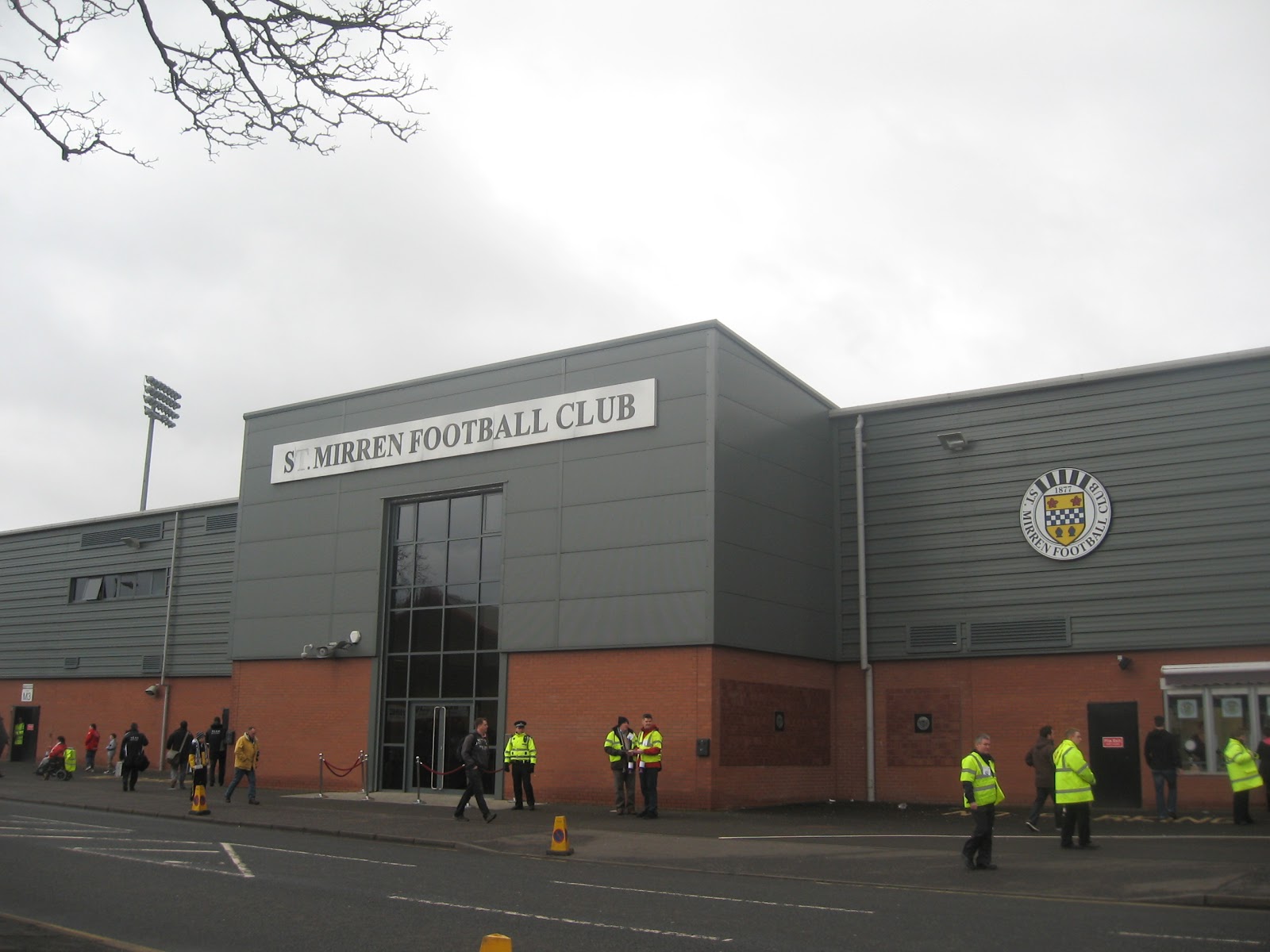
My Matchday - 307 St Mirren Park

St Mirren 1v1 Aberdeen
Scottish Premier League
Saturday 25th February 2012
It’s four years since I made my last visit to Paisley to tick off Love Street, a year before retail giants Tesco got their greedy hands on St Mirren’s home for the previous 115 years. The noon kick off meant the possibility of bagged two grounds, so I set off on the 0738 to Glasgow Central for the first train journey out of a series of six in pursuit of a Scottish double.
As I’ve already featured St Mirren on 100FgC, any Googlewallers that have arrived at this page looking for information on the Saints, their ground history and the town of Paisley should check out my previous post - My Matchday – 157 Love Street.
I have a bit of a soft spot for St Mirren, the principal logic being that I have an affinity for clubs that wear vertical black and white stripes, well apart from Juventus of course, and Grimsby as well, and come to think of it I’m not too chewed on Notts County either, but apart from them I always cheer on the black ‘n’ whites.
St Mirren completed their move from one St Mirren Park to another in January 2009, or to use their more common names - from Love Street to Greenhill Road. The new stadium was officially opened by club chairman Stewart Gilmour and First Minister Alex Salmond, prior to the first match against Kilmarnock. The game finished 1-1, with the stadium’s first goal scored by Kilmarnock striker and former mackem lummox Kevin Kyle ,with Dennis Wyness grabbing the first goal for the Buddies.
St Mirren Park was built on a former housing estate site in Ferguslie Park by Barr Construction at a cost of around £8m. The ground is pretty basic affair containing four separate stands with an overall capacity of 8,023.
There are single tiered stands on three sides, similar in size with large windshields at each side. The North and South Stands have a capacity of 1,600, decked out in black with two horizontal white bands of seats.
The 2,200 Main Stand is taller than the others due to the large panel wall which rises up to the roof. This area contains office space, hospitality, press room as well as having the team dugouts at the front.
Opposite is the 2,216 capacity East Stand, which is similar to the stands behind the goals except it has SMFC in white seats in front of the TV gantry.
Outside of the stadium there’s plenty of car park space around three sides and next to the main reception is the club shop with a supporter’s wall of fame. There are also outdoor 5-a-side pitches behind the North Stand.
I arrived at Paisley St James just before 11am, then after doing a lap of the interior of the ground I picked up my press pass and got prepared for the noon SPL clash with Aberdeen.

I don’t know if it was the early kick off or maybe the cold breeze and rain showers but the match produced an uneventful first half. Aberdeen were the better side with Icelandic playmaker Kari Arnason going close with a header and shooting just wide from the edge of the box.
I welcomed the half time interval as I was pleased to get out of the wind tunnel stand and get stuck into the hot drinks, scotch pies and biscuits in the press room. The lads covering the game for ESPN struggled to find anything to discuss, focusing on the disallowed goal in injury time from Ryan Jack who was marginally offside, the linesman getting the decision spot on.
The game sprang into life with two goals in the space of a few minutes just before the hour mark. Danger man Nigel Hasselbaink (before you ask it’s Jimmy’s nephew…Eddy) got on the end of a Steven Thompson flick to race into the box and place his shot inside the far post. However the Dons reply was instant, a long ball from Mawene found Megginson in the box who calmly laid the ball into the path of Vernon, who rifled the ball high into the net.

The match improved as both sides looked for a winner and it was the visitors who went closest with substitute Pawlett going close and then Teale had a last minute strike which Brown dealt with comfortably.
After the match I legged it across the road to catch the Gourock train, the 30 minute journey gave me time to defrost before alighting at Cartsdyke for the second leg of today’s double at Greenock Morton.


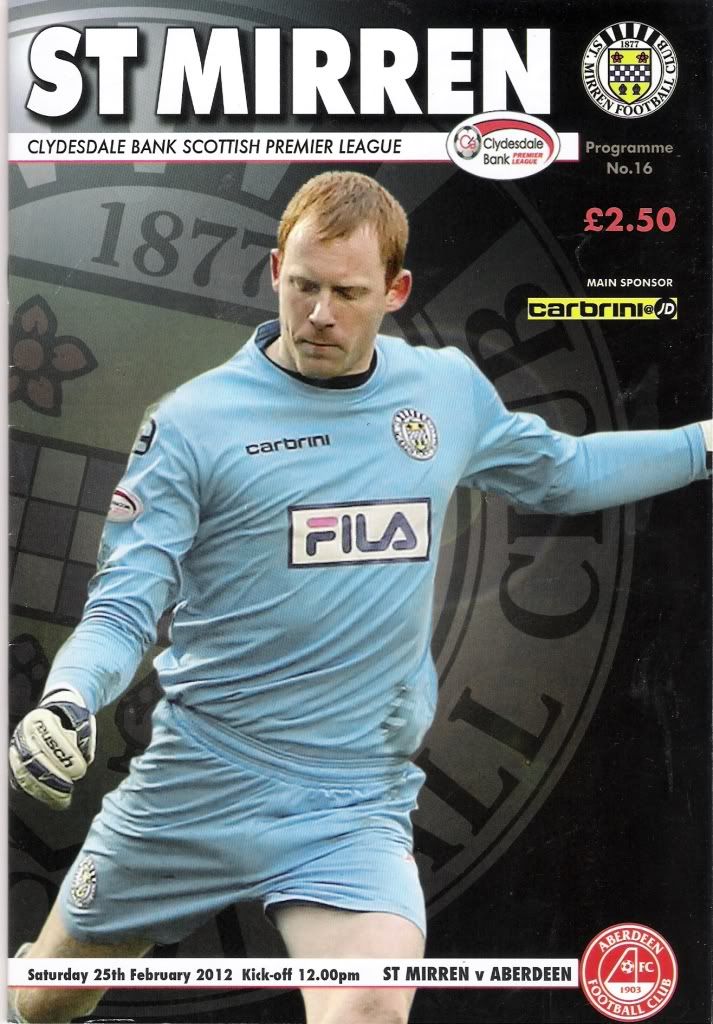
SMFC 1(Hasselbaink) AFC 1(Vernon 59)att.3,627     Admission:Press (£20) Programme £2.50

My Matchday - 308 Cappielow Park

Greenock Morton 1v2 Hamilton Academicals
Scottish League First Division
Saturday 25th February 2012

As part of my Scottish double, I left behind a typical modern identikit stadium at St Mirren and headed to Cappielow Park, a classic old fashioned football ground and the home of Greenock Morton.
Established in 1874, Morton Football Club became founder members of the old Scottish Second Division in 1893. The reason behind the innovative name remains uncertain, although it’s believed the name derives from a row of houses named 'Morton Terrace' next to the original pitch where some of the players lived. The town’s name was finally added 120 years later, becoming Greenock Morton FC in 1994.

Greenock is a town in Inverclyde and a former burgh within the historic county of Renfrewshire. The town lies on the south bank of the Clyde at the "Tail of the Bank" where the River Clyde expands into the Firth of Clyde and forms part of a contiguous urban area with Gourock to the west and Port Glasgow to the east.

Historically the town was established through shipbuilding, the first harbour was built in 1710 with the Scotts Shipbuilding and Engineering Co. commenced work the following year. Sugar refining and wool manufacturing has also been major sources of employment, although none of these industries are today part of Greenock's economy.


Cappielow Park has been home to Morton F.C. since 1879 and in its early years hosted public lectures, athletics, cycling and the novelty of women’s football (it’ll never catch on…Eddy) as well as hosting a Scotland v Wales clash in the 1902 Home International Championship.

The record attendance of 23,500 was set in 1922 for a league-decider against Celtic, which kicked off both on and off the pitch, as the match ended in a riot causing damage to the ground and surrounding area.

The existing main stand was built in 1931, initially installed with bench seats until the late 1990s, when replaced with blue flip seats with GMFC picked out in amber. The stand has a blue roof and frame with three distinctive floodlights perched on the roof which were first used for a league match against Third Lanark in 1958. The stand is quite picturesque and is nicely completed with the club name and crest above the player’s tunnel.

Opposite at the north end is the Cowshed which once fully terraced until bucket seats were added at the front section instead of the traditional reverse style, probably because of the thick supporting pillars. The stand also has a set of three floodlights akin to those opposite and is three-quarters covered with open terracing at each side.

Behind the eastern goal is the open Sinclair Street Terrace and opposite is the Wee Dublin end, named after the Irish immigrant population of Greenock, that once lived behind the west side of Cappielow Park. Bench seats were bolted onto the terrace in 1978 after the club won promotion to the SPL, which takes the number of seats up to 5,741 in an overall capacity of 11,100. The stand is currently not used but that may change if plans go ahead to cover the seats with the Kerr Reid Stand from local rivals St Mirren’s old Love Street ground.
I arrived at Cartsdyke rail station at 2.20pm. The ground is only a five minute stroll away so I had time to have a good look around before heading onto the terraces early, to take my photographs before the Scottish Division One match with Hamilton Accademicals.

The home side had a nightmare first half; lucky to be only two goals behind at the break as the Accies constantly tore through the home defence like a spoon through jelly. After a spell of early pressure the opening goal arrived in the 10th minute, a cross from the left fell to McShane to fire the ball home from just inside the box.

The visitors were wearing a replica Brazil strip as their away kit and the second goal had a touch of the Brazilians about it, as Andy Ryan unleashed a 35 yard daisy cutter of a shot which totally caught Stewart by surprise, as the keeper’s desperate dive was made just as the ball hit the back of the net.

Morton improved in the second half but never seriously troubled the Hamilton defence, until grabbing a late consolation goal through David O‘Brien on 85 minutes, latching on to a flicked header to run through on goal before poking the ball under the ‘keepers body.

The home fans were naturally unhappy with their teams display and booed their side off at the end of each half and I don’t blame them, they made Hamilton look like world beaters in the first 45, it actually was just like watching Brazil.
After the game I headed straight back to Glasgow, having an hour to kill before catching train number 5 in a series of 6. I spent the time look around music stores, naturally going to ‘Spoons for a drink and calling to a takeaway for a fish supper(that’s fish & chips to you Sassenachs)
I caught the 1840 Virgin train to Carlisle, hoping it would reach my destination early as it was due to arrive at 1946 and there’s a Newcastle train at 1941, with the next one not until 2120. I was hoping one train would arrive early and one would depart late, however they were both late, I arrived in Carlisle at 1948 but the Toon train was still at the platform running 9 minutes late so luckily I caught it with seconds to spare, meaning I was back home at Gallowgate View earlier than expected.

I had an excellent day when everything ran like clockwork, the six different train journeys knitted nicely together which made the whole day more enjoyable and hassle free. The only spoiler was the typical west of Scotland weather; damp, breezy and very cold, but I’ll not be making that mistake again as I’ll be fitted up in thermals and scarf when I head further north for another Scottish one-two next week.

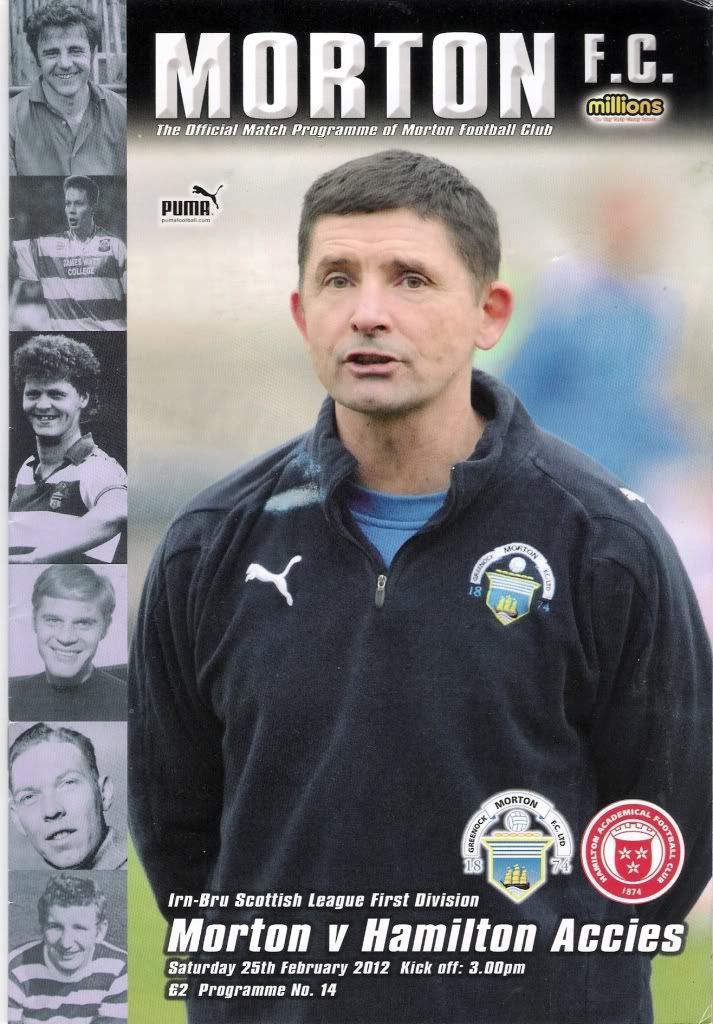
GMFC 1(O'Brien 85)HAFC 2(McShane 11 Ryan 30) att.1,594 Admission:£15 Programme £2.00


Sunday, January 22, 2012

My Matchday - 306 Fenland Stadium

Wisbech Town 2v2 Dunston UTS (a.e.t.)
FA Vase 4th Round
Saturday 21st January 2012
Away trips with Dunston in the FA Vase are amongst the highlights of my season, and I once again I enjoyed a good day out with the Fed Lads for the 4th Round clash at Wisbech Town.

We departed the UTS Stadium at 9am and after two (one would have been sufficient) stops we arrived in the Cambridgeshire town at 1.30pm. There was much debate over what today’s destination was actually called. I’ve always thought the town was pronounces as Wiz-beck, however my travel companion Lee Robbo declared it’s Wiz-beach, which was later confirmed by the locals. However if it is Wiz-beach then where is the A and where’s the Sea? (Did you C what I did there?)


Wisbech is a market town and inland port on the River Nene in the Fens of Cambridgeshire. The town’s main feature is Wisbech Castle built in 1071 by William I, which in the late 16th century became a notorious prison. Amongst those inmates were political Catholic priests and bishops, many of which died due to the jails unhygienic conditions. The Norman castle was destroyed in a devastating flood in 1236 and has been rebuilt several times throughout the centuries.

On arrival the club stewards pointed us in the direction of the nearest boozer. The ‘Black Bear’ was just a short walk away, so we also had time for pint in ‘The Locomotive’(Should be renamed “The Filthy Looks Saloon”…Eddy) before heading back to the clubhouse. As I waited to get served at the bar, I overheard one of the home supporters making an disparaging remark about people who live in the top end of the country, which quite frankly annoyed me. After travelling for over 4 hours and 200 miles this isn’t the kind of welcome I’m used to, and that I would expect at a respectable non-league club. I made the culprit aware that I was unhappy about the incident then disregarded it - determined to see a Dunston win which would wipe the smile of his smug face.


Wisbech Town formed in 1920 after the merger of three local clubs, originally joining the Peterborough & District League which they won on five occasions during the 1920’s and early ‘30s. The club formed a Limited Company and turned semi-professional in 1935, progressing to the United Counties League, becoming champions three times after the Second World War. In 1950 The Fenmen switched to the Eastern Counties League before joining the Midland League two years later.


In 1957-58 they reached the second round of the FA Cup, beating Colchester United 1-0 in the first Round, coupled with achieving promotion to the Southern League after finishing league runners-up. The club played within the Southern League set up for twelve seasons until returning to the Eastern Counties League in 1970.
Wisbech finished runners-up and won the League Cup in their first season back in the ECL and won the double the following season and lifted the league title again in 1976-77 and 1990-91.


In 1995-96 the club reached the first round of the FA Cup for the first time since 1966 and also finished second in the league winning promotion to the Midland Division of the Southern League. The club continued to produce good performances in the FA Cup reaching the first round again in 1996-97 and the following season they reached Round Two, losing 2-0 at home to Bristol Rovers.
Town had a second spell in the Southern League for five seasons until returning to the Eastern Counties League in 2002.
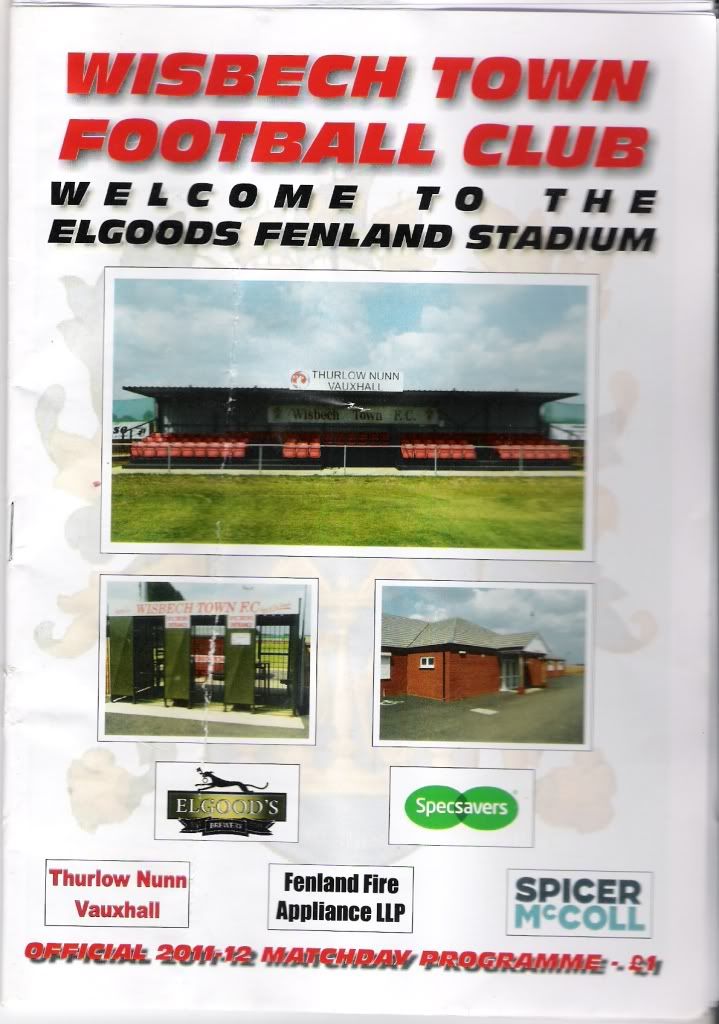
Fenland Stadium is a relatively new ground, opened in August 2010. The club previously played on several different grounds until moving from Harecroft Road in 1947 to Fenland Park, a former orchard in Walsoken. The record attendance at their former home was 8,044 against local rivals Peterborough United in August 1957.


Wisbech played there final game at Fenland Park in September 2008 and secured a temporary move to Outwell Swift's Nest ground after installing a seated stand, floodlights and terracing.
Construction began on the new 9-acre site ground in January 2010, with the first match on August 14th for an FA Cup extra-preliminary round tie against St Andrews which The Fenmen won 5-0.
The 118-seater stand which relocated from its brief home at Outwell is a basic structure filled with red seats. The stand is situated at the far side and is flanked by open hard standing. Behind each goal are fully covered single step terraces, named the Spicer McColl Stand and the Fenland Fire Stand.
Next to the turnstile entrance is the main building block which provides a large clubhouse, changing rooms and refreshment bar. The near side also provides more terrace space and the team dugouts. There’s also a club shop in one corner(£4.50 for a pin badge!) and the ground is finished off by a set of thin six lamped corner floodlights.
The Fenmen’s best performances in the FA Vase came in the mid-80s reaching the semi-final stage two years running. In 1984-85 they lost to Halesowen Town in a semi-final replay after a draw over the original two legs, and then the following year they again missed out on Wembley losing out to Southall. If The Fenmen are to progress towards the later stages in this year s competition they’ll have do it the hard way after this 4th round tie finished all square after 120 minutes.


Wisbech deservingly lead at the break after a disappointing first half performance from the visitors. The goal arriving on 25 minutes when a low cross from the right was sliced home by Nick Davey finding the roof of the net.
The Geordies produced a more positive performance in the second half, as they turned the match around courtesy of two scrappy goals. A free kick from 25 yards was crossed to the far post where Young nodded back across goal, where Bulford was on hand to get a faint touch that wrong footed the ‘keeper. Then on 76 minutes a free kick from the left from McAndrew, missed everyone and found the far corner of the net, although initially I though Swailes got his head on the cross.
Dunston looked set for a place in the fifth round but on 81 minutes it was all square, Matt Lunn picked up the ball on the right and darted into the box, then from a tight angle his cross shot found the top corner, if he did mean to shoot (I couldn’t tell from behind the opposite goal) it was a great goal to take the match into extra time.


The hosts almost took the lead after the restart hitting the foot of the post, but extra time was dominated by a monsoon which swept across the pitch which limited any clear cut chances and a crucial winner for either side. On 110 minutes a game which was littered with yellow cards produced a second booking for Michael Dixon, but Dunston’s ten men comfortably held on, which means The Fenmen will have to do the reverse journey to Tyneside next Saturday.

Unfortunately I’ll not be in attendance next week, but I can guarantee that followers of Wisbech Town can look forward to an enjoyable and hospitable afternoon at the UTS Stadium, because that’s just the way we are, as we understand how to treat visitors to our part of the world.

Squad #10 Tim Rigby attends the last match at Fenland Park. – Tims 92 Tims 92


Matchday stats
WTFC 2(Davey 24 Lunn 81) DUTSFC 2(Bulford 50, McAndrew 76)
att.548
Admission £7(but I paid a fiver)
Programme £1


Sunday, January 15, 2012

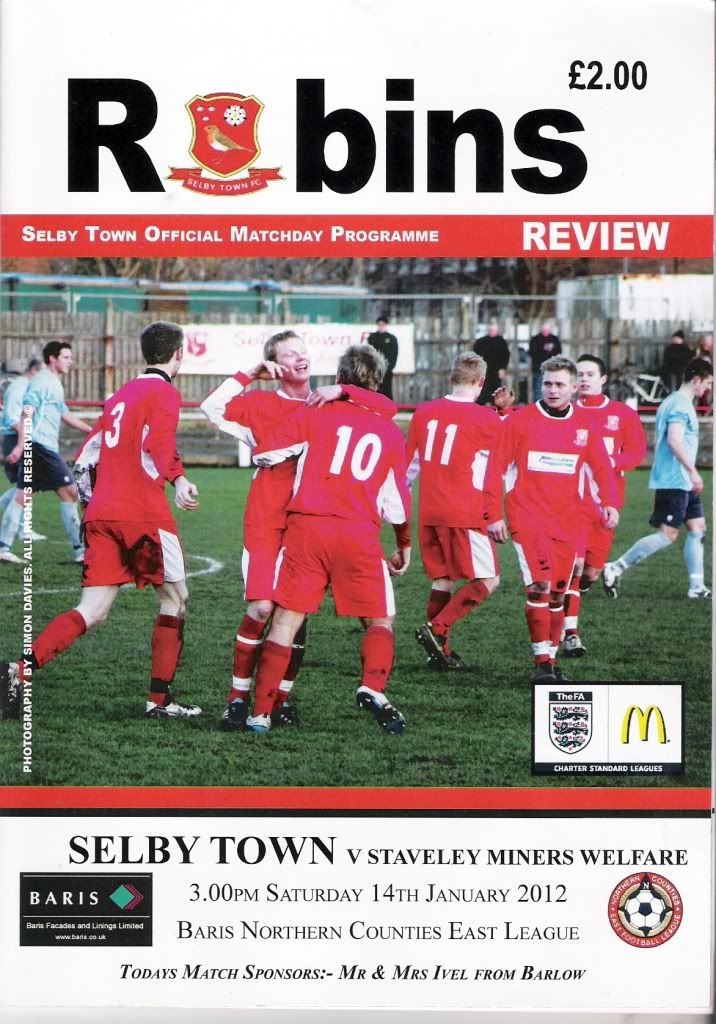
My Matchday - 305 Flaxley Road Ground

Selby Town 0v2 Staveley Miners Welfare
Northern Counties East League Premier Division
Saturday 14th January 2012

On this very day in 1988 as a bright eyed and bushy tailed shy young lad, I made my seventh attempt at permanent employment, crossing the office threshold for the very first time. I marked this 24 year anniversary and the fact my working career has stagnated with a day on the lash in one of my favourite drinking cities – York, incorporating of course another new ground visit at nearby Selby Town.


Historically a part of the West Riding of Yorkshire, Selby is a town and civil parish in North Yorkshire, situated 12 miles south of the city of York, along the course of the River Ouse. Historically the river was part of the town’s large shipbuilding industry and a thriving port due to the Selby Canal, which brought trade from the city of Leeds.


The main feature of the town is Selby Abbey, founded by Benedict of Auxerre in 1069 and one of few surviving abbey churches of the medieval period. Its main feature is the 14th century Washington Window which shows the heraldic arms of the ancestors of America’s first president George Washington.

Selby Town formed in 1919 and the following year entered the Yorkshire Football League as founder members. The club were ever present throughout the history of the Yorkshire League before it became part of the Northern Counties East League in 1982. During the league’s 62 year history ‘The Robins’ were champions on five occasions, three times in the 1930s and successive seasons between 1952 and ’54.
They also progressed in the FA Cup during this decade, reaching the 1st Round in 1953-54 when a club record crowd of 7,000 witnessed the clash with Bradford Park Avenue, and the following season were knocked out at the Second Round stage by Hastings United, the longest cup run in their history.
Selby won their first honour in the Northern Counties East League in 1995-96, lifting the Division One title and have remained in the league’s Premier Division since,with there best performance as runners-up in 2004-05.

The Robins originally played at the James Street Recreation Ground, known as The Bowling Green, which had also been home to both Selby Mizpah and Selby FC at the turn of the century. The club moved across town to the Flaxley Road Ground in 1951, opening in August with a local derby clash with Goole Town in front of a crowd of over 4,000.

The ground is open terracing on three sides with a covered seated stand behind the north goal. The stand has the club name in large red letters on the white back wall and has three rows of wooden block seats with a cordoned off section of 16 seats set aside for club officials and guests.
There is a small covered stand added directly behind the opposite goal, with the team dugouts and changing rooms at the far side. Next to the turnstile entrance is the clubhouse which was opened in the late ‘60s and is quite spacious with a selection of hot food and drinks.
There's a set of tall floodlights on each side which were installed in 1994 and as part of a three-year sponsorship deal, Flaxley Road was renamed the Rigid Group Stadium from August 2010. There’s plans afoot to move to a brand new Conference-standard stadium on East Common Lane next to Selby College.
The Robins stretched their current run of successive defeats to eight games and remain rooted at the bottom of the NCEL Premier Division, as a goal either side of half time secured a comfortable win for Staveley who strengthened their position at the top end of the table.
The visitors were awarded a penalty five minutes before the break when keeper Barford brought down Barraclough with Ryan Damms making no mistake with the spot-kick. The points were assured on 54 minutes, when a nice exchange of passing was finished off with a neat chip over the keeper from Simon Barraclough, to move The Welfare into second spot in the promotion race.
To break up my journey to Selby I enjoyed a canny pub crawl in York, a city where your spoilt for choice as far as a decent pint is concerned. I started off with breakfast and a pint in the Punch Bowl, then called into Brigantes, Last Drop Inn, Three-Legged Mare and the cities oldest pub Ye Olde Starre Inne.


I arrived in Selby at 2.10 and the Flaxley Road Ground is a 10 minute walk to the station, so I headed straight to the clubhouse for a pint and a read of the match day programme, which had an interesting feature inside titled ’On this day… 14th January.
The many landmarks on this particular day include Zsa Zsa Gabor getting her leg chopped off(2011) The Simpsons premiered on Fox-TV(1989) Roy Castle breaking a tap dancing record on the Beeb(1973) and the Sex Pistols final concert in 1978. Another personal milestone which could go on that list is in 1988 when I began working for one of the world’s biggest communications businesses, an occasion I marked by not actually being in the f***ing place but instead spending a great day doing the things I like i.e. enjoying my football ground hobby and a day on the lash.


STFC 0 SMWFC 2 (Damms 40p Barraclough 55)
att.82
Admission £5
Programme £2


Saturday, December 31, 2011

The 100FgC 2011 Accolades

(Shaun's choices in the 100FgC new years honours list)

*Best Match Attended*

Gateshead 5v4 Sunderland RCA,Durham Cup QF 12th January.
The best game of the year goes to a Durham Cup tie witnessed by roughly 100 supporters “crammed” inside the International Stadium, the quarter final tie between Gateshead Reserves and Sunderland RCA producing a nine goal thriller.

The Northern League side came from behind to lead 4-2 courtesy of a Richard Logan hat-trick and looked set for a place in the next round, however the young Heed side refused to lie down, scoring three goals in the last nine minutes to progress into the semi-finals on route to lifting the Durham Cup for the first time in the club’s history. 
                                  *Goal of the Year*

Paul Clayton - Alfreton Town
My goal of the year goes to Alfreton Town striker Paul Clayton, who scored a cracker against Gateshead in the Blue Sq.Bet Premier in November. The ball was played up the right wing to Jake Moult, his back heel flick fell into the path of Clayton who placed an unstoppable shot beyond the reach of Jak Alnwick from 18 yards.
*Favourite Previous Uncharted Senior Ground*
Amex Stadium - Brighton & Hove Albion
The Amex Stadium wins the best senior ground because it’s bonny, with lovely comfy seats, nice mantled shiny stands and most of all it became my Shangri-La in the lifetime pursuit of The 92.

* Favourite Previous Unchartered Non-League Ground*
Church Road - Hayes & Yeading
Church Road in Hayes is another classic old non-league ground which was lost this year after over 90 years of use. I arrived just in time for the final match making the long trek to Middlesex on a Tuesday night for the final farewell.

*Favourite My Matchday*
281 Plainmoor
The most enjoyable My Matchday was my furthest journey of the year, a 380 mile drive to Torquay on the Thursday before their Good Friday clash with Wycombe Wanderers.

This was the first of an Easter treble which included Yeovil and Bournemouth which formed part of an enjoyable weekend in the South West for the Smudger family.

*Best Pre-Match Bevvy*
The Bear - Oxford

The Bear Inn in the fine city of Oxford is probably the titchiest pub I’ve ever been in. The bar is decorated throughout with old school ties and serves a regular selection of Fuller's beers as well as a couple of guest ales. The Bear claims to be the old boozer in the city and is worth seeking out, found just off the main High Street on Bear Lane. 

*Silver 'Spoons Award*
Tilley Stone - Gateshead
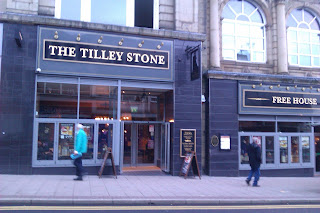
At long last we have a JDW in Gateshead(the one in the Metty doesn’t count) The Tilley Stone opened in October and over the last few months I’ve been a regular caller, especially on Thursday’s, as the weekly curry nights are popular with the Smudger family.


*Scabby Eye of the Year*
Cornish Pasty - Yeovil

The ‘Scabby-eye Award’ goes not to a pie but another form of pastry based product with the delicious belly filling Cornish pasties at Huish Park in Yeovil. This is the first and probably the only time a Football League club takes this award which is usually dominated by the superior food on offer at non-league grounds.

Last years winners and the year before and the year before that can be viewed HERE.